Altseason: Is it coming or not? And if so, when?
- A full growth cycle is expected from late 2026 to 2028, following a market accumulation and capitulation phase.
- By 2030, $155 billion worth of token unlocks will hit the market with no buyers available.
- Liquidity is constrained by tight monetary policy (high rates, strong USD) and capital outflows into AI sector stocks.
- Due to the emergence of millions of low-liquidity tokens, the classic model of a full-market rally is impossible. The altseason will become highly selective.
- For growth to start, the Fed rate needs to drop below 2.5%, the USD index (DXY) below 94, and the ISM business activity index above 55%.
- According to experts, a mass rotation of capital into altcoins is possible only after Bitcoin reaches the $160,000–200,000 range.
- The traditional cycle of BTC -> ETH -> altcoins has been invalidated because the market has evolved toward TradFi instruments that require real project revenues.
- A historical model analyzing 32 years of data points to the completion of a super-bubble formation and the start of growth in 2027–2028.
- Spot Bitcoin ETFs hold the bulk of institutional capital, preventing its flow into the altcoin sector.
- 84.7% of new tokens drop by 71% after the first day of listing.
- Pavel Grachev, editor at bytwork.com, forecasts a bullish hype cycle from late 2026 to mid-2027, with a market cap of $6.5–7 trillion.
Read our full research below, where you will find all historical facts, comparisons, and illustrative examples.

Many in the crypto market tirelessly ask: when will altseason finally come? Let's honestly analyze not speculation and guesswork, but the facts and factors that could lead to market movement toward alts.
We will also examine the opinions of popular crypto enthusiasts to form the most comprehensive picture.
When is altseason according to the crypto community?
The 6 sources below provide their arguments in favor of altseason occurring in the 2026-2028 range. Let's look at their reasoning.
|
Expert |
Will it happen or not? |
When? |
Argument |
|
Altcoin Daily |
Yes |
2026 (second quarter) |
Altseason is determined by the business cycle and liquidity inflow. Due to changes in debt structure, the cycle has lengthened to 5 years. |
|
Crypto Radar |
Unlikely (in the near future) |
2028 (for taking profits) |
2026 is a year of reset, capitulation, and bottom formation. Real growth will only begin in 2027. |
|
Benjamin Cowen |
Unlikely (traditional) |
Not before 2027-2029 |
Under current tight monetary policy, altcoins will fall against BTC. A shift to loose conditions is needed. The economy must calm down. |
|
Satoshi's Tears |
Yes (but timeline shifted) |
Spring 2026 or 2027 |
He expected altseason in late 2025, but due to lack of liquidity, he postponed expectations to a later date. |
|
Alexander Mendel |
Yes |
After new Bitcoin ATH |
Altseason is only possible if BTC consolidates above $100-110k and moves into the $160-170k zone, which would cause new euphoria. |
|
Tom Lee |
Yes |
Will start in January 2026 |
In fact, he was already wrong, because it didn't happen in January. |
Overall, those who believe in the upcoming altseason argue that it will be driven by a new business cycle, monetary policy easing, and BTC reaching a new ATH above $120k. This should trigger a new peak of euphoria in the market and breathe life into altcoins.
Now let's look at the bearish assessments.
| Expert / Source | Will it happen or not? | Expected timeline | Argument |
| No Bs Crypto | We are in a bear market | From January 2025 to...[unknown] | We are in a protracted bear market for altcoins that began in early 2025. No one knows when this cycle will end. |
| @Crypto With Colin | Still a "boring" market | Soon (after BTC consolidation) | Altseason is not random; it follows a strict chain: BTC -> ETH -> dominance drop -> flow into alts. Current phase is accumulation and psychological fatigue. |
| @Rus Vasilevich | Depends on the printing press | When QE is turned on | Real growth will only begin when the Fed starts injecting money into the economy due to geopolitics or a crisis. Part of that money traditionally flows into alts. |
| @Dvigatel Kapitala | It already happened (a trap) | New one only in 2027 | He believes the local growth in early 2025 was the altseason, which lured retail before the dump. The next growth cycle is possible only after a full-fledged bear market. |
| Bitcoin Adept | Yes, but with BTC growth | After BTC at $200k | The main altseason will happen only when large players start taking profits from retail when Bitcoin reaches $160-200k. |
| Peter Schiff | No (collapse) | Drop to $20k | Expects Bitcoin to fall to $20,000. He considers crypto an overvalued asset. |
Many analysts agree that the classic altseason scenario has been nullified due to changes in the cycle structure. We only saw a minor local altseason for a small number of projects (Zcash, BNB, Hyperliquid). The market entered a bear market in late 2025, and now a long consolidation period (at least a year) is needed to accumulate strength for a new push.
Now let's look at what crypto exchanges think. Although they may have a conflict of interest – giving a positive forecast to attract users.
| Exchange | Altseason forecast | Timeline | Argument |
| Binance Square | Growth due to institutional capital | 2026 | Inflow of institutional capital (15–20% from BTC/ETH-focused funds) into networks with real yield (Solana, Sui, Chainlink) will drive seasonal growth. |
| MEXC | Bearish momentum is weakening, but season is not near yet | Not defined (current bear trend) | Less than 5% of altcoins are trading above the 200-day moving average. The altseason index has dropped to 39, indicating a strong bear market. |
| CoinEx | There will be NO traditional altseason | 2026 | Liquidity will be selective and will only go to blue chips with real adoption. Most altcoins will remain unnoticed. |
| Coinbase | Altseason will happen | Promised in 2025 | In fact, they were completely wrong. |
| OKX | Trends indicate the start of another altcoin season | Promised in 2025 | They were wrong. |
| Gate | In November 2025, a number of technical and fundamental indicators confirm the start of one of the most profitable altcoin rallies | Promised in 2025 | They were wrong. |
| HTX | The market is "pricing in patience" | 2026 | Altcoin season may begin in 2026. (in fact, it hasn't started, editor's note) |
According to our research, forecasts regarding prices or the start of altseason from crypto exchanges should not be trusted because they are interested in attracting traders.
Most exchanges gave forecasts for 2025 or early 2026. The others spoke cautiously about 'possible altseason for selective altcoins'.
In turn, our editor Pavel Grachev came to the conclusion that massive bullish hype will occur between late 2026 and mid-2027. The expected market capitalization will be $6.5–7 trillion, and this will allow BTC to reach $200,000–250,000, and ETH to reach $7,500–8,500.
The drivers will be the US midterm elections, institutional inflow via ETFs, and Fed policy easing.
Altseason according to bytwork.com
In our opinion, blindly following the old cycles (BTC -> ETH -> alts) is 'dead,' because the market has evolved and become more like traditional finance (TradFi). It is no longer the small and cozy market that grew in previous cycles. And 4-year cycles have changed towards lengthening.
At the same time, the global landscape has changed, including geopolitics and the AI race. To more accurately understand the possibility of altseason, one needs to understand the market structure and what shapes it.
How does the noise around AI divert interest from crypto?
AI is the main competitor for investor attention and liquidity. Probably, altseason in the old sense will not happen yet due to AI hype.
Retail liquidity is now limited and flows into the trendier AI sector, leaving crypto as a 'dead zone' for now. Historically, people have been screaming about an AI bubble since 2023, but the point is that the noise about AI, whether as a bubble or as a future technology, further increases interest in neural networks.

Previously, people went to altcoins for super returns. Now attention has shifted to stocks like Nvidia, which show explosive growth. Convenient tools for speculation have also appeared (e.g., futures on AI sector stocks), allowing one to play on growth without even touching crypto.
How does the number of cryptocurrencies dilute interest?
There are more than 30 million tokens in the crypto market, of which only 9-13 thousand (0.04%) have real trading. The number of junk tokens grows by thousands daily, and this dilutes overall interest. This is because every project tries to grab a piece of liquidity for itself.
For comparison, in 2017 there were less than 10,000 tokens on the market, by 2021 there were 100,000, and now their number exceeds 30 million (including those that are not traded at all).
The math is simple. In 2017, $1 million distributed across the entire market gave $100 per token, and now that amount turns into less than 3 cents per token. Because of this, liquidity simply cannot cover such a number of assets to cause their simultaneous growth, called altseason.
Most crypto aggregators can no longer cover such a number of coins, so you can see different estimates of their quantity. From 9,000 to 29,000. New projects are added daily and dead ones are removed.

Moreover, many investors have become accustomed to quick trades (via Pump.Fun and memecoins), which killed the previous patient altseason that lasted for months. Now pumps will be short, sharp, and selective. In confirmation, local growth was seen in BNB, Tron, Hype, XMR, ZEC, and XRP, which quickly collapsed.

Many claim that 'whales are just accumulating.' If so, great, but this should be backed by deep on-chain analysis, not as an excuse for losing positions. Let's try to conduct an analysis.
When will altseason begin?
To forecast altseason, we need to look at the market structure through its most important indicators for the onset of hype. These are liquidity injection into the economy, the crisis of crypto ideas, institutional investors, and ISM PMI indicators.
ISM PMI Indicators
The crypto market does not live on its own, but depends on the global economy. The Purchasing Managers' Index (PMI) measures economic expansion or contraction. A value above 50 means economic expansion, and below 50 means slowdown. Historically, strong altseasons only began after the ISM index started to rise. Both in 2017 and 2021, the biggest altseason began after the ISM exceeded 55%:

We have not yet reached 55%. But this is the first sign that the macroeconomic factors blocking altseason have begun to weaken. That's how it all starts.
Crypto analyst Raoul Pal believes that the absence of altseason is solely explained by the depressed state of the business cycle (ISM < 50). The index was below 50 for more than 32 months (a record period since 1948!).
Simply put, when the business cycle is strong, corporate and investor incomes grow, and they begin to invest these funds in riskier assets (and further along the 'risk curve'). However, the business activity index is not the only factor.
The role of quantitative easing (QE) and liquidity
Quantitative easing (QE) is a process by which the Federal Reserve (Fed) adds liquidity to the financial system. Simply put, the printing press, making money expensive or cheap.
When money is expensive (high rates, strong dollar, leverage is punished), capital flows out of alts. But with liquidity expansion and increased risk appetite, they gain support.
This is not just theory. This is confirmed by the altseasons of 2017 (against a backdrop of easy conditions) and 2020–2021 (zero rates and stimulus).

Easy liquidity does not guarantee altseason either, but it creates the necessary market breadth for it. Our bullish argument is not about the magical return of altseason, but that a favorable macro environment can bring back the conditions that made it possible in the past.
The role of institutional investors
Although many institutional investors invest only in Bitcoin and do not buy alts, they were never the driving force of altseason. They move Bitcoin itself, but not altcoins.
If macro conditions ease and risk appetite returns, capital will flow into alts not from funds, but from crypto-native players - traders, market makers, capable of moving down the risk curve.
Altseason is not a decision of one player, but a chain reaction driven by a confluence of factors. Bitcoin's maturity does not kill the risk curve, but merely changes the early part of the cycle, as we showed in our study of BTC cycles.
Crisis of crypto ideas?
The bears' claim that cryptocurrencies have run out of ideas is not new. The crypto market is a sandbox where altcoins serve as a testing ground for experiments, unlike conservative Bitcoin and Ethereum.
Yes, 90% of projects die, but the remaining 10% define the next trends. Sectors may change over time - whether AI, RWA (real-world assets), gaming, privacy, or something else - but the behavior remains the same.

How Does Crypto Regulation Affect Things?
Regulation is also important for these sectors. For instance, the Clarity Act bill aims to establish a clear regulatory framework for digital assets and cryptocurrencies. However, it has yet to be passed due to disagreements over DeFi, stablecoins, and ethical concerns.
Once CLARITY is enacted, we can expect new Layer‑1 protocols to emerge and race for a spot in this digital‑commodity basket, aiming to become comparable to existing ones like Ethereum and Solana. Historically, the value of an L1 was determined by user numbers and exchange availability, but in the new cycle, real revenue takes center stage. Most protocols lack such revenue, unlike projects such as Hyperliquid.
Among the entire middleware infrastructure, the SEC has only included Chainlink on its list, thanks to the utility of the LINK token for gas, staking, DeFi, and cross‑chain oracles. The omission of other projects proves that without comparable market dominance, achieving a similar status is practically impossible.
Again, while more favourable regulation does not guarantee an altseason, it does clear the way for new ideas to enter the market. And where builders go, capital tends to follow.
The next altseason – harsh reality
The harsh reality is that most altcoins will never recover. Given the endless number of coins created each cycle, it is mathematically impossible for every altcoin from past bull cycles to rise to new highs again.
Here you can see that only a small portion of altcoins show gains every 3 months: Altcoin Season Index

It is impossible to know which coins will survive and which will not. One can guess that large ones like ETH or Solana might recover, but even quality projects like Avalanche failed to update their all-time highs in the last cycle.
Fundamental analysis cannot predict a comeback. Why? Because you cannot rely on fundamentals, as growth is caused by a complex combination of momentum, market making, team behavior, and seller pressure - all of which are impossible to research and often subject to insider trading.
This is the harsh truth that many refuse to accept, but it is inevitable: mathematically, most old coins will not return to their peaks.
As a result, for growth to resume, 5 macroeconomic conditions need to be met:
- a drop in the DXY dollar index below 94 (current - 97-99),
- a reduction in the Fed rate below 2.5% (current - 3.5%),
- return of liquidity,
- sustained inflation drop to 2% (current - 2.4%), and
- a drop in Bitcoin dominance.
It is important not just to guess, but to analyze open interest in coins and the market as a whole through Coinglass, Dropstab, DefiLlama, Nansen.
Calculation methodology based on Omni score indicators
To gain a fuller understanding of when Altseason occurs, let's take another index. The methodology has been verified on data from 1995 to 2026. The Omni score composite index is an aggregated AI-driven assessment of market sentiment based on a combination of social, media, and on-chain signals.
The point is that there are five metrics here.
- Omni score – an aggregated AI-driven assessment of market sentiment (from Panic to Euphoria), taking into account price momentum, liquidity, and structural indicators.
- Cycle fuel (macro liquidity + market euphoria),
- Altseason Score – a metric of the probability and intensity of altcoin dominance over BTC, signaling the start or end of altcoin season.
- Tech mania – tech frenzy.
- Credit/housing – the credit/housing cycle.

We analyzed 32 years (1995–2026) and created the Omni score index. It crossed the 80 mark five times (2000, 2006–07, 2013, 2017, 2021) – each time coinciding with a super-bubble, but with different drivers: dot-com, credit and housing, liquidity/crypto mania. All of them came together in 2021. That's why the strongest altseason occurred.
However, since 2021, Omni score has not risen above 80, which is why there has been no full-fledged altseason and 2025 has been a bust. Admittedly, there was a local tech mania around AI (peaking in Q4 2024–Q1 2025), but liquidity and the credit/housing factor were insufficient to fuel a broad super-bubble where everything rises. Since then, AI has been capturing attention and capital, leaving crypto in the shadows.
The current situation is 64% similar to the dot-com era, followed by 2017 and 2013. Historically, it took 5–10 quarters from the Omni score level to the mania.
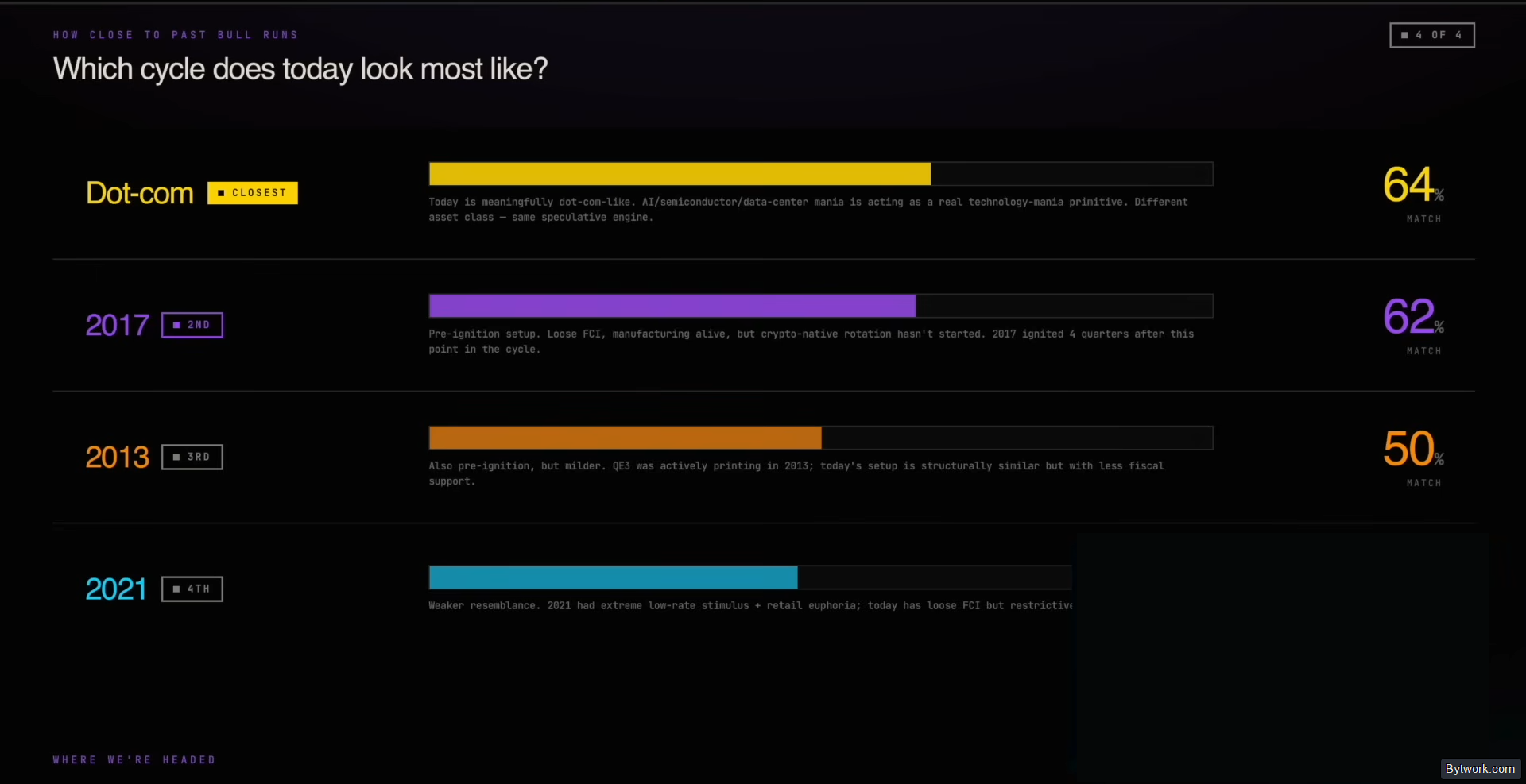
Our research indicates that the next crossing of the 80 mark will occur in 2027–2028. The peak of the super-bubble is expected in 2028. This will be a massive AI bubble that surpasses all previous ones. In crypto, the next altseason will be tied to AI tokens and blockchain. A large window of opportunity is expected from late 2026 through 2027, despite possible corrections.
In summary, the index's failure to reach the mark dictates the absence of a broad altseason and a sluggish 2025 for crypto. Trust in this indicator is based on its historical accuracy over 32 years, not on subjective forecasts. None of the sub-indicators individually explains all five cases, but their combination in the Omni score has achieved 100% accuracy. For a strong altseason, all factors must align.
Conclusions
Why hasnt there been an altseason? Spot Bitcoin ETFs ($767 million weekly inflow in March 2025) have captured institutional capital, preventing it from flowing into altcoins. The Feds balance sheet has shrunk by $2.2–$2.4 trillion from June 2022 to December 2025, drying up liquidity. US trade tariffs have risen to 7.7% (a high not seen since 1947), fueling inflation and blocking any easing of Fed policy. Additionally, the growing number of coins and the AI hype are also diluting interest.
The upcoming altseason will be more selective than in 2017 or 2021. Cryptocurrency has left the easy mode when everything grew indiscriminately.
These are the conclusions of the altcoin market research:
|
Bearish factors |
Over 30 million tokens dilute liquidity. |
|
Bullish factors |
Turning on the printing press (Fed transition from QT to QE) and rate cuts. |
|
EXPECTED TIMELINE (Consensus) |
2026 - 2028. |
And why did everything collapse? Large players who used to supply liquidity to the 'long tail' of altcoins went bankrupt after the FTX and Luna collapse. And new infrastructure never appeared. Mentions of the term altseason on social media have fallen to a 2-year low. New retail investors simply are not coming to the market.
The problem with blog assessments is that many analysts never have a point where they admit they are wrong. They just keep promising growth to not lose views and monetization. It is profitable for exchanges and market makers to promise growth regardless of whether it actually happens or not.
In the current market structure, the inflow of capital via ETFs reduces the likelihood of rotation into alts, creating a risk of apathy without repeating historical return patterns.

4 main signals have already changed, repeating patterns from 8-10 years ago:
- The business activity index (ISM) has been rising for 2 months.
- The downtrend in the altcoin/bitcoin pair has been broken.
- Signals have appeared regarding Bitcoin dominance.
- Mass apathy and despondency ahead of the next possible growth cycle.
However, it is important to understand that the appearance of these signals is not yet a guarantee of an immediate start of altseason. It only indicates the possibility of its beginning in the future.
To resume the bullish trend and a new altseason, the market may need Bitcoin to fall to $30,000–$40,000 (25% below the average cost basis of long-term holders) followed by a rapid rise to $200,000. This will provide the necessary volatility and inflow of retail investors.
Overall, on the negative side, it can be noted that there are more than 30 million tokens on the market, of which only 9-13 thousand are traded, but liquidity is too diluted among them.
If altseason does return in 2026-2027, it will be 'selective' – not all coins will grow indiscriminately, but only projects with real yield or the strongest narratives.
Speculative capital is now moving to other instruments: prediction markets (Polymarket/Kalshi), stock futures, or the AI sector, which has become a stronger narrative than crypto.
Also gaining traction are RWA projects, a bit of DePIN, and of course the ubiquitous Hyperliquid with its system of betting against the market.
In turn, the change in the macroeconomic regime (transition from QT to QE and growth in business activity) will be the catalyst that will allow altcoins to stop falling against bitcoin.
Ultimately, we have seen many times that after a prolonged correction, altseason starts again. From this perspective, the question should be not whether it will happen, but when it will happen and in what form.
A true bottom and subsequent growth are possible only after the complete capitulation of average traders and the death of hope, when investors stop waiting for moonshots.
Also relying on the opinions of analysts, exchanges, influencers, and the entire crypto community, we can conclude that altseason usually begins when no one believes in it anymore. Well, we'll live and see.
Happy trading! Your editor - Maxim Anisimov for bytwork.com.
This material is for informational purposes only and is not financial advice.

Now reading


In DePin, people create networks themselves, share traffic or capacity, and receive rewards in tokens from these projects.




The Ellipal firmware update enhances security (fixes vulnerabilities), adds support for new cryptocurrencies and tokens, and optimizes the interface and operational stability.


