Chainlink Price Prediction 2026-2030. Could LINK reach $100?
- Forecasts of $40, $60, and $100 are based on the tokenomics, the growing demand for RWA technology, and the projects underlying fundamentals.
- Chainlink, the largest oracle provider with roughly 70% market share, has facilitated over $29 trillion in transaction value and supplies 90% of the data for the Ethereum, Arbitrum, and Base networks.
- Following the Layer Zero protocol hack that led to a $292 million theft from Kelp DAO, nearly $13 billion was withdrawn from DeFi within 48 hours - highlighting just how critical security is in crypto.
- Chainlink uses 16 independent node operators for CCIP and is the only oracle provider working with major financial institutions such as DTCC, J.P. Morgan, and Swift, thanks to its ISO 27001 certification and a focus on security over speed and low cost.

Chainlink – a dying project left behind by the new cycle? Or is this one of the most undervalued projects in the entire crypto space in 2026?
Let's briefly look at the scenarios and then assess their realism through fundamental analysis and tokenomics.
Conservative Scenario: $40-44
This target is achieved with a market capitalization of $30 billion. This is the lower limit for the peak considering the inflation of the token supply. Currently, there are ~700 million LINK in circulation compared to 420 million 5 years ago.
Base Scenario: $60-82
Most expect the all-time high ($52.88) to be updated and growth to $70-82. This aligns with a $40-60 billion market cap. Many investors may take profits in the $90-95 zone before the psychological $100 mark.
Bullish Scenario: $100-150
The $100 target is achievable with a market cap of $65-67 billion. The $151 level is possible with a token market cap of ~$99 billion.
Hyper-Optimistic: $200-300
According to our optimistic calculations based on historical analysis of infrastructure tokens, LINK's growth potential exceeds 12x from current levels, suggesting a price around $200-300 per token at the cycle peak.
But is 12x growth possible? For this, Chainlink would need to become the Amazon or Microsoft of the blockchain world and reach a market cap exceeding $127 billion. Are there such prerequisites?
Let's examine the project under a microscope to understand all its aspects.
Fundamental Analysis
The total value secured by the Chainlink network (TVS) is about $51 trillion – $15 trillion more than a year ago. This demonstrates the exponential growth in network usage.
The network secures over $95 billion across thousands of projects, while its market capitalization remains below $10 billion. This is a significant price-to-value disproportion.
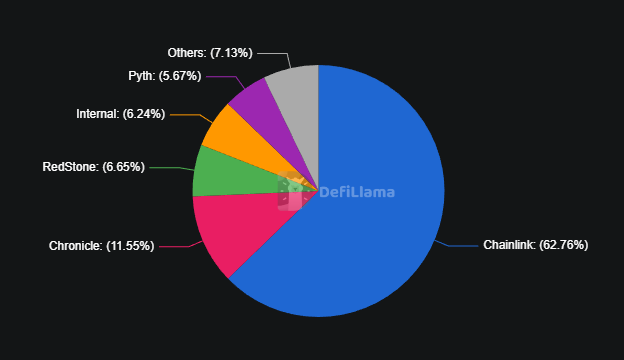
With approximately a 63% share of the oracle market, Chainlink remains substantially undervalued compared to other major crypto assets!
An oracle in crypto is an intermediary that delivers information from the external world to a smart contract, like a bridge between reality and the blockchain. This connection of crypto to the real world leads to tokenization technology (RWA).
$16 Trillion for the RWA Market
Chainlink positions itself as the foundation of a tokenized economy, linking it with Real World Asset (RWA) technology.
Market size estimates for RWA technology have already matured: by 2030, it could reach $16 trillion.
Chainlink helps bring assets from the real world into DeFi.

And even if only a fraction of these assets end up on the blockchain, developers will still need Chainlink's technology. And precisely for this, Chainlink built an open protocol that allows applications to exchange tokens across different blockchains through a single interface (CCIP).
Growth Catalysts for 2026
The public version of the CCIP protocol simplifies self-service token integration and lowers barriers within the network. Simply put, it makes networks understand each other and interact directly. Importantly, this is no longer a test technology – real money and fees flow through this protocol.
In Q2, the launch of Chainlink Confidential Compute technology is planned, necessary for mass institutional adoption. For example, a bank can issue a tokenized bond without disclosing the amount, participants, or terms.
There are already early signs of institutional interest – the Grayscale ETF, which attracted $37 million on its first day. These are not retail LINK purchases, but major capital investing in infrastructure. Typically, the rest of the market follows Grayscale!
The Chainlink Reserve mechanism automatically directs a portion of the protocol's revenue to buy back and burn LINK from circulation. The mechanism has already removed $3 million worth of tokens from the market. This directly reduces selling pressure and supports the price.
Valuation and Tokenomics
LINK is priced approximately 70% below its previous all-time highs. The ATH was around $50. And this is with a circulating supply of about 700 million tokens out of a total supply of 1 billion.

Unlike many inflationary tokens and upcoming unlocks, Chainlink's tokenomics are improving: there is a reserve that locks up tokens. When tokens are bought back, there are fewer in free circulation, and the lower the supply, the more strongly demand affects the price.

The network also has staking with about 45 million LINK locked.
The network collects fees and is becoming deflationary. A $9.5 billion market cap – for infrastructure underpinning almost all of DeFi – looks like a clear undervaluation!
Why does DeFi rely on LINK? Because without its oracle system, smart contracts remain blind to external data. In our opinion, Chainlink is absolutely undervalued.
Nazarov - A Strong Leader?
Sergey Nazarov is an industry pioneer who has been working with smart contracts since 2014. His authority is recognized by the world's largest banks, who invite him as a consultant. For the community, integration with Chainlink is a sign of a project's seriousness, largely due to Nazarov's reputation.
Nazarov actively shapes crypto policy in the USA. He participated in a crypto summit at the White House, regularly meets with legislators and regulators, lobbying for the adoption of blockchain standards.

Left – Sergey Nazarov. Right – Donald Trump.
Nazarov's goal is the total tokenization of all global assets on the blockchain. He is confident: the advantages of transparency and lack of manipulation will make this transition irreversible, but growth requires integration with traditional institutions.
Project Risks and Criticism
Attention is the asset of the 21st century. People jump from coin to coin to catch the hype wave. In such an environment, Chainlink seems boring. The project does not attract as much attention as, say, memecoins.
Theoretically, companies could create their own Chainlink analogs. However, Chainlink already has a network effect and community trust. Secondly, Chainlink previously funded development through LINK token sales. With a limited emission of 1 billion tokens, resources may run out in a few years. The solution could be growth in revenue from products and partnerships.
Furthermore, there is a geopolitical risk: the project is based in the USA but actively works with China (Hong Kong, CBDC). This could cause regulatory conflicts, forcing it to balance between jurisdictions.
Next – there is a dependence on Ethereum, as much of the Chainlink ecosystem is tied to it. The growth of alternative L1 and L2 solutions could change the balance of power, but for now, this is just an observation.
Competitors
The closest competitor is Pyth Network, which has become a serious alternative player. Its data update speed and architecture, focused on high volatility and derivatives, have made it attractive to new protocols, especially on Solana, SUI, Base, and other high-performance networks.
Its Total Value Secured (TVS) has grown significantly over the past year. Note that Pyth Network will buy back its tokens from the market monthly, using 33% of the DAO treasury funds, to support the price and reduce circulating supply.
Chainlink's success is closely tied to the development of the DeFi and RWA industries. If growth in these areas slows or encounters regulatory obstacles, it will directly affect the demand for Chainlink's services and, consequently, the value of LINK itself.
Conclusions
We see a large-scale disproportion, convergence – the inevitable closing of the gap between the token's market price and its fundamental value created by the network. Over $50 billion depends on the operation of a single protocol. If it stopped working tomorrow, 90% of the entire DeFi ecosystem would simply halt.
Chainlink is an excellent project by most criteria: a dominant position in DeFi infrastructure, advanced cross-chain technologies, partnerships with major banks for tokenization, a strong team, and healthy tokenomics.
This does not mean there are no risks – they exist, as with any crypto asset – but the potential profit-to-risk ratio looks very attractive, especially at current price levels.
Personally, we view LINK as an asset for a crypto portfolio, worth holding long-term and capable of showing good results regardless of which specific crypto market sector explodes in this cycle.
We are optimistic but aware of the risks: the main risk is not Chainlink's technology or team, but market attention.
And what will you choose? Will you keep patience, or is your patience regarding Chainlink running out? Is it a walking dead or the main bet for 2026?
Whether to trade Chainlink or choose another currency from the rating – the decision, as always, is yours. Happy trading! Your editor – Anton Sastrptsin for bytwork.com.
Disclaimer: All information provided in this article should not be taken as financial advice. The article was created for educational purposes. Never invest more than you can afford to lose, and seek advice only from your personal financial advisor.

Now reading


In DePin, people create networks themselves, share traffic or capacity, and receive rewards in tokens from these projects.





The Ellipal firmware update enhances security (fixes vulnerabilities), adds support for new cryptocurrencies and tokens, and optimizes the interface and operational stability.


