Polymarket: What it is and how the prediction market works. Overview and reviews

Geographic restrictions; Insider predictions.
A more transparent form of trading - no complex schemes like in options or leverage that wipe out deposits during liquidations.
You will learn how to use the Polymarket prediction markets. You'll get strategies, tools, and analytics from successful traders, as well as an understanding of the Smart Money concept.
What is Polymarket?
Polymarket is a prediction market, i.e., an exchange that allows you to make predictions on the outcome of future events, and if you're right, you can earn money. You can bet on anything: from politics (e.g., who will win an election) to technology (e.g., when a certain product will be released).
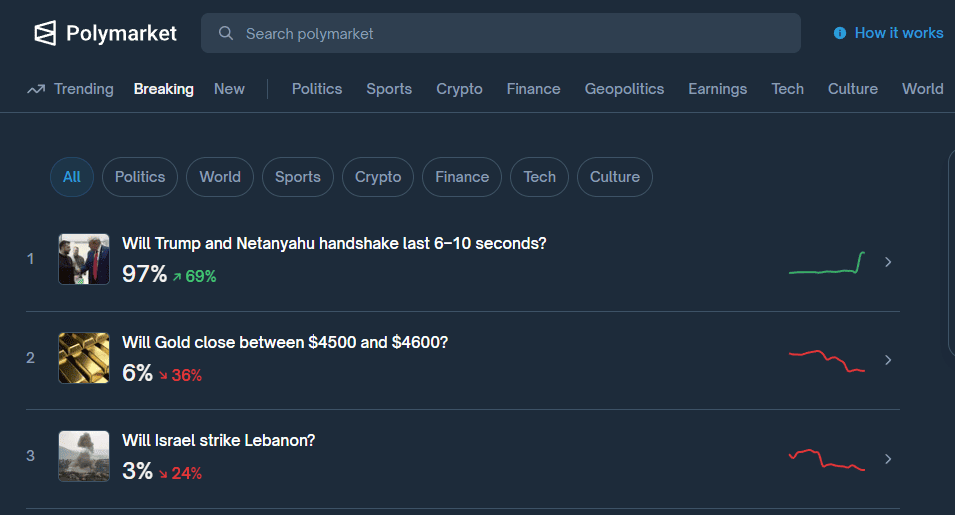
You can even bet on culture: who will be the top Spotify artist of the year, what will happen before the release of GTA 6, or whether we will confirm the existence of aliens by 2027. There is an endless number of markets for predictions, no matter how absurd some of them may seem!
How does Polymarket work?
Each event on the platform is represented as YES (YES) and NO (NO) shares. The share price always ranges from $0.01 to $0.99 and reflects the current probability of the event. For example, if a YES share costs 30 cents, it means the market estimates the probability of that outcome at 30%.

For example, you predict an event and buy 100 shares at $0.30. If the event happens, you spend $30 and receive $100. Your profit is $70.
When the event concludes, the shares of the correct outcome are redeemed for 1.00 USDC, and the shares of the incorrect outcome become worthless (0).
It's important to understand that you don't have to wait for the final outcome - shares can be sold at any time at the current market price to lock in profits or minimize losses.
What's the technology behind it?
Technically, it involves: blockchain, smart contracts, a Central Limit Order Book (CLOB), and an oracle (UMA).
It's simple: Polymarket is like a giant exchange where instead of Apple stock, 'future tickets' are traded. Here:
- The Smart Contract is an incorruptible cashier that gives you 2 tickets of different colors in exchange for a dollar.
- The Oracle is the judge who, at the end of the day, officially announces which color ticket won and is worth a dollar, and which turned into a regular piece of paper.

Predictions are made through a trading book of market and limit orders.
- A Market Order is an instant buy or sell of shares at the best available current price. This order type is useful for reacting quickly to news, but on illiquid markets it can lead to unfavorable execution prices (slippage).
- Limit Orders are trade requests at a specific price you set. Such an order enters the order book and waits until another user (counterparty) agrees to your terms.
Limit orders also allow experienced users to act as liquidity providers and earn rewards for it.
All this runs on the Polygon blockchain, but since blockchain cannot 'see' real-world news directly, Polymarket uses the UMA Optimistic Oracle verification system.
Advantages
We like Polymarket for its diversity: firstly, there's always something to bet on. Secondly, there's a market for everyone. Maybe you're not a huge sports fan, but perhaps you're interested in politics, have a good grasp of technology, music, or movies. Whatever it is, you might have an edge in one of these markets!
From words to action – let's see how to make predictions in practice.
How to use the exchange
Polymarket is a decentralized exchange, meaning there is no KYC verification, and you don't need to confirm your identity.
How to register?
To register, you'll need a decentralized wallet, for example, MetaMask or Phantom; luckily, we have guides for both.
To register, simply click Sign Up, select a web3 wallet, and confirm the connection.

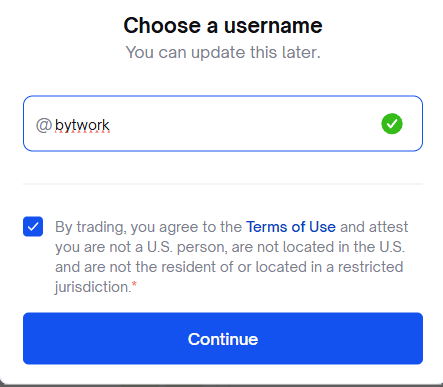
Then the exchange will run a brief tutorial: choose a username (we entered 'bytwork'), accept the terms by checking the box, and click Continue.
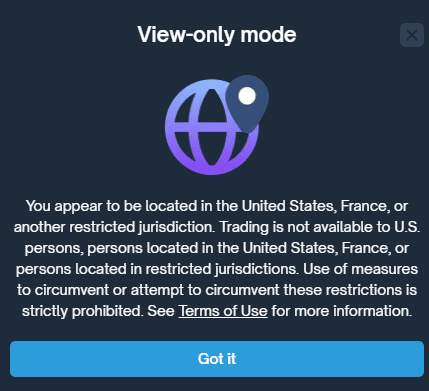
If you see a pop-up about jurisdiction blocking, it means the exchange does not operate in your region.
After setting up your wallet, you'll need to deposit funds.
How to fund your account?
Click the Deposit button. For new users, Polymarket will ask to enable trading, so click Enable trading. Then confirm in your wallet, and now you can fund your account.

The exchange offers PayPal, cards, crypto exchanges, but the fastest and cheapest way is to simply send cryptocurrency directly.

So, choose Transfer Crypto. Polymarket will show a list of supported tokens like BTC, ETH, SOL, or even Trump, but the easiest is to use USDC on the Polygon network with very low fees.
Select USDC, then select Polygon as the network, and the exchange will show a deposit address with a QR code.

Now it's time to send some coins. You'll see a wallet address with a QR code, and that's where your funds should go. Polygon will automatically convert the funds to USD.
How to make a trade?
Let's look at a specific example. For this, open any prediction.
For instance, here's a question: "Will the next leader change before 2027?".
- The chart shows the price change of the "Yes" contract (i.e., the probability of departure) over time.
- Below – the probabilities of departure for specific leaders. E.g., Schoof (Netherlands): 39%
- The trading panel. You can buy
Yes(price 41) orNo(price 63).

How to make a trade:
- Select a contract (e.g., Schoof - Netherlands PM).
- Click
Buy Yes(if you believe he will leave) orBuy No(if not). - Specify the bet amount (e.g., $10).
- Confirm the trade.
If you bought Yes for 41, and the event happens – you will receive $1 for each contract purchased.
Your profit = the difference between $1 and the purchase price. Simply put, if the event occurs (the Yes contract) it pays out $1. If No – the contract becomes void.
We predict he will leave. Congratulations, you've officially made your first prediction!
However, it's important to see the pitfalls as well.
What are the pitfalls?
There are a number of caveats that are important to understand.
Always read the rules
The fine print of each market specifies the exact conditions for resolving the bet. They can be non-obvious and strict, so check them BEFORE funding.
Trade on familiar markets
Start with topics you already understand (cryptocurrencies, sports, elections) - this way you can better analyze price movements.
Use early selling
You don't need to wait for the event outcome: you can sell your position at any time to lock in profits or limit losses.
We've covered the basics. Now we can move on to advanced strategies.
Strategies
And now for the main part: how not just to guess, but to earn. We've prepared several strategies for you, from simple to complex.
Strategy 1: Betting on undervaluation
The first strategy is betting on undervaluation. This is the basics. Let's say the market gives a 42% chance that Apple will release a foldable iPhone before 2027, price 42 cents. You've studied patents, supplier leaks, analyst reports and determined the chance is about 60%.

The gap between 42% and 60% is your edge! And you buy. This is investing, not guessing, but it's important to truly understand the specific topic.
Strategy 2: Arbitrage
The same piece of news on Polymarket is priced at 74 cents, and on Kalshi (a Polymarket analogue) - 73.

Different platforms, different liquidity, different participants. You buy Yes where it's cheaper and short No where it's more expensive. During chaotic moments, like debates, these spreads can yield 10-15% profit instantly.
Cons: fees and gas costs. So with $10 there's nothing to do here.
Strategy 3: Speed
Imagine news breaks: the SEC head is resigning. The market doesn't react instantly. You have up to a couple of minutes max before the crowd reaches Polymarket. Bots, of course, are faster, but with complex news where context needs to be understood, humans can still win.
See the news - quickly assess the impact, buy, sell 10 minutes later on the pump. This is essentially scalping, folks!
Strategy 4: Pro math (Kelly Criterion)
The fourth strategy is pro math. The most important question: how much to bet? There's a formula called the Kelly Criterion. It tells you what percentage of your bankroll to allocate to maximize profit over the long run. Complicated? Let's simplify.
For example, if the odds are 2 (i.e., a true 50/50), and you personally after some analysis give this event a 55% probability, then your bet should be 10% of your deposit.
If your deposit is, say, $100, then you should bet $10, no more.
But the catch here is that the Kelly formula is very aggressive: if you misjudge the probability, it can wipe out your deposit.
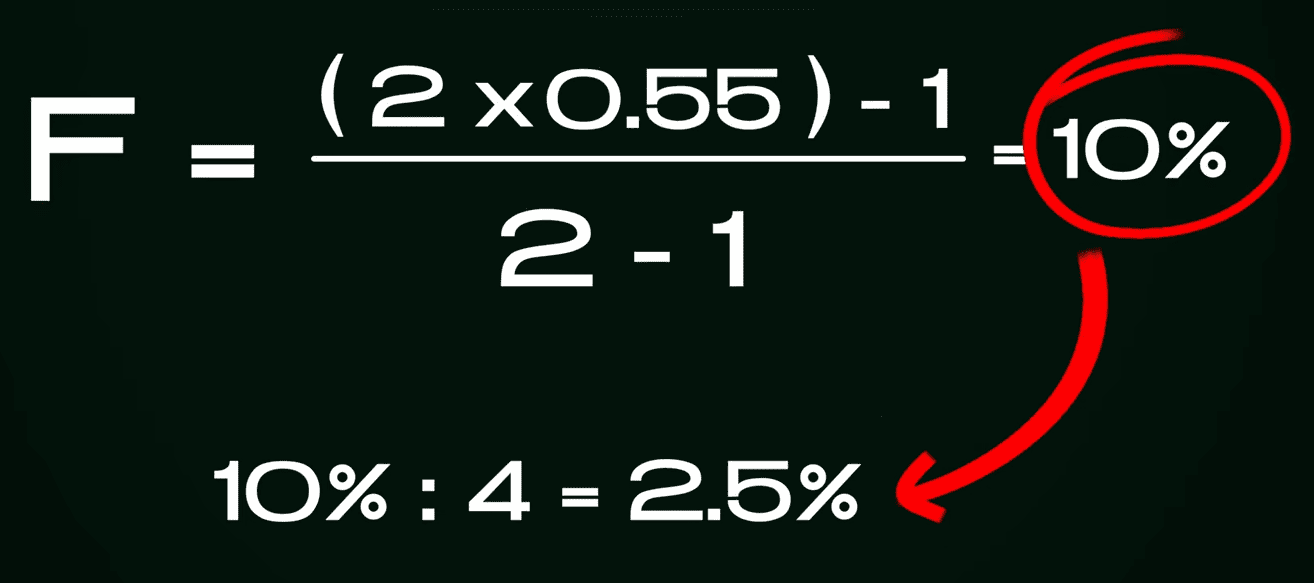
That's why pros use fractional Kelly: if the formula says bet 10%, divide by 4 and bet 2.5%. Remember, it's better to under-earn than to be wiped out of the market!
Strategy 5: Simply earning liquidity rewards
Polymarket pays you for placing limit orders, and payouts happen every day at midnight.
A very important point: to receive a payout, you need to earn at least $1. It's worth considering that it might not make sense to do this if you don't cross this threshold per day.
Go to the Rewards page and select markets with active reward pools. Look for options with high rewards and low competition, but consider the risk of sharp price movements!

If you see a market with low competition and high reward, perhaps newly created, you can quickly start earning these rewards by being the first to place orders. But remember, if you do this, you need to know how to place and cancel orders well if things go south.
For an order to start earning, it must be within the maximum spread (usually 3 cents) from the market midpoint. The closer your order is to this midpoint and the larger its volume, the higher the reward!

For the NO side, the order must be within 10 cents of the price, which on the screenshot is 90. So a bid at 87 (within 3 cents of 90) fits this rule and allows you to start earning a share of the reward pool.
If your order is successfully earning rewards, it will be highlighted in blue in the order book, and a blue outline will appear next to the clock icon.
Advanced tools for trading on Polymarket
Advanced services will help you find insiders on any Polymarket market. This helps identify those whose performance suggests possession of non-public information, not just guessing. First, let's look generally at what these services are, then consider cases of their real application.
|
Category |
Function / Tool |
What does it provide? |
|
Automation |
Creating AI agents for trading. Allows setting up strategies (e.g., arbitrage on BTC price), placing Stop-Loss and Take-Profit orders, trading 24/7. |
|
|
Data Analytics |
Comprehensive market analysis. Provides trader success ratings, tracks whale activity, and distribution of shares between retail and large players. |
|
|
Copy-trading |
Works like a fund: you invest funds in a successful trader. |
|
|
Complex Bets |
Allows combining multiple predictions into one deal with enhanced rewards (Parlays). For example, if all included bets come true, the payout will be higher than a regular bet. |
|
|
Arbitrage |
A strategy to extract profit from price differences for the same event outcome on different platforms or within the market itself. For example, if on Polymarket YES costs 64 cents, and on Limitless NO costs 32 cents, you can lock in a 4% guaranteed (risk-free) profit by buying both outcomes simultaneously. |
Since 88% of platform users lose, success lies in joining the remaining 12%.
Analyzing Smart Money actions and tracking whales are strategies based on finding an information advantage by observing the most profitable and informed market participants.
Let's consider how you can increase prediction effectiveness using these tools.
Hashdive
Hashdive provides phenomenal capabilities for studying Polymarket markets. It's used to search for 'smart money' and analyze the historical success rates of supporters of various outcomes.
For example, if you need a market, you can use the dropdown list, but it's probably better to just type its name. You can also analyze other traders' actions here.
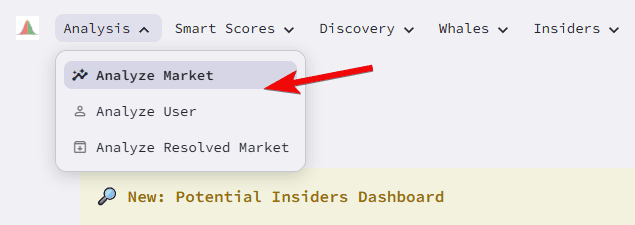
And if you're not quite sure what you're looking for, just click on one of the popular options, like "24h volume." There's also a search by event name on the right.

In the table on the main page, you'll see all the information: Yes price history, tags, days remaining, and something very important – the spread (price difference).

You can sort by the largest spread, where you can place bids and offers far apart and thus earn, or work with a very narrow spread.
Opening a specific event, on its page you'll see many metrics. Among them – Top Holders Aggregate Scores.
Here the answer is immediately visible: "Yes" is winning. In this prediction, traders on the "Yes" side have historically shown much better results.

If you open a specific wallet, you'll see the User Smart Score - a rating that determines the quality of a trader based on their past results and helps understand which side (YES or NO) the most successful players are concentrated on.

If a user's score is in the range from 20 to 100, it may indicate possession of insider information or exceptional skills!
In general, Hashdive helps you go beyond the standard interface and see hidden data – whales, insiders – and engage in copy-trading.
Fraction AI
Fraction AI is an automated assistant and a place to create trading agents (bots) for Polymarket.
For example, you can automate trading on a specific market, say, Bitcoin. Just click Create agent, specify capital, e.g., 50 USDC, and choose a strategy, such as probability price arbitrage. You can set conditions: if Bitcoin exceeds $120,000 and the event probability falls below 90%, then the bot will make a purchase.

You can either use ready-made agents from developers or create your own bots for unique market conditions.
Polyfund
Polyfund works on the principle of staking or investment funds. The essence is to allow regular users to invest their capital into funds managed by experienced traders with high profitability ratios.
You can sort available funds by profit and view the entire history of orders, sales, and payouts of a specific manager.
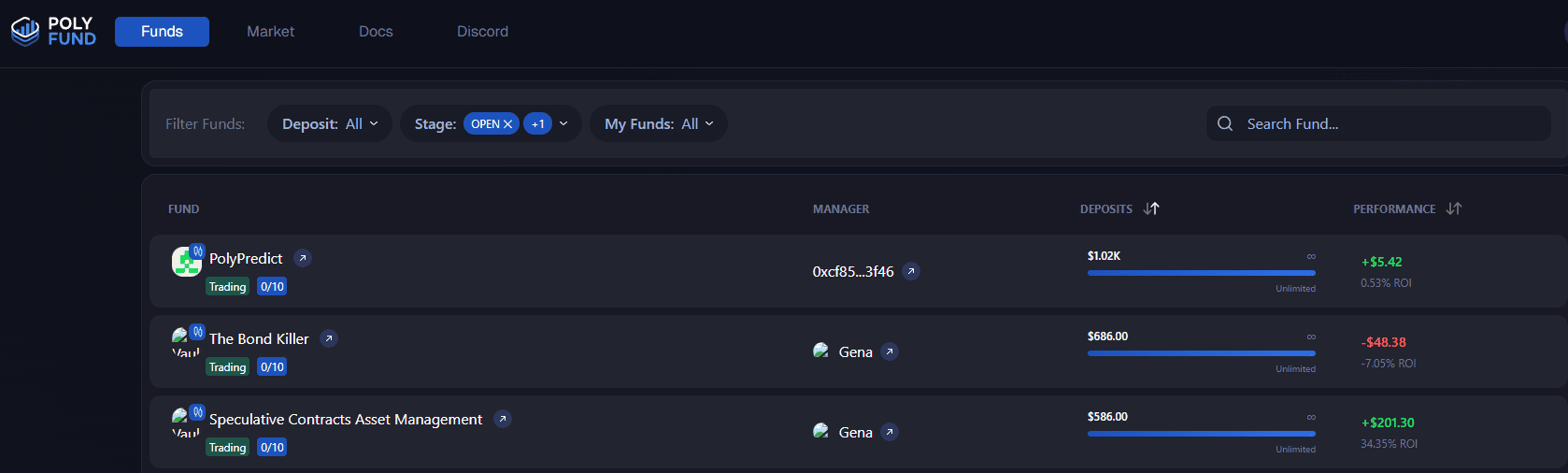
For the investor, the process is fully automated - just deposit funds into the chosen fund, and then withdraw them back to your wallet along with the profit earned at any convenient time.
Predict Shark
Predict Shark is designed for creating combined predictions (parlays). Its essence is to combine several independent predictions into one deal. This allows for a multiple increase in potential payout with small investments.

Predict Shark works directly through MetaMask, without requiring a separate Polymarket account. However, note that a 1% fee is charged for entering a deal, and it's impossible to exit a parlay before all events conclude.
Limitless / Kalshi
Limitless is an analogue of Polymarket on the Base blockchain, and Kalshi is a regulated American platform. And all 3 exchanges are used for arbitrage (finding price differences).
You can use aggregators like polymarketanalytics, which compare quotes on all 3 platforms in real time.

This allows sniping profitable offers or hedging positions by opening opposite bets on different sites. For example, if the price on one market lags behind another, you can buy a "YES" contract on one and a "NO" on the other, getting risk-free profit.
However, it's worth considering that data on these aggregators may lag slightly.
Market Sentiment Analysis via Grok and GPT
AI models Grok and ChatGPT are used for trading analysis, but for different purposes.
- Grok specializes in real-time tweet analysis to find new trends (memecoins, events) and boasts greater pricing accuracy.
- ChatGPT is strong in deep research of context and news for predicting market direction, but weak in determining the exact entry moment.
Grok provides the ability to create automated Tasks for monitoring events and sentiment in real time.
For example: "Alert me about any spikes in mentions or sentiment on X regarding certain tokens or events."

AI is most effective for analyzing concepts (culture, politics, technology), but poorly suited for sports trading or short-term crypto market speculation.
It's important not to trust AI with order execution, but to use models only for analyzing outcome probability. Hallucinations are still a thing.
Also, some AIs (e.g., Google AI Studio) can be trained on your strategies by uploading Google Docs describing GTO (Game Theory Optimal) principles or mathematical models.
Let the model conduct research and confirm your prediction, but choose the execution price and trade timing yourself based on the order book.
How to avoid losses?
The internet has many examples of people earning, but there is insider trading and risks here. For instance, there have been cases of insider info and volume pumping (wash trading).
To avoid blowing up your deposit, here's a short algorithm:
- Check trading volume and order book depth. If liquidity is low and the spread is wide, walk away.
- Read the market rules on the platform. If the oracle's wording is unclear – there's a risk of dispute, don't bet.
- Don't rely on a feeling of Bitcoin going up - look for numbers, polls, facts.
- Start with 2-3% of your deposit on one bet, even if you're 100% sure.
- The Leaderboard tab shows the actions of top traders. You can copy their trades for a small amount, but keep in mind they may have hedges on other exchanges that you don't see!
But that's not all. For example, when people start buying YES shares, the price rises, which makes others believe in the inevitability of the event and buy even more. The odds for an event might start at 60%, but due to hype, the price soars to 90%, even though the real probability hasn't changed! How to combat this?
A method to combat groupthink
Groupthink and confirmation bias kick in the moment you see the price (e.g., 90% on YES): your brain subconsciously starts accepting it as truth.
Counter-strategy:
- Set your own price BEFORE opening the chart: first conduct research and determine your own true probability.
- Compare with the market: if you estimated a 50% chance, and the market gives 98%, it's a signal of inefficiency and crowd groupthink.
- Statistically, the vast majority of markets on Polymarket resolve to
NO(about 74-75%), because many events ultimately don't happen and initially sound like nonsense.
Risks and drawbacks
It is believed that about 88% of users lose money, often falling victim to 'herd mentality' or inefficient pricing amid information noise. We've already covered how to combat this above.
Moreover, self-fulfilling prophecies often arise on markets - rising prices make people believe in the inevitability of an event. This creates bubbles. Market observation shows: events with a 98% probability only materialize 94% of the time, and at 92% - only 86%.
Polymarket can manually interfere with oracle decisions by requiring sources to confirm events. The UMA oracle deliberately makes contradictory decisions, creating volatility, and Polymarket wants to take control of the oracle for itself (through its POLI token) to resolve disputes in the interest of large investors.
Research has uncovered 210,000 suspicious trades generating $143 million in abnormal profits, resembling insider trading based on confidential military data, while Israel has filed the first criminal charges for insider trading on Polymarket.
Geographic restrictions
The platform is officially banned in the USA after a $1.4 million fine from the CFTC. Citizens of Russia, Belarus, and Ukraine have also been restricted.
The exchange also warns that users using workarounds in prohibited regions risk facing a 'Close Only' mode. In this case, the wallet may only close positions, not open new ones.
What's the bottom line?
Prediction markets are perhaps the most honest form of trading: there are no complex schemes like in options or leverage that wipe out deposits in liquidations.
Here it's just you, your information, and the price reflecting collective opinion. It's an interesting exchange if used wisely. Study, analyze, and never risk more than you can afford to lose!
The final result depends on a combination of strategies, a model for combating collective hype, and using advanced tools for prediction analysis.
Whether to trade on Polymarket or choose another platform from our top-rated crypto exchanges is, as always, your decision. Happy trading in the new year! Your editor, Maxim Anisimov, for bytwork.com.
Disclaimer: All information provided in this article should not be construed as financial advice. This article was created for educational purposes only. Never invest more than you can afford to lose, and seek advice only from your personal financial advisor.


