A guide to reading Japanese candlestick charts with examples of working patterns.

Japanese candlesticks visualize the struggle between sellers and buyers, showing who dominates the market. Yet there is a secret most traders miss: candlesticks primarily reflect market psychology, not just price or the battle between bulls and bears.
Below you will learn how to recognize the emotional meaning of candles-this will give you a real edge in trading.
Let’s look at the 4 main pillars of successful candlestick reading:
- color,
- body,
- wick and
- range.
We’ll start with the very basics to explain everything as simply and holistically as possible.
Anatomy of a Candle: Color, Body, Wick, and Range
On the chart we see two types of candles:
- green and
- red.
A green candle forms when the closing price is higher than the opening price, indicating that buyers are stronger than sellers. The open is the price at the beginning of the period (e.g., a day), the close is the price at the end of the period.
- If the close is higher than the open, the candle is green (buyers are stronger).
- If the close is lower than the open, the candle is red (sellers are stronger).

Each candle represents the price movement over a specific period of time. For instance, on a daily chart one candle shows the price action for one day, on a minute chart for one minute, and so on.
Wicks (Shadows)
A candle consists of a body and wicks (sometimes called shadows). The wicks indicate the high and low of the period.

The body shows the opening and closing prices: for a green candle, the open is at the bottom and the close at the top; for a red candle it’s the opposite.

Before moving to candlestick patterns, there are a few concepts you need to grasp. The first concept is large body vs. small body.
Candle Body Size
The candle body shows the balance of power between buyers and sellers. The larger it is relative to the wicks, the more confident the control of one side.

For example, a long green candle with small wicks shows clear buyer dominance. In contrast, a small body with long wicks indicates a balanced struggle where sellers negated the rally, bringing the price back near the open.
Thus, the larger the body relative to the shadows, the clearer the market control; the smaller the body, the more uncertain the outcome.
Wick Size
The second concept is long wicks (shadows). Whenever we see a long shadow above or below the body, it gives an important clue about price action. A long upper wick shows that sellers were actively selling at those levels, and buyers will need significant effort to push the price higher.

Similarly, a long lower wick indicates that buyers were actively buying at those low levels, so sellers will have to overcome their pressure to push the price down.

Simply remember that long shadows point to seller or buyer pressure, a large body signals strong momentum, and a small body with long wicks signals uncertainty and a struggle between the sides.

These concepts of body and shadows are essential to keep in mind when moving on to basic candlestick patterns.
Basic Patterns
Candlestick patterns are recurring combinations that reflect trader psychology and help predict the direction of price. Out of hundreds of existing models, only a few work, so mastering 3–10 reliable ones is enough. By understanding market structure and how candles form, patterns will help you read the market-capturing the emotional context and structure.
Patterns can be:
- reversal – signal a trend change
- continuation – confirm the current move
Let’s look at these patterns: Engulfing, Doji, Morning/Evening Star, Pin Bar.
Bullish Pin Bar
A bullish pin bar is a strong reversal pattern indicating a potential upward reversal. It consists of a small green body, a long lower wick, and a very small or absent upper wick.

The psychology is this: although sellers initially pushed the price down, their momentum was overpowered by strong buying pressure that returned the price higher to close above the opening level.

This indicates that buyers stepped in and are taking over, especially if the pattern appears after a downtrend.

To trade this pattern, look for additional confirmation before placing a buy order above the pin bar’s high. While some enter the trade immediately, it is safer to wait for the candle to close and see that the next candle is also green (bullish). A stop loss should be placed below the pin bar’s low, and the target set at the next resistance level.

On the chart, the red line marks the stop-loss level below the local low, the blue line is the broken resistance at the entry point, and the upper green line is the take-profit with upside potential to the previous high.
Bearish Pin Bar
The second pattern is the bearish pin bar, which is the exact opposite of the bullish one. It is a red candle with a small body, a long upper wick, and almost no lower wick. It signals a downward reversal.

The psychology here is reversed: buyers initially pushed the price up, but then sellers took over, driving the price below the opening level to the low.

This suggests that sellers have temporarily gained the upper hand. A sell order can be placed below the low of this pin bar, with a stop loss just above its high.

It is important to understand that a bearish pin bar only carries weight when it appears at a resistance level, in a supply zone, or after a prolonged uptrend. A pin bar in the middle of random movement is just market noise!
Doji
The third pattern is the doji, which is unique because by itself it does not give a directional signal. It is characterized by a very small body and roughly equal shadows above and below.
The doji represents a state of equilibrium where buyers and sellers are balanced.

A single doji indicates a pause, while a series of such candles signals intense struggle that often leads to a volatile breakout in either direction.

If a doji appears after a strong price move (trend), it often serves as a warning that the current momentum is fading and the market is either ready for a reversal or to move sideways.
Intermediate Patterns (2 Candles)
Bullish Engulfing Pattern
It occurs when a large green candle completely engulfs (covers) the body of the previous red candle. This means its high is higher and its low is lower than those of the previous candle.
Psychologically, this is a shift from seller control during the red candle to a sudden and overwhelming burst of buying pressure that erases all of the sellers’ gains.

The pattern demonstrates that buyers are now in control. To enter a trade, you can go long above the high of the engulfing green candle, placing a stop loss below its low.

The larger the second candle relative to the first, the greater the advantage for buyers and the higher the probability of a reversal.
Bearish Engulfing Pattern
The bearish engulfing pattern is the opposite of the bullish one. It consists of a large red candle that completely engulfs the previous green candle.

The psychology reveals that after a period of buyer control, sellers exert such strong pressure that they overwhelm buyers and push the price below the low of the previous candle. This signals that initiative has passed to sellers.
A sell order can be placed below the low of the engulfing red candle, with a stop loss above its high.

The pattern only holds weight after a prolonged uptrend or when forming at a key resistance level. An engulfing pattern in the middle of a sideways range is often a false signal (market noise).
Advanced Patterns (3 Candles)
Now we look at more complex three-candle patterns.
Morning Star Pattern
The Morning Star is a bullish reversal pattern. It begins with a strong red candle, followed by a small‑bodied candle (e.g., a doji or pin bar) that indicates indecision. The formation is completed by a large green candle that closes significantly higher.

The pattern is considered strongest if the final green candle is the same size as the first red one. This is an especially strong signal if it closes above the high of the first candle. Psychology shows a shift from seller control to buyer dominance.
A buy order is placed above the high of the final green candle, while the stop loss is placed below the middle doji candle.

The pattern’s effectiveness greatly increases when it forms near support levels or in oversold zones.
Evening Star Pattern
The Evening (Falling) Star is the bearish counterpart of the Morning Star pattern. It starts with a strong green candle, followed by a small doji, and ends with a large red candle.

Psychologically, the pattern shows how buyers lose control to sellers, who eventually win the battle and push the price down.
A sell trade is opened below the low of the last red candle, and the stop loss is placed above the high of the doji.

The target is usually the nearest support levels or a risk‑to‑reward ratio (e.g., 1:2 or 1:3).
Applying Patterns in Practice with Price Action
These patterns are most effective when combined with price action concepts such as support and resistance levels.
For instance, in one example, a Morning Star pattern formed exactly at a specific support level within a downtrend, giving a strong buy signal. Price then moved up as expected.

In another scenario, after drawing a trend line, a bullish engulfing pattern formed at it, indicating a breakout of resistance and offering another long entry point. Conversely, a bearish Evening Star pattern that appeared at a resistance level gave a high‑probability sell signal.
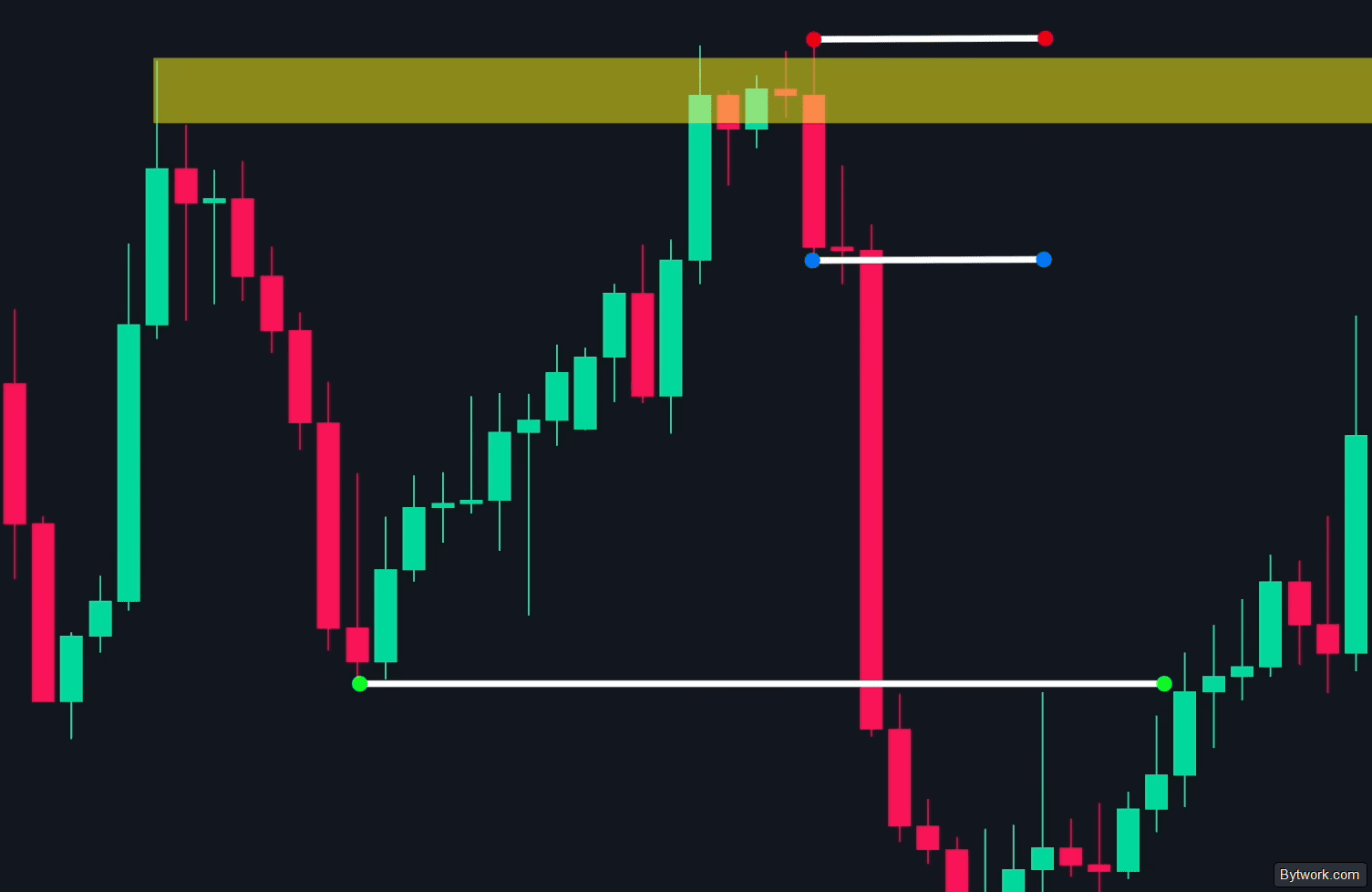
Remember: location is more important than shape! The biggest mistake beginners make is trading a pattern in isolation. A candlestick signal only makes sense at points of interest (POI).
Patterns should form at support and resistance levels, trend lines, Fibonacci levels, or liquidity zones.
Candles in the middle of a trading range (flat market) are considered market noise and should not be used for entries.
How the Psychology of Struggle Creates Momentum
The market is a constant battle between buyers and sellers, and Japanese candlesticks are the visual report of each round’s outcome. It’s important not only to read candles, but also to see the momentum they form.
Momentum can be identified in two main ways. The first is to look for tight (compressed) price movement, where candles are close to each other without wide ranges. In an uptrend, this indicates complete buyer control. In a downtrend, it indicates complete seller control.

The second way is to observe increasing candle sizes. This shows that price is covering more distance per candle and momentum is accelerating in the direction of the trend.
Remember that price movement should be confirmed by high volume: a rise on falling volume is weakness and a reversal. Abnormal volume spikes combined with patterns are manipulations by whales to hunt retail stop‑losses.
How to Understand Market Trends
Understanding the sequence of peaks and troughs allows you to read the market as a coherent story, not a collection of isolated candles. Without this structure, any candlestick pattern is just noise.
The market does not move in a straight line but in waves. It constantly forms new highs and lows.
An uptrend is identified by a sequence of higher highs and higher lows.

A trend change from uptrend to downtrend can be identified in several ways:
- First – after a series of higher highs and higher lows, a lower low forms.
- Another way – a lower low forms, followed by a pullback to a lower high before a full break downward.
- A third signal – a lower high forms first, also suggesting a potential trend change.

A downtrend is a series of lower highs and lower lows, indicating bearish momentum and seller control. This favors short positions (selling).
A sideways or ranging market is identified when price action forms similar highs and lows, moving in a horizontal direction. In such markets, traders can consider trades in both directions with more confidence.

A range is characterized by consolidation candles – a series of candles with small bodies and short wicks. Dojis (candles without a real body) are also common, signaling participant indecision. Trading in a range is harder than trading with a trend, because a trend forgives mistakes, while a range often knocks out stop‑losses with false breaks of boundaries.
To track reversals, RSI indicators are also used. Candles with long upper wicks (price rejection) in a zone above 70 on RSI indicate a potential pullback or reversal due to market overheating.
Traders also use candle history to determine market cyclicity, finding levels where liquidity grabs or reversals previously occurred. And after a three‑candle reversal pattern forms, traders often place conditional orders into the level zone, expecting a small retest to get a better price.
Overall, this masterclass on trading with Japanese candlesticks ends here. However, our guide would be incomplete without analyzing the drawbacks of candlestick charts.
Drawbacks and Risks
Candles are not a predictor, but a scoreboard of already completed movement. It is important to understand the risks.
|
Risk |
Essence / Consequence |
|
Probabilistic nature |
No pattern offers a 100% guarantee. Technical analysis is about probabilities (on average 50–60% success). |
|
Trading without context |
A signal in isolation (without reference to levels and trend) is market noise, not an entry point! |
|
Lagging signals |
Candles show already completed movement. Entering on a pattern often means entering after the big players. |
|
Timeframe influence |
On lower timeframes (1–5 minutes), the number of false signals is highest due to the high level of noise. |
|
Market manipulation |
Large players create false patterns (traps) to provoke retail entry and collect stop‑losses. |
|
External factors |
Release of important news or economic data instantly nullifies any technical signal. |
|
Psychological traps |
Impulsive candles provoke FOMO (entering at the peak), while fear and hope break risk management. |
|
Conclusion |
Candles only work as one element of a system, requiring confirmation from volume and market structure. |
The takeaway you must remember: Japanese candlestick patterns by themselves mean nothing. Always use them in combination with other factors, such as key levels and trend lines, to build a reliable trading system.
Summary
Japanese candlestick analysis is built on 4 elements:
- color (green/red),
- body (large – emotional outburst and frequent direction change, small/doji – accumulation),
- wick (long – reversal signal), and
- range (distance between extremes).
The strength of a pattern is determined by the ratio of the candle body to its shadows (large body – market control) and the length of the shadows (strong buying/selling levels). Patterns should be used together with support/resistance levels and trends, although subjective interpretation and dependence on market context reduce their reliability.
Trading rules:
- Entry – at the close of the confirming candle
- Stop loss – beyond the pattern’s extreme (pin bar wick or min/max of the adjacent candle)
- Multiple confirmations are mandatory (e.g., alignment with a demand zone)

We have been trading cryptocurrencies since 2018 and have tested hundreds of indicators and strategies. The trading system section will help you choose a system! Your editor – Pavel Grachev for bytwork.com.
This material is for informational purposes only and does not constitute financial advice.

Now reading


In DePin, people create networks themselves, share traffic or capacity, and receive rewards in tokens from these projects.