What does a conditional order on the exchange give you? Benefits and risks

You will learn how to use conditional orders using the example of the Bybit exchange for spot trading, as well as on futures.
What is a Conditional Order?
A conditional order is an order based on a specific event or trigger. Unlike standard market or limit orders, it is not executed instantly and does not enter the order book immediately after creation.
A conditional order is a request that waits for the desired price and only then triggers, without revealing your plans in the order book and without freezing funds until the very moment of execution. This order is also called a trigger or planned order.
The question arises, how does it differ from other order types and how to use it?
How Does a Conditional Order Differ from Limit and Other Orders?
Limit orders allow you to buy/sell at a specified price - for example, setting a sell order at $100,000 when the actual price is $89,000. However, you cannot place a limit order below the market price, as it would execute instantly.
The conditional order solves this problem. Unlike a limit order, a conditional order only triggers when your specified trigger price is reached. For example, you can set a trigger at $80,000 and a limit sell order at $79,000. This mechanism is similar to a stop-loss. After placement, the order is displayed in the open order list but not in the order book.

The absence of your order in the order book means that large market makers, who might try to manipulate the price, will not see your order - it is hidden until the trigger activates.
What Advantages Does a Conditional Order Give You?
Savings on Fees
Conditional limit orders on some crypto exchanges reduce fees to 0%, making you a maker.
On crypto exchanges, fees depend on the order type:
- A maker often pays a lower fee because they add liquidity to the order book by placing a limit order that waits for execution.
- A taker pays a higher fee and takes liquidity by executing an order instantly at the market price.
For example, on the MEXC exchange, the maker pays 0%, and the taker pays 0.05%.
Why is that? The devil is in the details. It might seem logical to a beginner to place a regular limit order above the current price to buy an asset when a resistance level is breached. But there's a catch here.
If you place a limit buy order above the market price, the system will treat it as an instruction to buy at that price or better. Since the current price is already better (lower) than your limit, the order will execute instantly as a market order. You will become a taker and pay an increased fee.
Stealth and Protection from Manipulation
The order conditions are hidden - meaning the trader is protected from manipulation by large market participants and market makers.
Market makers often move the price towards clusters of visible liquidity, such as stop-loss levels. Since your conditional orders are hidden, no one can see your entry or exit points in advance and "hunt" for them.
The "Set and Forget" Concept
Conditional orders help plan actions in advance. You are not tied to the screen waiting for a good price.
Set a trigger for a breakout of resistance or support. The order will be sent automatically when the condition is met. This is convenient if you work full-time and cannot check the charts.
What are the Disadvantages and Risks of Conditional Orders?
Along with advantages, there are also disadvantages. For example, when the final execution price differs from the expected one, price slippage occurs.
Conditional orders carry 5 risks:
- Price slippage during high volatility (especially on altcoins with low liquidity),
- Non-execution of limit orders during sharp market movements,
- Automatic cancellation of orders due to insufficient free funds in the balance (the order mechanism does not lock capital upon creation),
- False triggers from sudden crashes and price manipulations,
- And also errors in parameter settings.

Let's look at an example of setting a conditional order in practice and how to mitigate these risks.
Example of Setting Conditional Orders
Let's consider an example of setting a conditional order for selling on the Bybit exchange.
For example, set a trigger price of $80,000, and then set a limit or market order - say, a limit sell order at $79,000.

The Post-Only checkbox automatically cancels the order if it cannot be executed as a maker, protecting against unnecessary fees.
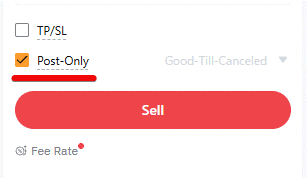
After that, click Sell, and you will see a notification about the successful order placement, which will be displayed in the open orders section below.

This is a typical stop-loss strategy - you want to sell if the price drops to $80,000, but you are willing to sell at $79,000 (slightly below the trigger to ensure the order executes).
Now let's consider an example of setting a conditional order for buying. Let's say you expect a breakout of the $100,000 level to confirm a trend reversal upwards and want to buy on momentum.
Select a trigger price, for example, $100,000, and then configure a limit or market order.

When choosing a market order, the purchase of BTC will occur instantly when the price reaches $100,000. This can be useful if you expect the BTC price to continue falling and want to buy on the dip, believing that reaching the $100,000 level will mark a breakout and further growth.
Now you have set up an analog of a stop-loss for selling and a buy order in case the BTC price breaks upwards. To cancel the orders, simply click Cancel. You can always start with a clean slate!

Conditional Orders on Bybit Futures
Now let's move on to trading futures on Bybit and consider the use of conditional orders, as even more features are available here.
As usual, select a trading pair on the left panel, and on the right, specify the order type - among standard limit, market, and other types, there is also a conditional one. When comparing spot trading and futures, you will see that for the trigger price you can choose last (last price), index, or mark.

In spot trading, only the trigger price is available, so the additional settings make futures more flexible.
What Do These Price Types Mean?
The question arises: what do these price types mean?
Last- the price of the last trade,index- the average market price,- and
mark- the index price adjusted for the funding rate.
Under normal market conditions and low trading volumes, all 3 prices are practically the same, so the choice does not matter significantly for most traders.
However, during large trades and fast market movements, the last price can fluctuate sharply, while index and mark remain relatively stable. In most cases, it's better to choose last.
Examples of Long and Short Orders
Let's give an example with long and short orders. For a long position, set a trigger price, for example, $3,100 for Ethereum, if a breakout to the upside is expected. Scroll through the settings, click Open long and make sure the order is successfully placed.

For a short position, let's say you have ETH and you want to limit downside risks by opening a short position when the price decreases. Set a trigger price, for example, 2,900, choose market execution so that the order opens instantly when the trigger is reached, and click Open short.
You will see a notification of successful placement, and the conditional buy and sell orders will be displayed in the corresponding section. They can also be canceled.

Conditional orders allow you to protect against a fall and take advantage of a breakout, acting as automatic stop-loss and take-profit, with the added benefit of stealth until the trigger activates.
Now let's look at how to secure conditional orders.
How to Protect Against Conditional Order Risks?
Conditional orders require precise configuration.
How to protect against slippage?
High volatility in low-liquidity markets can significantly shift the execution price. For protection, use limit orders instead of market orders. It's better to split a large trade into several smaller ones (e.g., a TWAP order). During periods of strong movements, avoid trading low-liquidity altcoins.
How to protect against non-execution of limit orders?
A sharp price surge can skip past your limit order, leaving it unfilled. To prevent this, place limit orders close to the current price, within the visible depth of the order book. For entering on a breakout, use stop-limit orders - they activate when the trigger is reached but execute at your specified limit price.
How to protect against automatic order cancellation?
On many exchanges, funds for a conditional order are not blocked in advance. If there are insufficient free funds in the account at the time of triggering, the order will be canceled. Therefore, always account for fees. The ideal solution is to use bracket orders (OCO). They immediately reserve capital for all possible scenarios.
How to protect against false triggers?
Short price spikes and manipulations can trigger a stop order at the most pointless moment. To avoid this, set the trigger based on the mark price, and do not place tight stops near key levels.
How to protect against configuration errors?
Incorrectly chosen order type or price can lead to losses. Therefore, check the parameters against your checklist, test new strategies on a demo account.
Q&A
How to Confirm a Reversal Using a Conditional Order?
Instead of simply buying on a pullback, there is a safer method. You set a trigger when the price enters deep into the correction zone, for example, below 50%.
The buy order is configured to execute only upon confirmation of the reversal - for example, when the price crosses back above the 61.8% or 50% level from below. This gives confidence that the correction is already over and the decline will not continue further down.
What are the Execution Conditions for Conditional Orders?
The Time In Force modes govern conditional orders:
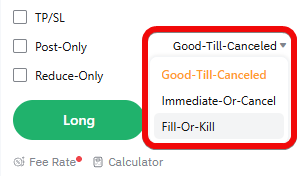
GTCkeeps them active for months with partial execution (by default),IOCexecutes the available amount instantly and cancels the remainder,FOKrequires complete immediate fill or complete cancellation (but there is a risk of zero execution with low liquidity).
Is a TWAP Order Also Conditional?
TWAP (Time-Weighted Average Price) is not a conditional order in the classical sense, but a strategy that splits a large order amount into many small ones. However, the type of orders within the TWAP fully depends on the exchange rules or the logic of the trading bot. The main purpose of TWAP is to avoid slippage.
What Other Order Types Are There?
Besides Conditional orders, crypto exchanges have orders such as:
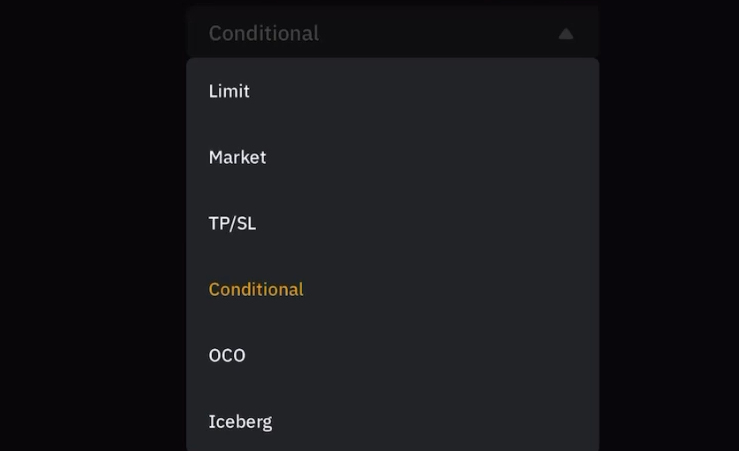
TP/SL- Take-Profit/Stop-Loss. Automatic closing of a position at a specified profit or loss price.OCO- One Cancels Other. A pair of linked orders: execution of one automatically cancels the second (usually TP + SL).Trailing Stop- A floating stop. The stop-loss automatically follows the price at a set distance, locking in profits.Chase Limit- Price chasing. A limit order is automatically moved closer to the market price for quick execution.Scaled Order- Scaled entry. Splitting a large order into several smaller ones at different prices within a specified range.Iceberg. Only a part of the volume is displayed, the rest is loaded as it is executed. Hides the real position size from the order book.
Conclusions
The advantage of a conditional order: you can plan trades in advance based on support and resistance levels.

- When the price falls below a support level, you can use a conditional order to stop losses, lock in profits, or cut losses.
- When the price breaks through a resistance level, you can use a conditional order to open or increase positions. This provides more convenient position management.
Conditional orders require knowledge in configuration, and the crypto market remains a volatile and dangerous place. Therefore, it is best to start with a demo account or small amounts. Happy trading! Your editor is Maxim Anisimov for bytwork.com.
Disclaimer: All information provided in this article should not be taken as financial advice! The article was created for educational purposes. Never invest more than you can afford to lose, and seek advice only from your personal financial advisor.

Now reading


In DePin, people create networks themselves, share traffic or capacity, and receive rewards in tokens from these projects.