Aave Guide - from Connecting Your Wallet to Collecting APY in 15 Minutes

After reading, you will learn how to lend and borrow crypto on Aave without intermediaries, explore the protocol's security and its risks. And to avoid liquidation, you will learn how to monitor the Health Factor parameter. As a bonus, you’ll discover looping strategies for stablecoin yields of up to 15% and higher, as well as advanced parameter settings that few discuss - eMode and Isolated. Let’s start with an overview.
Aave Protocol Overview
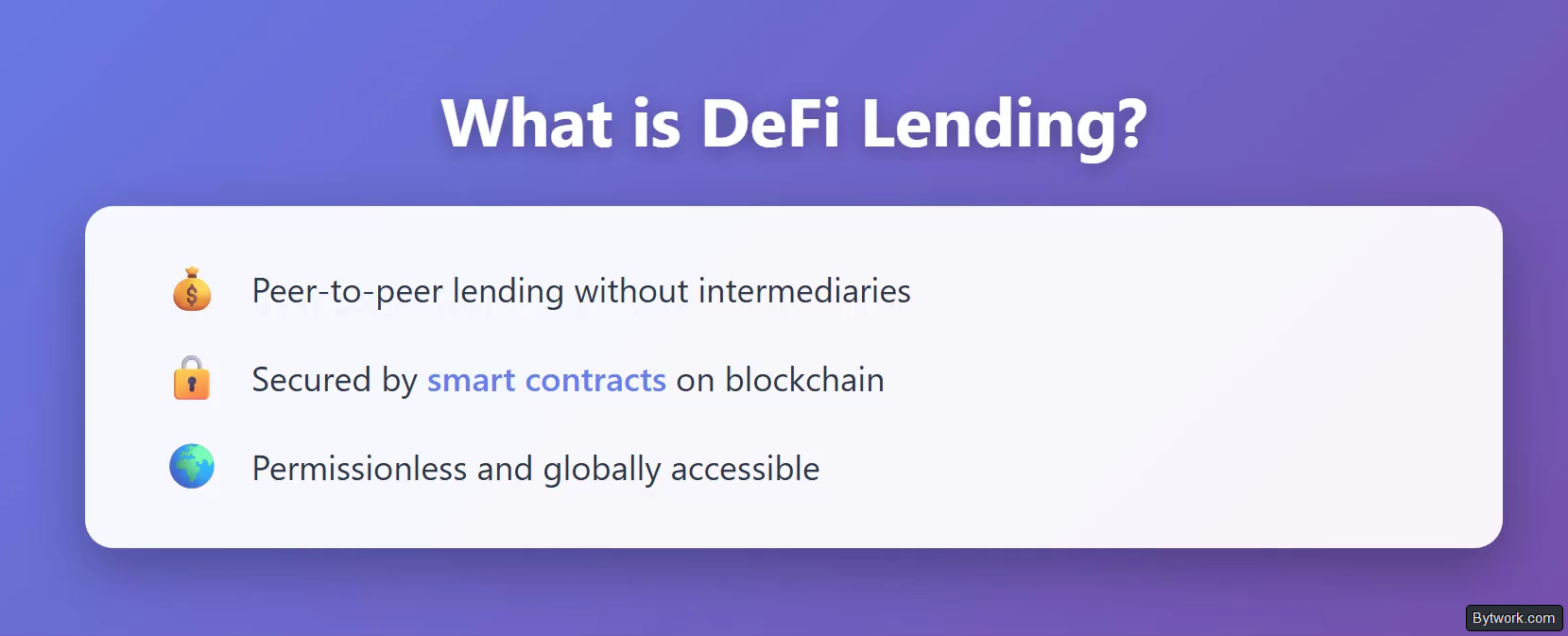
Aave is a decentralized, open-source liquidity protocol that lets you earn interest on deposits and take out loans against crypto collateral. All operations are executed automatically by smart contract code, without intermediaries. That’s the key difference from banks.
The protocol works on networks like Ethereum, Arbitrum, Base, MegaETH, and others.
In essence, users supply assets at variable APY or take out overcollateralized loans without credit checks, fixed terms, or minimum payments.
How Does Aave Work?
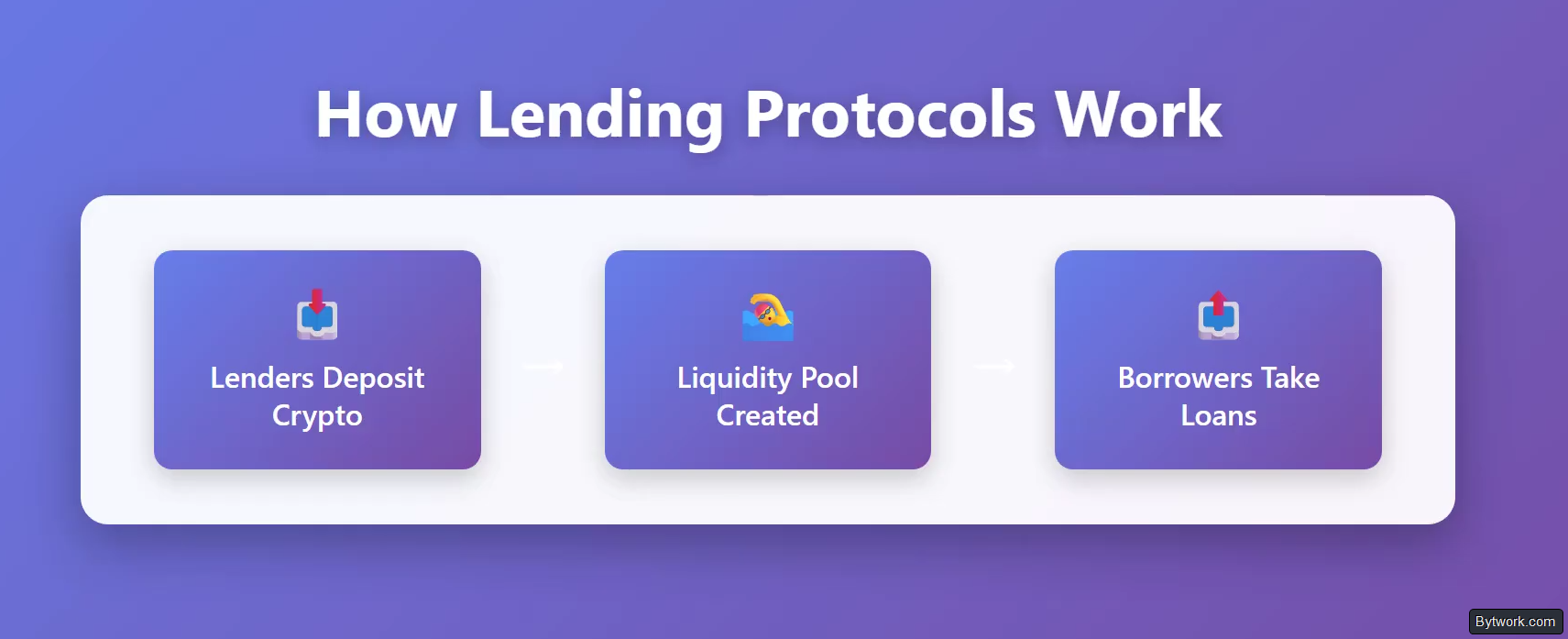
Aave pools user deposits into shared liquidity pools. Borrowers access that liquidity by posting collateral whose value exceeds the loan amount (overcollateralization). The interest paid by borrowers goes to the suppliers.
In simple terms, some users deposit assets (USDC, ETH, BTC) to earn interest, while others borrow them. The interest from borrowers creates the income for depositors.
Aave, like Compound, uses a DAO-lending model that enables passive participation through a single liquidity pool. However, this model suffers from low flexibility, high costs, and scaling difficulties due to its rigid monolithic architecture.
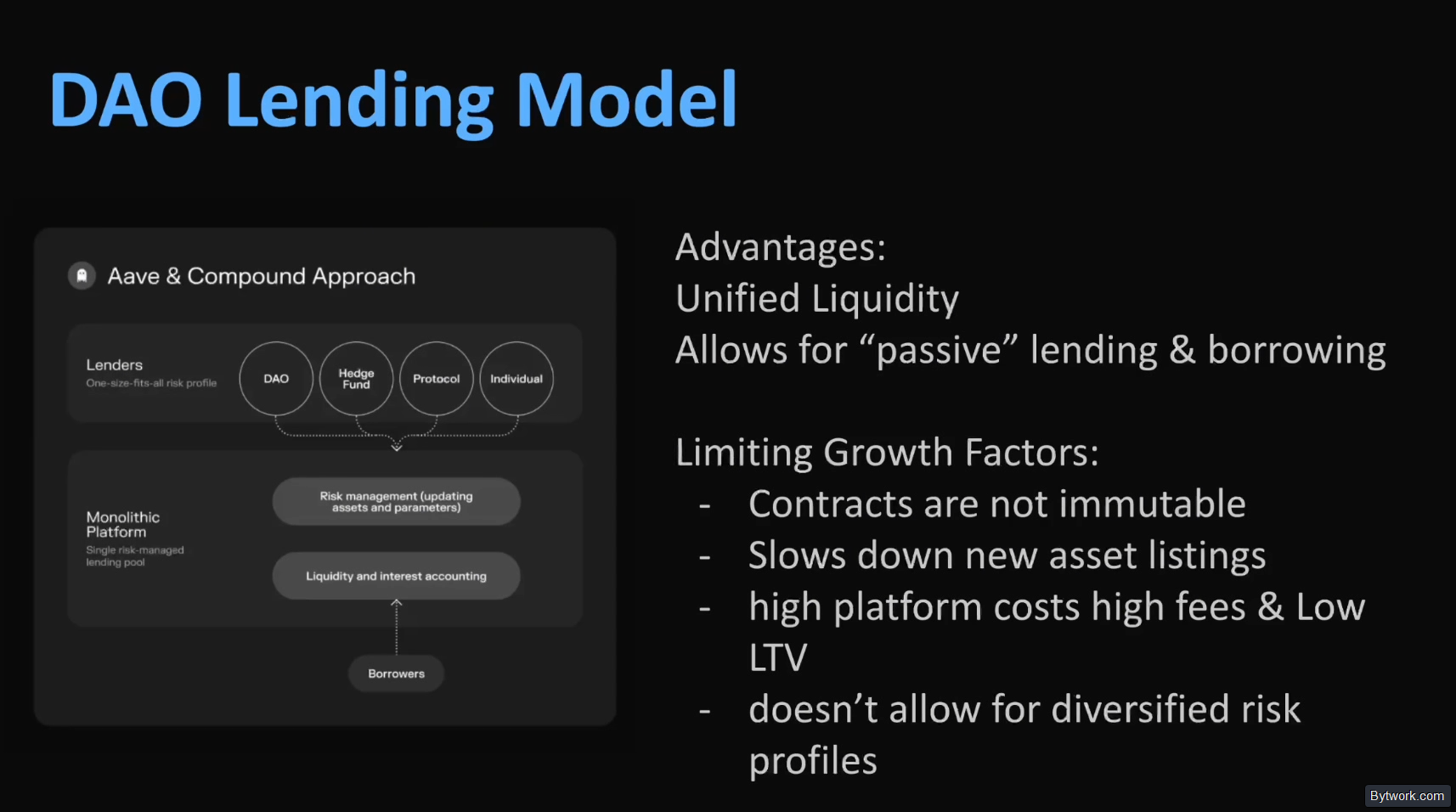
The DAO is an organization of AAVE token holders that controls market updates through on-chain voting. This includes allocating the accumulated treasury to ensure protocol security and development. Although development is moving toward version 4, version 3 remains the priority.
Aave V3 vs V2 vs V4. Which Version to Choose?
Aave V3 concentrates nearly all liquidity and has proven its security across several market cycles. V4 is not supported by the original Aave development team and carries higher smart contract risk because it is still immature and has little TVL. TVL (Total Value Locked) is the total value of all assets frozen in the protocol’s smart contracts.
Compare the versions in the table below:
|
Parameter |
V2 |
V3 |
V4 / Aave Pro |
|
TVL |
~$130 million |
~$12 billion |
~$28 million |
|
Status |
Deprecated, being phased out |
Active, DAO-governed, battle-tested |
Third-party development. Not built by the original V1–V3 team |
|
Recommendation |
Migrate to V3 |
Primary choice |
Avoid |
|
Risk management |
Basic |
|
Differentiated risk premiums* |
|
Liquidation |
Hard (one-time) |
Hard (up to 50% of position at once) |
Gradual (incremental) |
*Differentiated premiums in Aave V4 dynamically increase the borrow rate based on collateral risk. This fairly compensates lenders for risk. However, V3 offers the best conditions for ordinary users thanks to E-Mode, which allows borrowing more against correlated assets (e.g., stablecoin against stablecoin). Moreover, V3 is the safest and has deep liquidity. That’s why we choose it.
Markets, Networks, and Gas Costs
To use Aave effectively, explore its markets - isolated asset pools with different risk parameters. This prevents risky assets from threatening established ones.
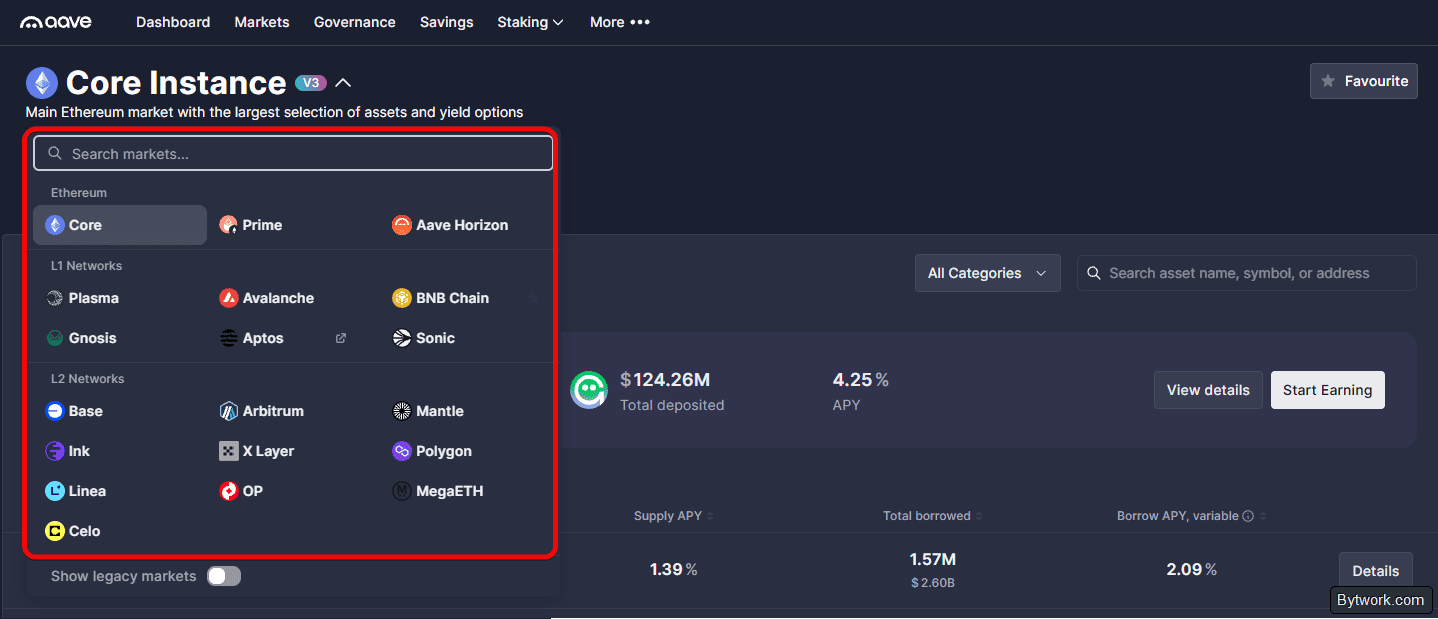
- Core Market – like “blue chips” (ETH, WBTC, USDC, USDT, DAI). The most conservative and liquid market. The best starting point for beginners, but fees are higher than on alternative networks. Suitable for positions of $5,000+.
- Other markets by network (Base, Arbitrum, Optimism) and custom ones (e.g., Horizon). Fees can be lower. Suitable for capital between $100–$5,000.
Choose a market based on your convenient network and compare APYs - sometimes yield is higher on one market than another. Inside these markets, there is an interesting feature called eMode (Efficiency Mode).
What is eMode (Efficiency Mode)?
eMode (Efficiency Mode) allows you to borrow significantly more against collateral from the same category (e.g., stablecoins) because the risk of collateral devaluation is minimized due to their nearly identical price correlation.
eMode is a capital optimization mechanism that significantly increases the LTV ratio (up to 90% or higher). LTV is the percentage of your collateral’s market value that you can borrow.
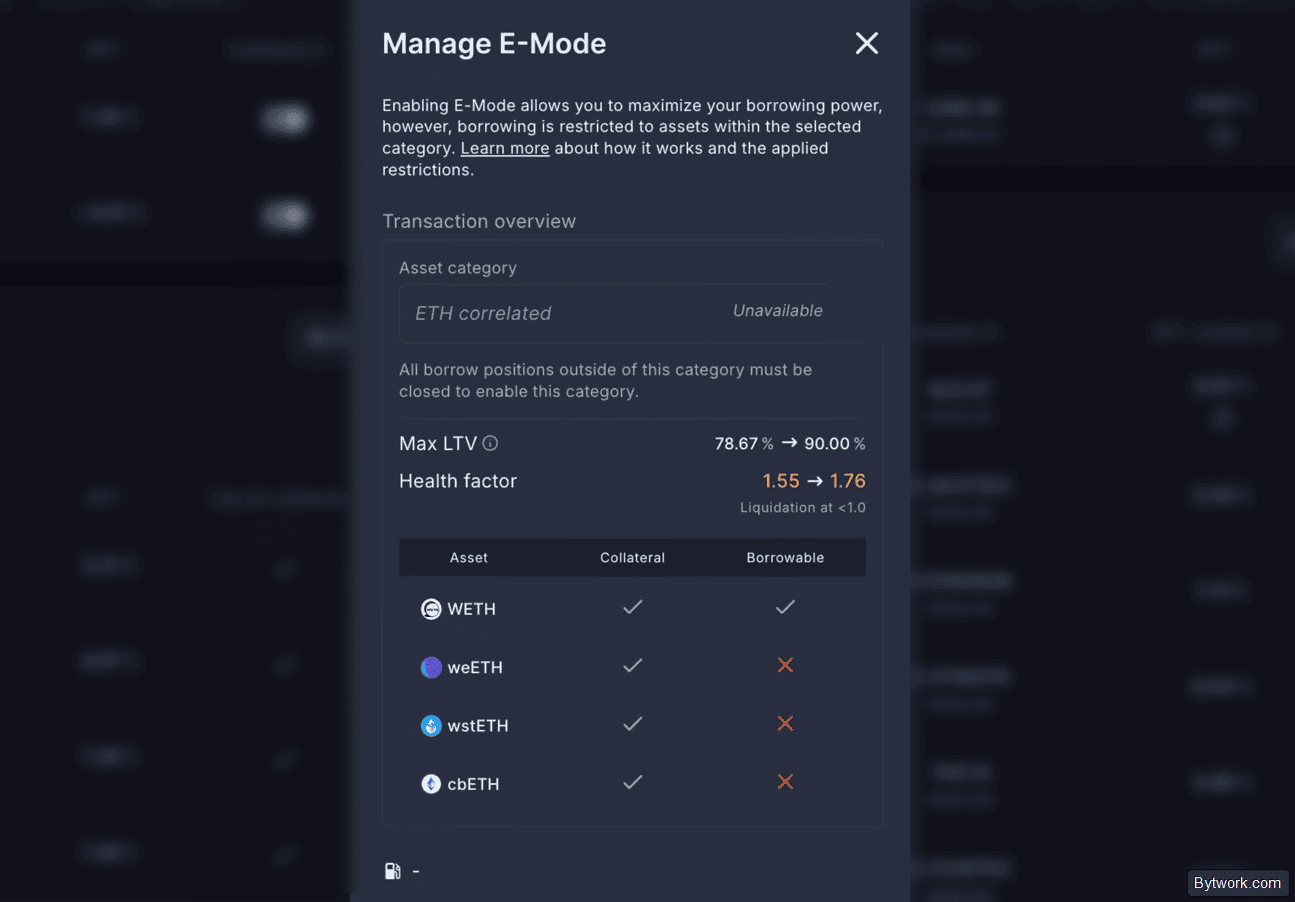
Here’s a comparison:
Standard Mode– gives LTV up to 75% (e.g., collateral USDC -> borrow USDT).eMode Stablecoins- LTV up to 90% for USDC/USDT/DAI pairs, because price correlation is nearly 1:1.eMode ETH-correlated- LTV up to 93–95% for ETH/wstETH pairs.
There is a limitation. When eMode is active, you can only borrow assets within the chosen category. To borrow from another category, disable eMode. This restriction protects the system. The enhanced borrowing capacity is granted precisely because assets move in sync.
Simply put, Aave can safely allow you to borrow more without increasing liquidation risk. That’s what eMode means. Besides that, there is also Isolation mode.
What is Isolation Mode?
Isolation Mode (Isolation mode) is an Aave safety mechanism designed to limit risks when using new or volatile assets by imposing strict debt ceilings on borrowing.
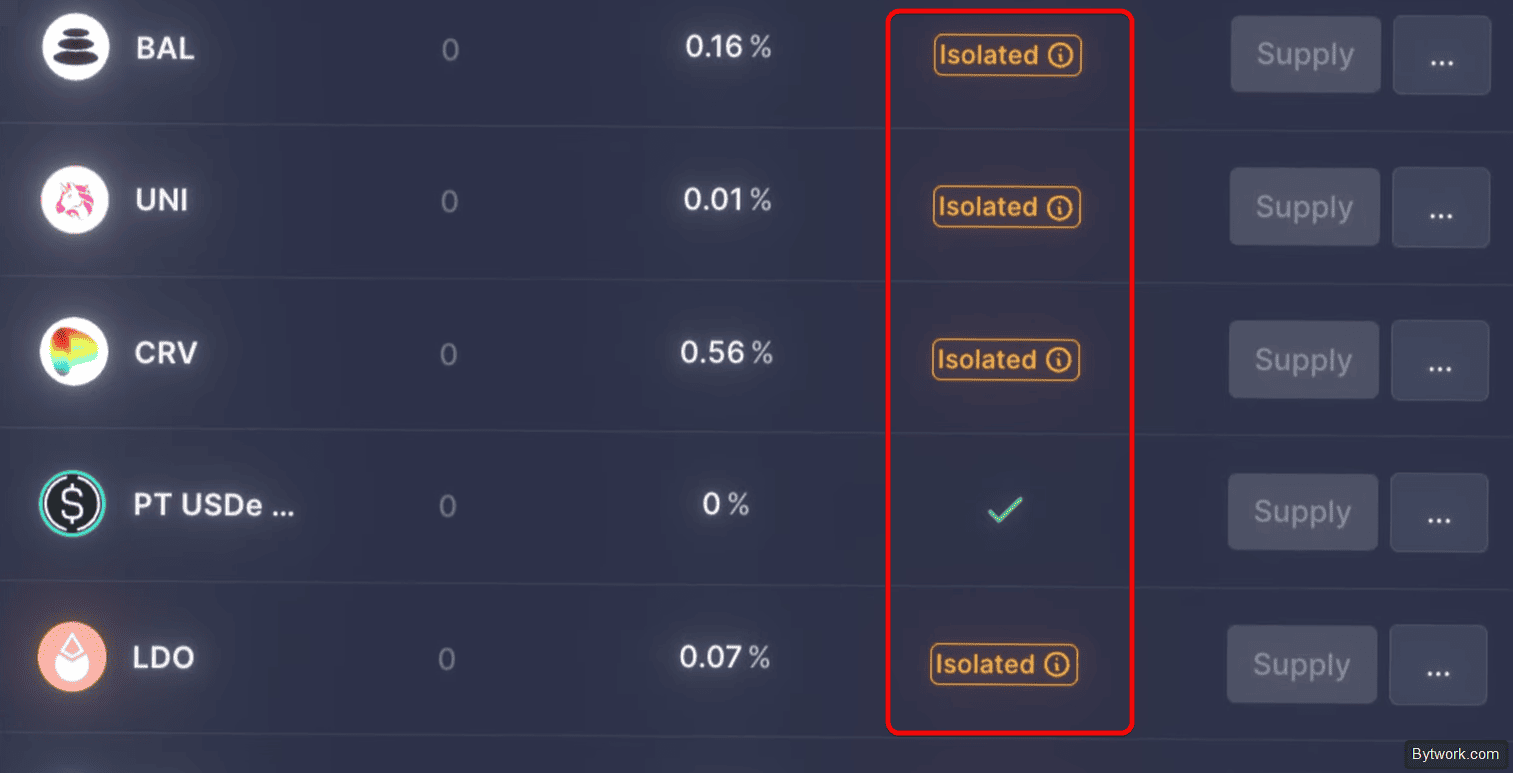
In this mode, you can only borrow specific stablecoins. Moreover, the isolated asset must be the sole source of collateral for that position.
Each isolated asset has a Debt Ceiling parameter - the maximum amount of stablecoins that can be borrowed against that particular asset across the entire protocol. Isolated collateral cannot secure unlimited debt, thus protecting the main pool from contagion risks.
How Does APY Dynamics Work?
Supply APY rates in the protocol are constantly changing. They directly depend on the utilization rate of a given pool (Utilization Rate). The higher the demand to borrow an asset, the higher the interest paid to liquidity suppliers.

High Utilization is beneficial if you want to earn maximum yield on deposits, but it makes borrowing expensive and risky for borrowers.
To estimate yields, you can look at historical average ranges for major markets.
Ethereum (ETH) offers conservative yield, typically around 1%–3% APY. Rates rise during periods of high network activity.
APY dynamics are as follows:
- Stablecoins (USDT, USDC, USDe) – traditionally the most rewarding base assets. Due to constant demand for leveraged trading, rates stay in the range of 3%–6% APY, sometimes going higher during bull markets. Regarding stablecoins, Aave is appropriately linked to Ethena because USDe from Ethena delivers 10–30% APY instead of the 3–6% on ordinary stablecoins.
- Wrapped Bitcoin (WBTC / cbBTC) has minimal yield (often near 0%). This asset is used mainly as collateral, not as a tool for earning supply yield, because demand to borrow it is extremely low.
Check current interest rates on the official website under the Markets section.
You’ve learned the theoretical part of using Aave. Now let’s look at practical usage, where you’ll see how to handle liquidations and analyze the health of a position.
How to Open a Position on Aave?
The first thing we do when entering Aave is connect a wallet. Go to app.aave.com, click Connect wallet, and choose the wallet you want to connect.
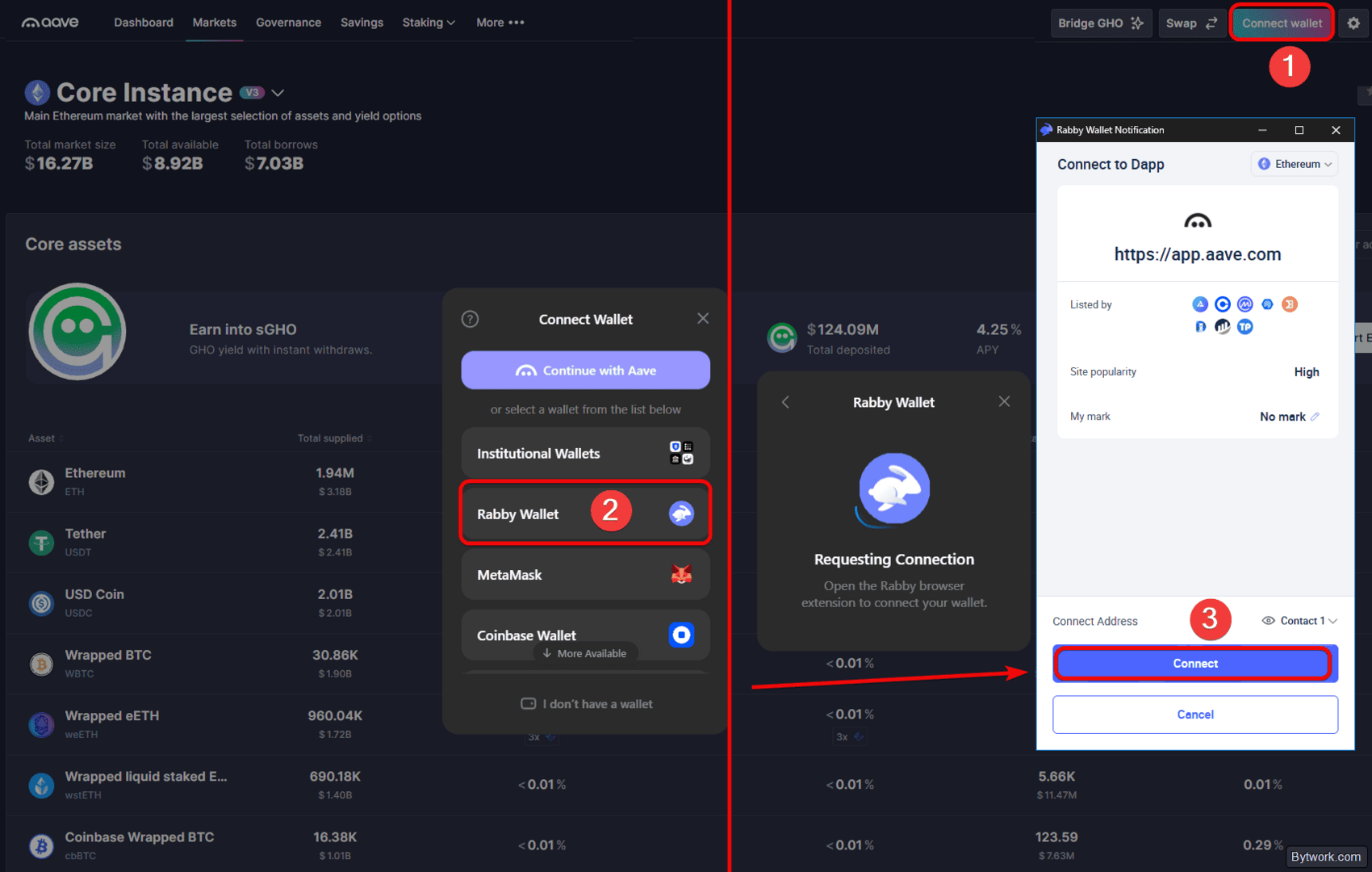
Step-by-step guide to Aave:
Step 1 - connect your wallet and select network
- Connect a non-custodial wallet (MetaMask, Rabby, Coinbase Wallet) to app.aave.com by clicking
Connect wallet. - Choose the network through the Aave interface. For capital < $5,000, use Base or Arbitrum. For larger amounts, Core Ethereum is suitable.
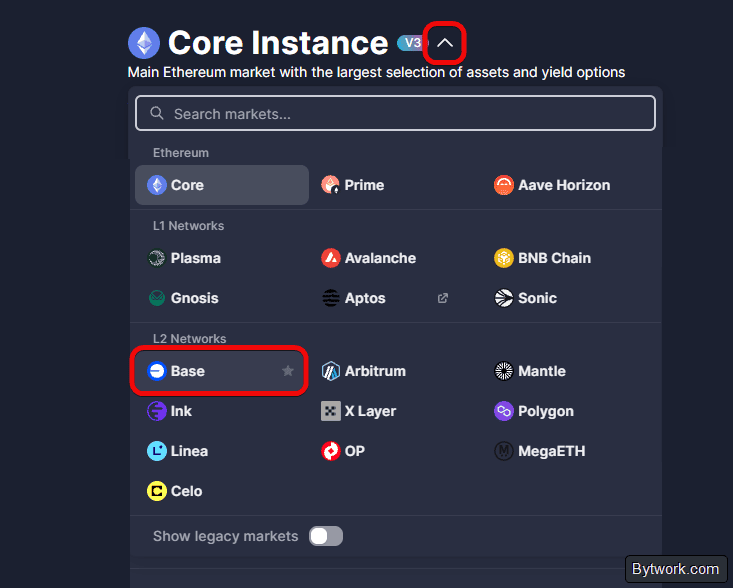
Step 2 - supply collateral
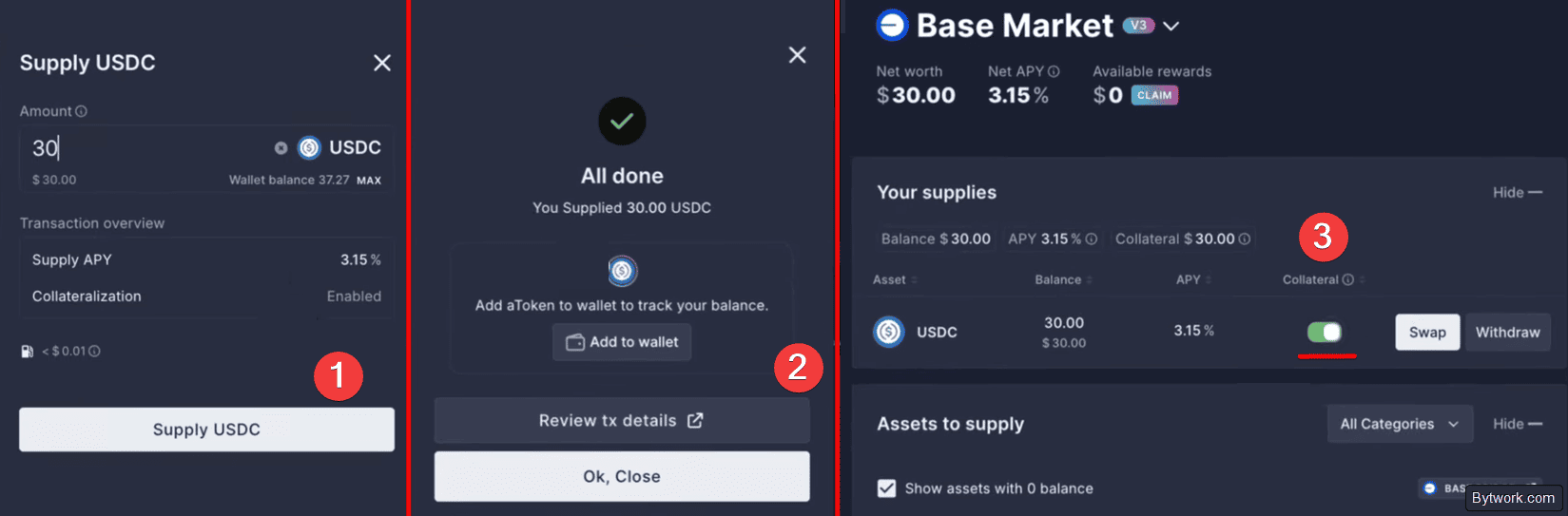
- On the Markets tab, select the asset to supply.
- Click
Supply. - Enter the amount. Always check the supply APY and the maximum LTV.
- Confirm 2 transactions:
- Approve transaction – to allow the protocol to spend tokens from your wallet.

- Supply transaction – the actual deposit into the pool.
5. Make sure the asset appears in the Your supplies section and is enabled as collateral (the Collateral toggle is active).
By the way, as ETH collateral, many use liquid staking tokens (LSTs) like rETH from Rocket Pool. This is because they let you participate in DeFi while also earning Ethereum staking yield.
Step 3 - take out a loan (Borrow)
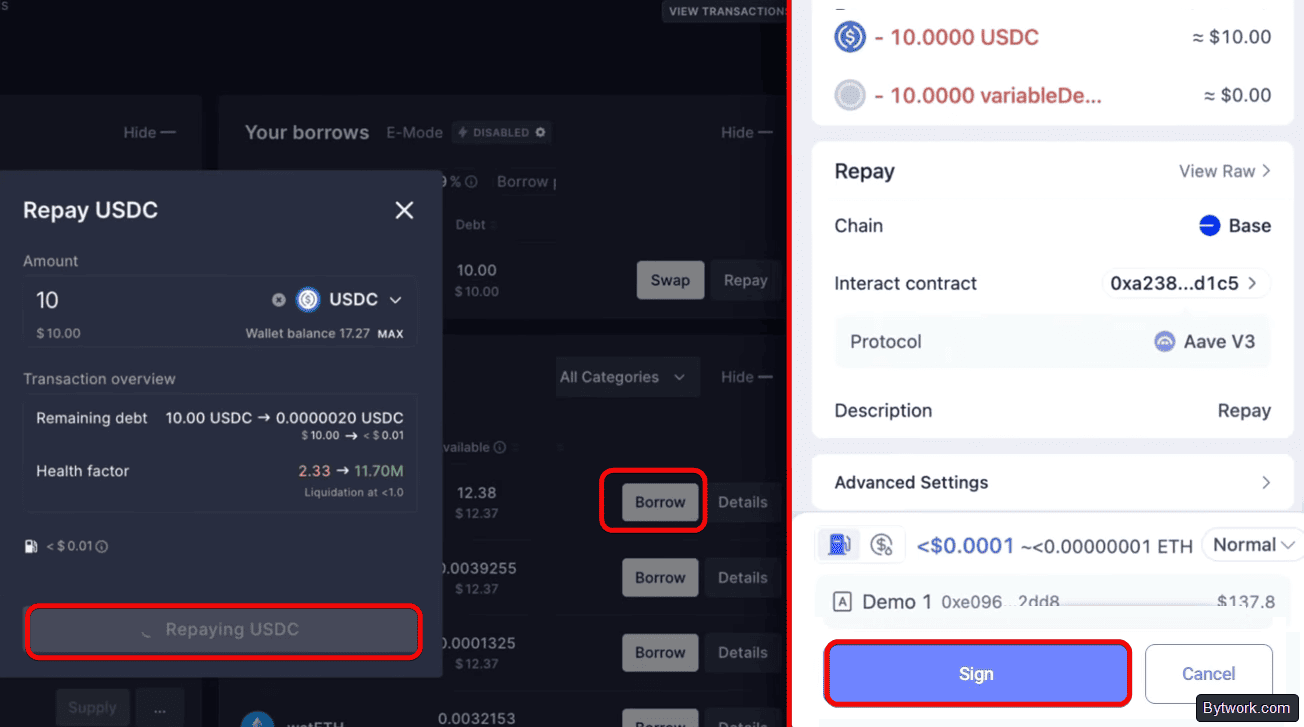
- Go to the
Borrowtab. - Select the same USDC or another asset (e.g., WETH).
- The system will show the available amount based on LTV. For a safe start, borrow no more than 30–40% of your maximum capacity.
- Enter the amount (e.g., 10 USDC with a deposit of 30 USDC).
- Sign the borrow transaction.
Step 4 - monitor your position (Health Factor)
The dashboard shows your current Health Factor. This indicator tells you how close your loan is to liquidation. Keep it above 1.5. When approaching 1.5:
- Add more collateral (
Supply). - Partially repay the debt (
Repay).

Step 5 - repay the loan and withdraw collateral
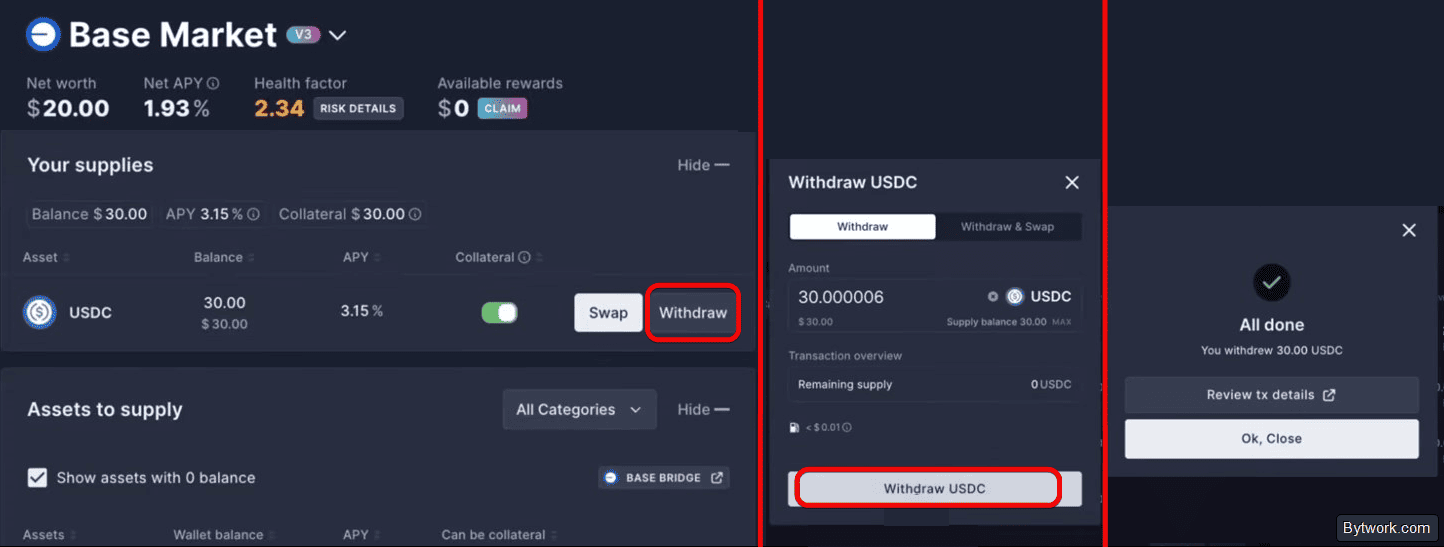
- Click
Repay, specify the amount (can be full). - Confirm the transaction.
- After the debt is cleared, click
Withdrawto withdraw your collateral.
With Aave, there are no minimum payments or set repayment dates. As long as you don’t approach liquidation, you’re fine and can keep the loan open indefinitely. The only thing to watch is that you never get close to liquidation.
LTV, Liquidation Threshold, and Health Factor
Before you learn about LTV and Health Factor, let’s make sure we all understand what liquidation means.
Liquidation is an event that occurs when the value of your collateral falls to an unsafe level, and Aave is forced to sell part of your collateral to repay your loan and restore a better health factor.
For example, if ETH drops by 30%, your collateral becomes cheaper, the debt remains, and the protocol sells assets. A liquidation penalty is applied (usually 5–10%), meaning you lose extra.
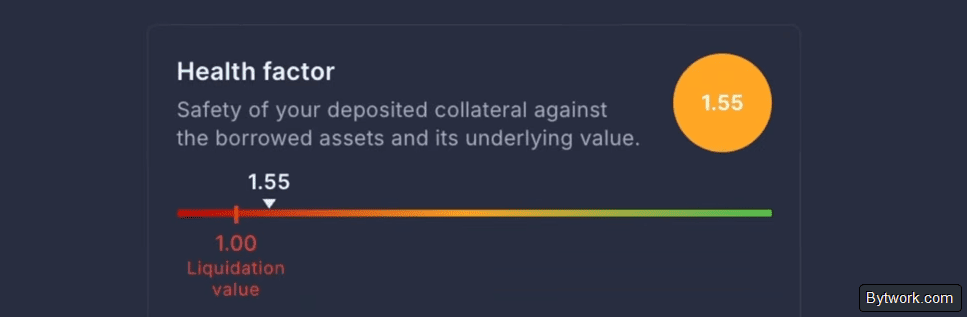
When Health Factor drops below 1.0, liquidation bots trigger within seconds, so it’s crucial to monitor and react early. It’s better to notice a drop from 2.0 to 1.55 and take action than to wait for 0.9.
Loan-to-Value Ratio (LTV)
LTV (Loan-to-Value) is the maximum percentage of your collateral’s value that you can borrow. Different assets have different LTVs. For example, Ethereum - 80%, USDC - 85%, and risky altcoins - 50%.
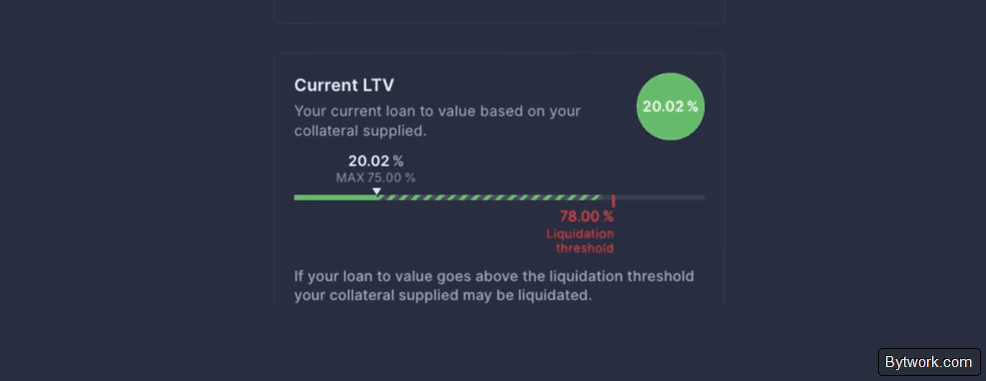
If your Loan-to-Value ratio exceeds the liquidation threshold, your collateral may be forcibly sold.
For instance, if you deposit $10,000 worth of ETH with an 80% LTV, you can borrow up to $8,000. However, we recommend borrowing no more than 50–60% of the maximum to leave a buffer in case the market moves against you. This allows you to add funds in time and avoid liquidation.
For a beginner, sticking to the official 80% loan‑to‑value recommendation ensures liquidation as soon as any volatility occurs.
Here’s the LTV formula:
Current_LTV = Borrow_Amount / Collateral_Value × 100%
Liquidation Threshold
The Liquidation Threshold is the critical ratio of debt to collateral at which your position becomes undercollateralized and subject to forced sale by liquidators.
Values depend on asset volatility and the chosen network:
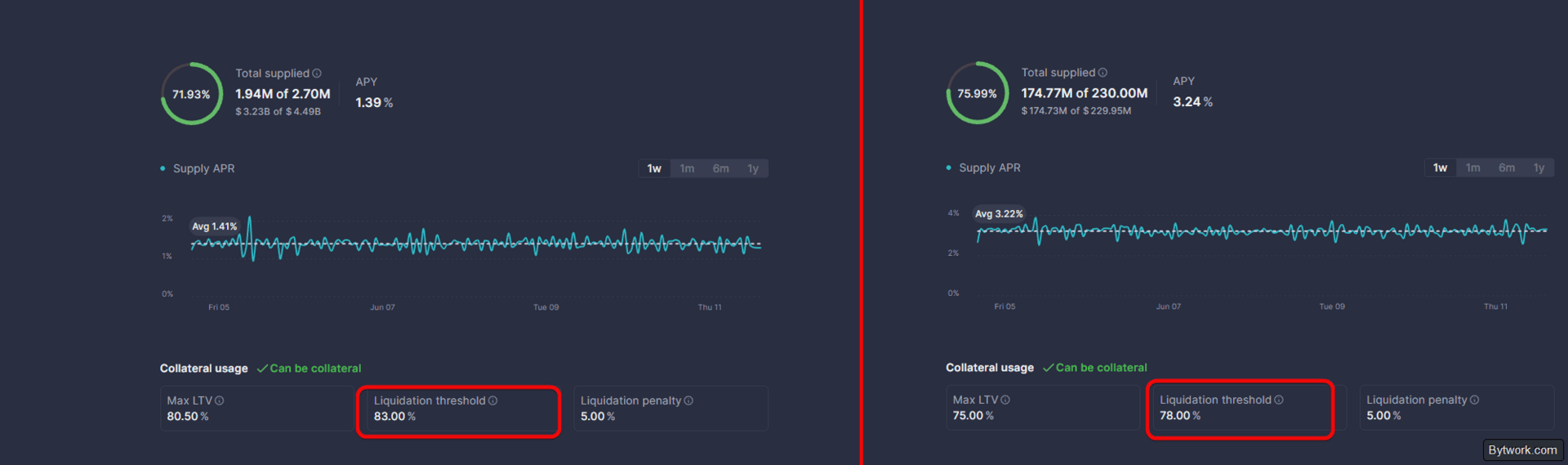
- Ethereum (ETH) - ~83%.
- Wrapped Bitcoin (WBTC) - ~78%.
- Stablecoins (USDC) - ~78%.
- LINK - ~71%.
- Polygon - ~73% of collateral value.
Experience shows that you should keep LTV no higher than 30–40% to have a sufficient buffer against sudden price crashes, especially in volatile crypto markets.
Here’s the liquidation price formula:
Liquidation_Price = Current_Asset_Price / Health_Factor
Health Factor (HF)
The Health Factor (HF) is calculated dynamically and changes every second based on market price fluctuations. There are generally accepted safety zones:

- HF above 2.0 (Green zone) – the position is considered safe with a good safety cushion against volatility. It is recommended to maintain this level to withstand price drops of 50% or more.
- HF between 1.5 and 2.0 (Yellow zone) – the position is moderately safe and requires attentive monitoring.
- HF below 1.5 – this is a risky zone. It is recommended to take action to improve the factor.
- HF = 1.0 and below (Liquidation point). This is the critical level. Once the factor reaches 1.0 or falls below, the position becomes undercollateralized, and the smart contract automatically allows liquidators to buy a portion of your collateral to repay the debt.
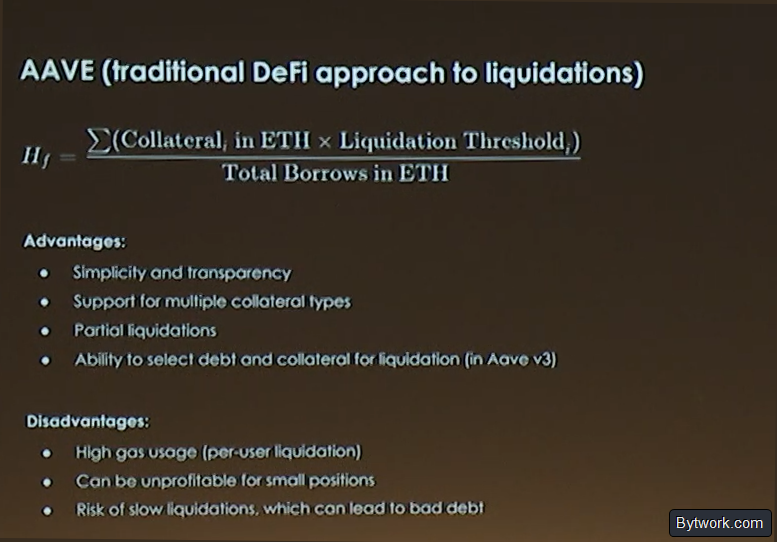
Here’s the Health Factor formula:
HF = Σ(Collateral_i × Liquidation_Threshold_i) / Total_Borrows
How to Calculate Liquidation Price?
Liquidation_Price = Current_Market_Price_of_Asset / Current_Health_Factor
For example, the current price of ETH is $3438, and your Health Factor is 1.96.
3438 / 1.96 = $1754
Thus, if the price of ETH drops to $1754, your Health Factor becomes 1.0 and the liquidation process begins.
Experienced players always keep a reserve of stablecoins in their wallet (not in Aave) to instantly raise HF via the Repay button if the market drops sharply.
Liquidation Mechanics and Penalties
Liquidations are carried out by specialized liquidation bots that monitor the blockchain and execute transactions within seconds after the critical threshold is reached. Bots activate when HF falls below 1.0.
The portion sold covers the debt plus a liquidation penalty - 5% for most assets. In eMode, the penalty can go up to 10%. The remaining collateral is returned after deducting the penalty.
It’s important to understand that during periods of high volatility, bots act faster than manual user actions.
Active DeFi investors check the Aave interface at least once a day just to glance at the HF number, especially if the collateral is a volatile asset like ETH or BTC. Because the “set and forget” strategy does not work in DeFi due to the dynamic nature of crypto.
Advanced Aave Strategies
Let’s look at 4 advanced ways to use Aave. Understanding these will help you determine which strategy suits you best.
1. Looping (Long ETH Position)
Looping is a DeFi strategy that allows you to multiply your returns and position size by repeatedly recycling collateral in cycles.
collateral -> borrow -> buy asset -> new collateral
The process is:
Supply– you deposit ETH (or its yield-bearing derivatives like wstETH) as collateral.Borrow– you borrow stablecoins (USDC or USDT) against that ETH.Swap– you use the borrowed stablecoins to buy additional ETH on a decentralized exchange (DEX).Re-supply– the bought ETH is again supplied to Aave, increasing your total collateral.Loop– the process is repeated several times (usually 3–5 cycles) to achieve the desired leverage level.
Simplified numerical example:
- You deposit $100 in ETH.
- You borrow $50 USDC and buy more ETH with it.
- Your new balance is $150 in collateral against $50 debt.
- If the price of ETH doubles, your collateral becomes worth $300. After repaying the $50 debt, your net capital is $250. This is better than simply holding $100 in ETH (which would have become $200).
However, the risk is that if ETH drops by ~40–50% from the entry point, liquidation will occur.
There’s a trick: if you use wstETH (staked ETH) as collateral and borrow ordinary ETH, the liquidation risk from price fluctuations is minimal because the assets move in sync.
However, looping strategies still suffer from low or unstable yields. The Pendle protocol solves this problem and also allows speculating on APY rates themselves, not just on asset price. This combination expands the boundaries of Aave usage.
2. Bullish Leverage (Yield Farming)
Unlike plain looping (where you just buy more of the same asset), Bullish Leverage aims to generate cash flow without selling your principal capital.
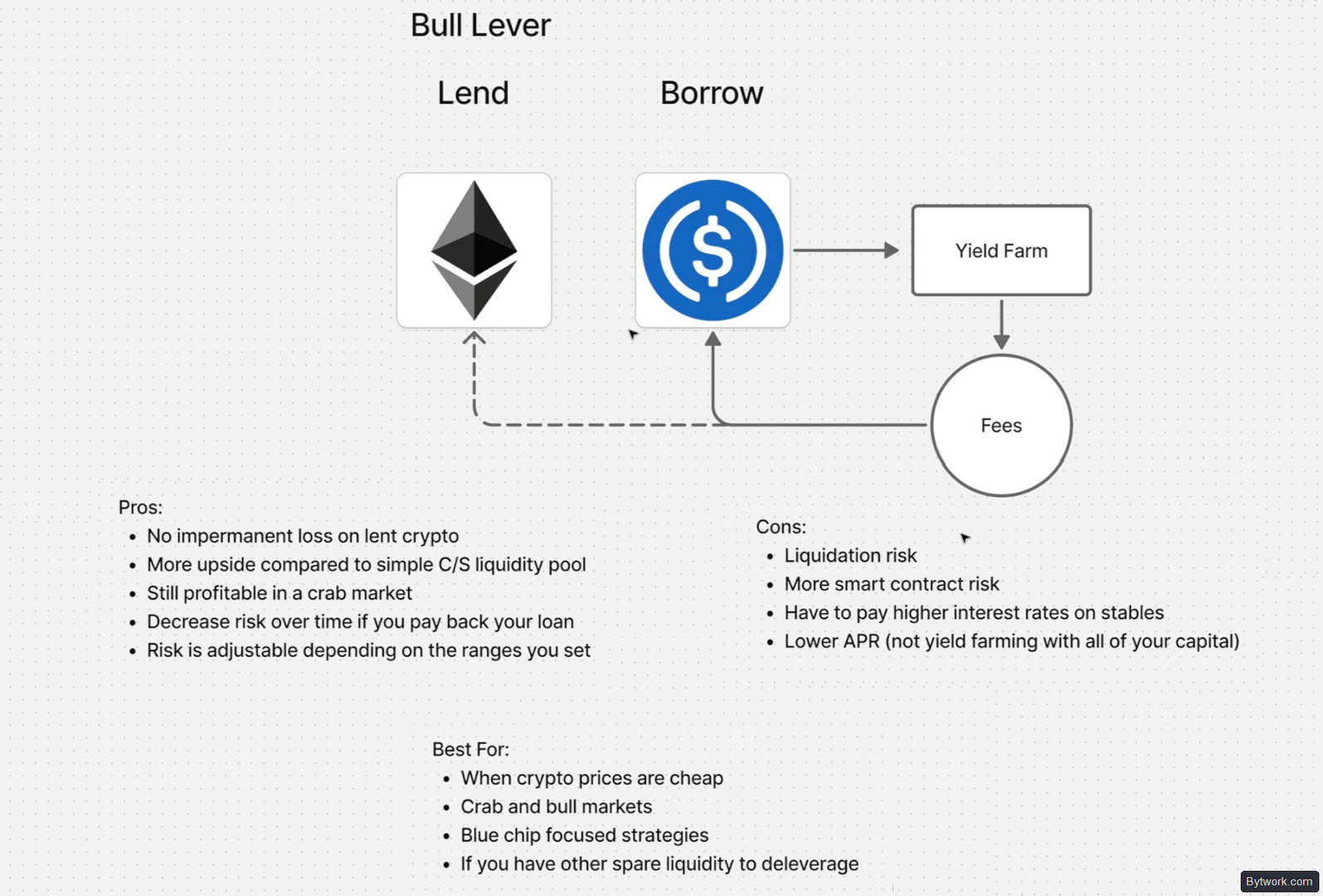
Supply– you deposit into Aave an asset you are bullish on (e.g., Ethereum or Wrapped Bitcoin).Borrow– you borrow stablecoins (USDC or USDT) against your deposited crypto.Yield Farming– you deploy the borrowed stablecoins into other DeFi protocols - liquidity pools (e.g., on Uniswap), yield aggregators, or airdrop opportunities.Profit– the farming income must exceed the interest rate on your Aave loan. For example, you borrow at 5% APY and deploy at 15–20%.
But there is smart contract risk from multiple protocols + liquidation risk if ETH crashes.
3. Bearish Leverage (Short ETH)
Unlike bullish strategies, here you profit when the asset price falls. The process:
Supply– you deposit stablecoins (USDC, USDT or DAI) as collateral into Aave.Borrow– you borrow Ethereum against your stablecoin collateral.Swap– you immediately swap the borrowed ETH for stablecoins on a DEX.Profit– if the price of ETH falls, you buy back the same amount of ETH cheaper than you sold it, return the loan to Aave, and keep the price difference as net profit.
But there is risk. If ETH rises, your Health Factor worsens. Combine this with crypto-crypto pools (e.g., WBTC/ETH) to hedge upside risk.
4. Yield Arbitrage (Stablecoin Carry Trade)
This strategy consists of borrowing a cheap asset (with a low interest rate) and investing it into an expensive asset (with a high yield).
Process:
- Look for opportunities. For example, a stablecoin with high Supply APY (USDT at 8% APY) and a stablecoin with low Borrow APR (e.g., DAI at 6% APY).
Supply(collateral) – you deposit existing assets (e.g., USDC) as collateral.Borrow– you borrow the cheap stablecoin (DAI).Swap– on a DEX, you exchange the borrowed DAI for the high-yield USDT.Re-supply– the USDT is supplied back into Aave to earn 8% APY.Profit– your net profit is the spread between the deposit yield and the borrowing cost (in this example, 2% APY), multiplied by your leverage.
Use eMode to increase leverage.
Remember the risk: if the Borrow APR suddenly jumps above the Supply APY, the position becomes unprofitable. That’s because rates on Aave are dynamic and depend on the Utilization Rate.
The Carry Trade strategy requires constant rate monitoring and a liquidity buffer to quickly close the position if market conditions change.
What Are the Drawbacks and Risks?
Aave V3 supports cross-chain operations, but moving assets through bridges carries risks. For instance, the Kelp DAO bridge exploit led to bad debt appearing simultaneously on Ethereum, Arbitrum, and Base. Aave itself was not hacked, but it accepted poisoned collateral (rsETH without real backing). Trust in the token collapsed, and the protocol urgently froze markets to stop a liquidity run.
The incident revealed the fragility of the chain of trust between bridges and lending protocols. In such crises, the DAO may socialize losses among users across different networks.
Based on our experience with the protocol, we have compiled all risks in the table below:
|
Risk Category |
What is it? |
Consequences |
|
Technical |
Vulnerability of bridges and third-party assets. |
Appearance of bad debt without real backing. |
|
Liquidity |
Risk of mass withdrawal of funds. |
Freezing of withdrawals from the protocol. |
|
Architectural |
Contamination of the common pool through one asset. |
Write-down of some balances to cover shared losses. |
|
Financial |
Automatic liquidation of a position when Health Factor drops. |
Loss of collateral and penalty on the loan amount. |
|
Interest rate |
Sharp spike in borrowing rates due to high demand. |
Strategies become unprofitable, debt grows quickly. |
|
Application |
Developers’ liability is limited to a cap of $1,000. |
Lack of insurance and risk of mandatory KYC. |
|
Strategic |
High sensitivity of eMode positions to de-pegging. |
Instant liquidation at the slightest price fluctuation. |
A method to protect against these risks is diversifying assets and constantly monitoring Health Factor, avoiding operating near the liquidation boundary.
Q&A
Let’s address the most popular questions we receive in comments on our YouTube, Telegram, and email.
Q. Can I lose my collateral on Aave?
A. Only if Health Factor drops to 1.0 or below, leading to liquidation. Otherwise, deposits remain withdrawable at any time.
Q. Is Aave safer than a centralized lender?
A. Aave is a non-custodial, overcollateralized protocol, but without deposit insurance. Smart contract risk replaces bank default risk.
Q. What is the minimum amount needed to profitably use Aave?
A. To work profitably on Aave, you need capital starting from $100 on cheap Layer 2 networks (Arbitrum, Base) or from $5,000 on Ethereum mainnet, so that accrued interest reliably exceeds network fees for depositing and withdrawing funds.
Q. Does Aave share data with tax authorities?
A. No. All transactions are recorded on the blockchain. Tax reporting is the user’s responsibility.
Q. Can I borrow without collateral?
A. No. Aave requires overcollateralization for all loans.
Time to sum up.
Summary
AAVE is a protocol where you can pledge assets (e.g., ETH) and receive stablecoins against them without selling your crypto. It’s important to understand that all assets in the shared liquidity pool are connected by common risks. The rsETH incident showed how bad debt from one asset impacts all users.
Therefore, before entering DeFi, establish risk management. Large capital is best split. For instance, part of our funds work in protocols and generate income, while another part is kept on a hardware wallet outside DeFi as a safety reserve. This isolates you from smart contract hack risks, which are not uncommon in DeFi.
Aave is convenient, offers many adjustable parameters, but is not without risk.
If you’ve mastered looping on Aave and want to increase yield without adding risk, the next step is Fluid. In the guide to Fluid, we detail how to set up looping with APY up to 15% and why combining Aave+Fluid mechanics creates synergy. But that’s about maximum capital efficiency, and we cover such mechanics in our DeFi guides.
Maksim Anisimov, exclusively for bytwork.com.
Disclaimer: all information provided in this article should not be considered financial advice! The article was created for educational purposes.


