Rocket Pool and a +11.2% Boost to Returns. The Complete Guide to Liquid Staking

You will learn how to properly stake on Rocket Pool, what yields different staking types offer, and how to safely operate while maintaining control over your private keys. Rocket Pool is changing the staking economy. Entry starts from 0.01 ETH or running a node with 4 ETH (4 times less than going solo). Node operators earn on average 10.5% more than solo validators thanks to pool commissions.
Let's start with the basics by understanding what this protocol is all about.
What is Rocket Pool?
Rocket Pool is a decentralized liquid staking protocol for Ethereum, launched in October 2021, where users have staked over 1 million ETH.
Only 0.1 ETH is required by the protocol to start liquid staking. This amount is pooled with ETH from other stakers. Each staker receives rETH tokens proportional to their deposit, while the remaining ETH is contributed by an investor who wishes to become a node operator.
Node operators run staking with 4 or 16 ETH, provided they post collateral in RPL tokens ranging from 10% to 150% of their ETH value. They receive a commission of ~14% from the ETH pool rewards and additional RPL payouts.
So, for liquid staking we use the rETH token, and for running a node – RPL. What are the differences?
|
Characteristic |
rETH |
RPL |
|
For whom? |
Regular investors (from 0.01 ETH) |
Node operators |
|
Function |
Liquid staking yield |
Security collateral and governance |
|
Yield |
Price appreciation relative to ETH (~3-4% APR) |
RPL rewards (~14% APR) and ETH commission |
|
Risks |
General protocol and smart contract risks |
RPL/ETH exchange rate volatility and slashing risk |
Below is a schematic representation of how the protocol works, using liquid staking (rETH) as an example.

Now let's look at the staking types in more detail to understand their differences.
What staking types are available here?
Rocket Pool offers 3 ways to participate:
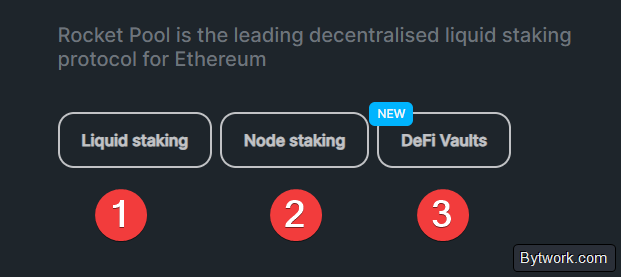
- Liquid Staking - a passive method without technical skills. You swap ETH for
rETH(a yield-bearing token that grows thanks to network rewards). Yield ~2.05% APY, entry threshold from 0.01 ETH. - Node Staking - running your own validator (minipool) starting from 4 ETH (instead of 32 ETH; the remainder is provided by liquid stakers). Yield is higher by ~13% due to pool commissions and the
RPLtoken. You can stake directly from a cold wallet. - DeFi Vaults – automated vaults that execute complex strategies with one click. Examples: MegaETH USDm Vault (~4.71% + airdrops), rETH Vault (~3.28% APR), Looped ETH Vault (~2.29% APR).
Here is a demonstration of DeFi Vaults and their terms:

Looped ETH is an auto‑looping strategy, for which we have a complete guide. It works well for those who are serious about diving into the intricacies of DeFi strategies and maintaining monitoring spreadsheets of their positions.
Let's take a closer look at the yields depending on the staking method.
How much does Rocket Pool yield?
Let's start with the simplest – liquid staking. It offers up to 2.05% APR.
The yield mechanism is as follows:
- You deposit 1 ETH into the pool and receive 0.859223 rETH in return.
- The exchange rate is 1 ETH = 0.859223 rETH and it constantly changes. Over time, 1 rETH will be redeemable for more and more ETH.
- Your profit is the difference in the exchange rate between the moment you buy rETH and the moment you swap it back to ETH.

Another method is running your own node. Here the stakes are higher:
- You earn ~3.83% in ETH on your ether.
- + You earn ~13.08% in RPL on your RPL tokens.
RPL is the utility and governance token of Rocket Pool for node operators (unlike rETH for liquid staking). It serves as collateral and rewards.

These are the classic rates. However, after the major upgrade called Saturn, the concepts of Combined APY and Theoretical RPL APY (21.42%) are introduced:

In the new model, part of the rewards that used to be paid only in ETH may be distributed among RPL holders who actively participate in voting and security provision.
And Combined APY of 11.20% is the calculator's attempt to bring everything to a common denominator. The calculator's mechanics are as follows:
- It takes your ETH staking yield (4.05% APY).
- Adds to it the yield from staking 3174 RPL (which in this example is very high – 21.42% in ETH equivalent).
- The result is a weighted average yield on your total capital (ETH + RPL) of 11.20%.
However, it is important to understand that the RPL token is volatile relative to ETH. Price fluctuations affect the collateral ratio and may require buying additional tokens to maintain the 10% minimum.
Now let's compare the yields and nuances of the staking methods.
|
Parameter |
Liquid Staking |
Running a Node |
|
ETH yield |
~2.05% |
~3.83% |
|
RPL yield |
0% (not required) |
~11%-13.08% (mandatory) |
|
Difficulty |
Simple swap (like buying a token) |
Server setup and 24/7 maintenance |
|
Entry threshold |
From 0.01 ETH |
Minimum 4 ETH + RPL collateral |
Running a node certainly yields more. That's an extra 10.5%–13.08% commission from the rewards of regular stakers. However, running a node is technically complex. By the way, here we covered running a node on Linux using Bitcoin as an example.
Which staking method should you choose?
The choice of staking method depends on your capital and technical skills. Here are 3 options:
- The simplest – if you just want to hold ETH and earn, choose
Liquid Staking. - Intermediate option – if you need maximum automation and compound interest, choose
DeFi Vaults. - The most complex – running your own node. If you have the technical know-how, choose
Node Staking.
Now it's time for practice. Let's launch liquid staking.
How to start liquid staking?
Go to the Rocket Pool website, click Launch, and you will be taken to the protocol page. Here you need to connect a browser Ethereum wallet containing some ETH to swap for rETH.

If you don't have a wallet yet, use the guides for setting up MetaMask and Rabby – popular Ethereum wallets.
After connecting the wallet, the protocol will see your ETH balance. Click Stake, check the details of the contract interaction and confirm the swap. You will send your ETH and receive rETH in your wallet.

After clicking the Stake button, confirm the transaction in your wallet. It will show all the transaction details, as shown on the left.

That's it. I have performed liquid staking. After receiving rETH, you start earning commissions, and because it's a liquid staking token, you can send it, trade it, or unstake it.
How to withdraw funds?
To unstake, go to the same Rocket Pool application, click on your wallet address in the top right corner, then select Unstake.

You will see your rETH balance and can choose the amount to withdraw.

First you need to approve the use of tokens (Approve Swap Router), and only then perform the swap itself as the second step.
Remember that you always need a small amount of ETH for gas fees.
What are the drawbacks and risks?
The risks of Rocket Pool are related to insufficient liquidity of rETH when exiting, dependence on the RPL collateral token, and non-obvious technical limitations of the interface. All of this is especially critical for small stakers and node operators.
Risks of liquid staking:
|
Risk type |
Essence |
Details |
|---|---|---|
|
Withdrawal liquidity |
Swapping rETH for ETH through the protocol is only possible if the pool has funds |
Otherwise you have to use a DEX with slippage and unfavorable rates |
|
Market volatility of rETH |
During panic, the price of rETH on exchanges drops below its actual value |
Due to limited DEX liquidity |
|
Dependence on third-party systems |
Routes like CoW Swap carry risks outside Rocket Pool's control |
Routing errors, incorrect quotes |
|
DeFi risks |
Using rETH in vaults or lending |
Protocol hacks, oracle errors, position liquidation |
|
Tax traps |
Swapping ETH for rETH is considered a sale of an asset in some countries |
Capital gains tax at the time of the transaction |
|
Testnets |
Sending real ETH to a test network |
Will result in permanent loss of funds |
Risks for node operators, running and maintaining a node:
|
Risk type |
Essence |
Details |
|---|---|---|
|
Slashing |
If the node behaves incorrectly, the Ethereum protocol destroys part of the staked ETH |
Up to 32 ETH irreversibly |
|
Hardware requirements |
Future upgrades may increase requirements |
64 GB RAM and 4 TB SSD |
|
Bandwidth |
High speeds are needed for local block building |
75–150 Mbit/s upload |
|
Setup complexity |
Running a node requires skills and time |
Knowledge of terminal commands |
|
Stake on behalf |
Withdrawals always go to the node's main address |
Mistake in the withdrawal address – loss of access to funds |
It is important to understand that the Rocket Pool protocol itself has never been hacked. Between September 2023 and March 2024, a phishing attack on individual users resulted in the theft of about $24 million.
In January 2024, the project's official X account was compromised and used to post phishing links.
What is the current state of protocol development?
The protocol is evolving; here is what the developers are doing:
- Rocket Pool has reduced the minimum node operator bond from 8 to 4 ETH, while simultaneously cutting their commission to 5%. However, the operator's net income has increased due to the expansion of the overall liquidity pool.
- Inflation of the RPL token will be reduced from the current 5% to 1.5–2.5%, and the protocol's ETH rewards distribution will be directly tied to the total volume of staked assets.
- The Saturn 2 upgrade introduces a mechanism for forced node exits via the execution layer. Yet this runs counter to the principle that mass account deactivations are impossible under decentralization.
- A strict withdrawal buffer priority has been implemented: as long as the buffer volume remains below the set threshold, the protocol blocks the creation of new validators and channels all deposits exclusively toward ensuring instant withdrawals.
Conclusion
This is the first protocol we started working with in DeFi 3 years ago. Yes, it's not the most profitable, but it has never been hacked.
It is also the simplest option. Rocket Pool allows you to stake ETH from 0.01 ETH via the rETH liquid token, which automatically appreciates against ETH thanks to staking yield.
More complex – running your own validator. It requires 32 ETH, so the protocol delegates pool funds to over 1,500 independent node operators, each of whom previously contributed 8 ETH, and after the Saturn 1 upgrade – only 4 ETH (the remaining 28 ETH come from the liquid pool).
If you run your own node, remember that penalties are possible if the node goes offline. That's why we set up an alerting system. Grafana Unified Alerting will work.
An alternative method – buying rETH on L2 networks (Arbitrum, Optimism, Base, Polygon). You don't need to click the Stake button – you simply hold the purchased rETH in your wallet, and it continues to appreciate against ETH by about 3% per year due to validator rewards. You can obtain the token through decentralized exchanges like Uniswap or Maverick that operate on these networks.
Risks include slippage and low liquidity on some L2s, as well as the possibility of counterfeit tokens and smart contract vulnerabilities.
Study the available strategies, conduct your own research, and always thoroughly understand the mechanics of both the protocol itself and the assets you invest in. Don't miss our guide on DefiLlama for analyzing and finding DeFi protocols.
Maxim Anisimov, exclusively for bytwork.com.
Disclaimer: this is not financial advice; always do your own research.


