SUI Price Prediction 2026-2030. Diverse Opinions and Scenarios

In this article, we have gathered opinions from analysts, companies, experts, exchanges, and bloggers about the future price of the SUI cryptocurrency.
What is the foundation of SUI built on?
SUI stands out from competitors due to three technologies: security, speed, and simplicity. How is this achieved fundamentally?
Sui is a decentralized layer-1 blockchain that uses a Delegated Proof-of-Stake consensus mechanism and the Move programming language. The essence of SUI is its excellent scalability for use in AI, DeFi, and gaming. The native SUI token is used to pay gas fees and for staking, yielding an average of 3% annually for securing the network.
Let's look at the fundamental differences of SUI from competitors.
| Technology and description | Advantages |
| Move programming language Object-oriented language from Meta. Assets as non-fungible resources. |
Eliminates attacks (unlike Solidity). 954 active developers/month (leader, twice as many as Aptos). |
| Mysticeti protocol (v2) Sub-second transaction finalization. |
390–480 ms (10 ms faster than Solana). Theoretically up to 297,000 TPS. Ideal for DeFi/gaming. No failures/congestion. |
| Authorization via ZK login Private login via Google/Facebook/Twitch/Apple. |
Stores private data off-chain |
For a forecast, it is important to understand the project's tokenomics, i.e., how many tokens there are, when they are distributed, and how they are distributed.
What is the supply, tokenomics, and TVL?
The Sui network launched with a total maximum supply of 10 billion tokens and has a circulating supply of about 3.9 billion.
Token distribution of SUI is as follows: 36.5% allocated to community reserve, 21.14% to early contributors, 12.4% to Mysten Labs treasury, and finally 10% to stakers.

Another important metric is Total Value Locked (TVL) - a fundamental indicator of trust in the SUI ecosystem and a driver of token value growth. Liquidity growth in DeFi protocols directly impacts market growth.
The historical TVL trajectory of the SUI network shows a rapid rise: from a modest $40 million in October 2023 to $600 million in March 2026.
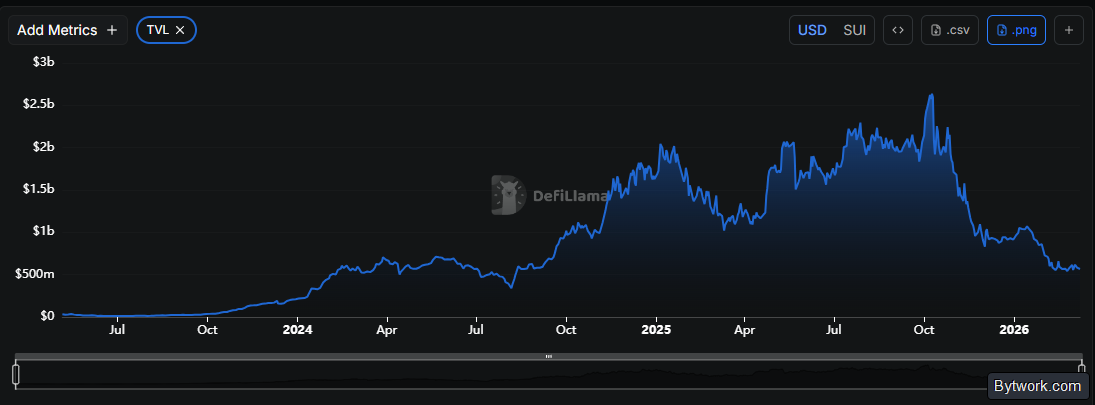
SUI is in the top 15 blockchains by TVL. The SUI network is anchored by key DeFi protocols that attract the majority of capital. For example, NAVI Protocol is a leader in lending and liquid staking. It incentivizes using SUI as collateral, removing tokens from circulation.
Another example is DeepBook - a decentralized central limit order book (CLOB) that creates deep liquidity for the entire network and attracts pros due to high transaction speed.
The remaining tokens will be unlocked over time according to the unlock schedule, with the planned period lasting until 2030. This is something an investor should be aware of.

The conclusion is that deep liquidity in DeFi protocols serves a critical function - it helps the market absorb regular token unlocks (about 64 million SUI monthly).
To fully understand price formation, one must understand the concept of the SUI Storage Fund. It reduces the available supply of SUI. Some tokens are permanently removed from circulation, while another part is locked for a long time. The more active the network (more transactions, contracts), the more tokens flow into the Storage Fund - this creates deflation and increasing de facto scarcity of SUI.
Having understood all the nuances of tokenomics, we can move on to predictions.
Bearish forecast - $1.20 - $3.00
The catalyst for the bearish scenario is disappointment in the performance of spot SUI ETFs. For example, the launched Grayscale Sui Staking ETF may simply fail to attract attention. If the inflow of regulated capital is insufficient to offset market supply, the asset will remain in a downtrend or enter prolonged stagnation.
Another important factor is the token issuance schedule. SUI may face pressure from the monthly issuance of 64 million tokens amid low demand and competition from Solana and new networks like MegaETH.
Technically, failure to hold above $1.00–$1.05 opens the way for a correction to the $0.85–$0.90 zone. In the worst case, due to competition and weak inflows, the price could go to $0.50–$0.80.
Let's move on to another scenario with TVL inflow.
Base scenario - $4.50 – $10.00
The base forecast assumes SUI will rise to $4.50 in 2026. By 2029, $10.00 is expected, and $15.00 by 2030. Growth conditions are TVL recovery above $2 billion, growth in spot ETFs, and market dominance up to 0.8%. All this, with a total market cap of $7 trillion, would give a price of $13.33.
Monthly token unlocks of 64 million SUI will be absorbed by demand for gas and staking, and the network should enter the top 15, becoming a hub for AI finance and implementing its own stablecoin.
Optimistic scenario - $20-$30 upon reaching Solana's market share
You will see such growth if the project captures a market share like Solana's. The math is: at a market cap of $75 billion (Solana's level), the price of SUI will reach $20. If the market grows to $9 trillion and SUI's share is 1%, the market cap will rise to $90 billion - the price in this case would be $21.42 per token.
What else justifies this? The foundation for a price above $20 is sustained growth in total value locked (TVL). Surpassing the $1 billion threshold and the operation of the launched USDsui stablecoin with a buyback mechanism could create a structural deficit of tokens in the market.

The success of the bullish scenario depends on expansion into the GameFi and AI agent sectors.
We view the launch of the Sui Play portable gaming console as a Trojan horse to attract millions of users from Web2. This will be possible thanks to simplified authorization via ZK login technology.
Now let's look at different points of view.
What do experts say?
First, let's look at analytical platforms. These sources rely on fundamental analysis of the ecosystem, technological updates, and macroeconomic models.
Table 1: Forecasts from analytical companies and platforms.
|
Analytics |
2026 targets (Min / Avg / Max) |
2030 targets (Min / Avg / Max) |
|
$1.20 / $4.50 / $7.50 |
$4.00 / $15.00 / $30.00 |
|
|
$2.00 / $4.50 / $7.00 |
$12.00 / $15.00 / $18.00 |
|
|
$5.16 / $7.21 / $9.26 |
$12.63 / $18.20 / $23.77 |
The average consensus forecast from 3 analytical sources suggests SUI will rise to $5.40 by 2026 and to $16.07 by 2030.
The range of targets is extremely wide: from $2.79 to $7.92 in 2026 and from $9.54 to $23.92 in 2030. And that's the usual high crypto volatility.
Next, let's look at exchange forecasts. They often rely on technical indicators and current market liquidity.
|
Exchanges |
2026 targets (Min / Avg / Max) |
2030 targets (Min / Avg / Max) |
|
$1.60 / $2.82 / $4.03 |
$3.17 / $4.58 / $5.98 |
|
|
$0.85 / $1.40 / $2.20 |
$3.20 / $5.60 / $8.50 |
|
|
- |
$5.00 / $10.00 / $20.00 |
The average consensus forecast from 3 exchanges suggests SUI will rise to $2.11 by 2026 and to $6.73 by 2030.
Many websites, bloggers, and influencers compare SUI's trajectory to Solana's success in the previous cycle. Let's look at bloggers' opinions.
|
YouTube |
2026 targets (Min / Avg / Max) |
|
Alexey Rudenko |
$3.50 / $7.00 / $20.00 |
|
Ran Neuner |
$3.50 / $10.00 / $20.00 |
|
CryptoMatt |
$2.85 / $5.00 / $10.00 |
|
Crypto 4Light |
$6.21 / $6.68 / $7.75 |
|
Gordon Frayne |
$8.33 / $13.33 / $21.42 |
|
That Martini Guy |
by 2030, the price of SUI could reach $20. |
|
Crypto.ru |
$0.82 / $0.95 / $1.03 |
Now, if we examine the consensus of all sources, the conclusions are as follows: in the short term (2026), analysts expect market consolidation with attempts to hold above the $1.00 level. For you, this means base targets with market stabilization are $1.50-$3.00. In an optimistic scenario, growth could reach $5.00.
The medium-term outlook (2027-2030) looks more ambitious. Experts see SUI's potential to reach Solana's levels. If the Move ecosystem becomes dominant, targets of $10, $20, and even $30 cease to be fantasy!
Some analysts look even further. By 2040-2050, extremely bullish forecasts appear - above $30. Such scenarios are based on the hypothesis of SUI becoming a global digital commodity.
Now let's consider why bullish forecasts may not come true.
What are the risks?
SUI, like all crypto, is a high-risk asset. Despite optimistic forecasts, there are a number of serious risks that could limit growth or lead to a decline.
The main risk for SUI is tokenomics: only 39% (3.9 billion) of the total supply is in circulation, and monthly unlocks of 64 million coins will continue until 2030, putting pressure on the price.
Also, the gap between the market cap of $6-7 billion and the FDV of $16-17 billion creates a psychological barrier to price growth.
Technical risks are confirmed by the drop in the number of full nodes from 2000 to 500 and a previously discovered critical bug in the Move language. The hack of Cetus Protocol on May 22, 2025, became the largest incident in the history of the Sui ecosystem, resulting in the theft of about $223 million.
The next risk is centralization. The entry threshold for a validator is 30 million SUI (over $30 million). At the same time, key products are developed by structures affiliated with the founders.
Finally, network activity has dropped by 50% since mid-2025, and positive funding rates in a downtrend threaten cascading liquidations down to $0.50.
Ultimately, SUI's success will depend on whether institutional inflow (ETF) and real usage growth outweigh the pressure from unlocks.
On the other hand, SUI has major support.
How do major players support SUI?
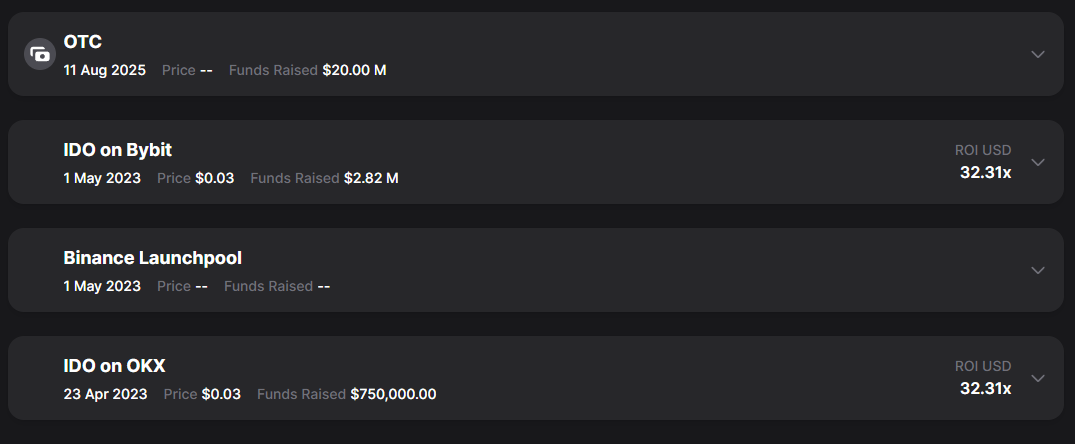
Institutional support for SUI comes from funds such as Binance Labs (participant in the $300 million Series B round), Coinbase Ventures, and Franklin Templeton. Exchanges Bybit and OKX are also interested in the project.
Coinbase acts as broker and custodian for the Grayscale spot ETF (GSUI), and Franklin Templeton runs validators on the network.
Thanks to demand from ETFs and support from Tier-1 funds, the market is able to absorb monthly unlocks of 64 million SUI.
SUI, Aptos, or Solana: who does the market need?
SUI and Aptos share common DNA - they were launched by former Meta* (Facebook) engineers who worked on the closed blockchain project Diem (Libra). Aptos appeared earlier and was initially valued by the market at a similar level to SUI. Both projects compete with Solana for the status of the fastest L1 blockchain.
As of 2026, SUI attracted 954 active developers per month (more than double Aptos), and its TVL reached over $600 million. All this against $300 million TVL for Aptos.
However, Solana holds a strong lead in non-EVM networks with over 40% of TVL.

Despite this, SUI surpasses Solana in theoretical throughput - 297,000 vs 65,000 TPS, and transaction finalization takes 390–480 ms. Speed is important in DeFi protocols. SUI strengthens the Solana killer narrative through the migration of protocols like Solend to Suilend, the SuiPlay console, and a focus on speed for AI agents.
At the same time, Solana suffers DDoS attacks, and many Solana users remember that the project has stopped network operations several times.
However, the SUI network also went down in 2026. Downtime was recorded at about 6 hours. In the crypto environment, this is considered unacceptable, as the network should always be operational. During the stoppage, over $1 billion in locked assets were frozen, but user funds were not affected.
What are the conclusions?
The SUI network attracts 954 active developers monthly - twice as many as Aptos - and leads in DeFi, Agentic Finance, and gaming with Sui Play.
Also, SUI, together with a Stripe subsidiary, launched its own stablecoin USDsui, the issuance income of which is directed to buy back SUI tokens from the market. This creates structural demand and helps absorb inflationary pressure from regular unlocks.
It is also important to consider open interest for SUI because this interest shows investors' intentions.
SUI's object-centric architecture with parallel transaction execution enables instant updates of independent positions, and this is critically important for autonomous financial operations of AI agents. This is enhanced by the Mysticeti v2 update, which reduced transaction finalization time to 390–480 ms compared to 13 seconds for Solana during periods of congestion.
At the same time, the network was halted in 2026, and this once again reminds us of the risks in the crypto wild west.
This material is for informational purposes only and is not financial advice.

Now reading


In DePin, people create networks themselves, share traffic or capacity, and receive rewards in tokens from these projects.





The Ellipal firmware update enhances security (fixes vulnerabilities), adds support for new cryptocurrencies and tokens, and optimizes the interface and operational stability.


