Lido Finance Review - an honest breakdown of fees, yields, and security

You will learn how to launch staking on Lido in 3 clicks, how to safely maximize returns with stETH, and which hidden risks (from depeg to smart contracts) you need to consider. We will also cover 3 DeFi strategies.
Protocol Overview (Essence)
Lido Finance is a liquid staking protocol that locks cryptocurrency in Ethereum and issues stTokens in return at a 1:1 ratio, allowing the owner to freely sell or use them in other DeFi protocols without waiting for assets to be unlocked.
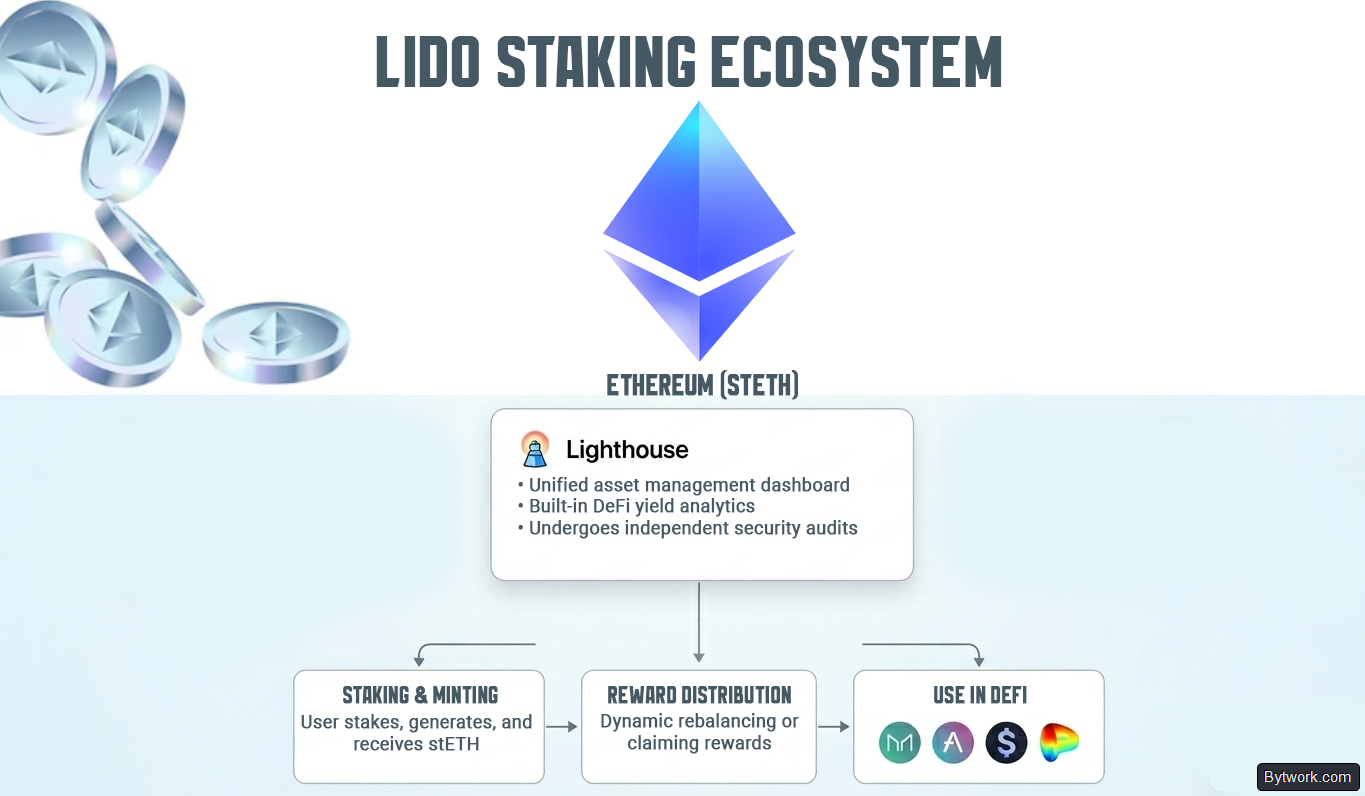
Lido Finance controls about 22–24% of all staked ETH, and its treasury net operating income averages between $30 and $37 million per year.
- Lido distributes rewards to stETH holders once a day at 12:00 UTC, keeping a 10% fee.
- Deposits are pooled in the Lido Buffer smart contract for instant withdrawals.
- Excess assets from the buffer are automatically directed to launch new validators, bypassing the Ethereum queue.
What is Liquid Staking and How Does Lido Work?
Liquid staking allows you to earn passive income by locking cryptocurrency, while receiving a tradable equivalent (receipt token) in return that you can freely sell or use in DeFi. In this case, you receive stETH – a token whose balance grows daily due to staking rewards. The original ETH remains locked during staking.
However, some DeFi platforms do not support stETH. For these protocols, stETH is wrapped into wstETH. This token has a fixed balance, but its value appreciates over time relative to ETH.
What is the Mechanism of Staking ETH?
- Deposit. You deposit ETH and instantly receive stETH 1:1 – a token confirming your right to the staked funds.
- Delegation. Funds are distributed among verified node operators approved by Lido DAO. They ensure network security but do not have access to your assets.
- Rewards. Your stETH balance grows daily. For DeFi protocols, the wrapped token wstETH is used – its quantity is fixed, but its price increases relative to ETH.
- Fees. The protocol takes 10% only from earned rewards – 5% goes to node operators, 5% to the DAO treasury.
- Withdrawals. You can swap stETH for ETH via the protocol (with a waiting queue) or instantly sell it on DEX (Curve, Uniswap).
How is Income Distributed?
|
Participant |
Share of Rewards |
Purpose |
|
stETH Holders |
90% |
Direct staking income |
|
Validators (Node Operators) |
3.5% – 5% (depending on the module) |
Compensation for infrastructure costs, rewards for independent and professional operators |
|
Lido DAO Treasury |
~5% – 6.1% (remainder of the 10% fee) |
Development funding, operational costs, insurance fund (slashing protection), new ecosystem modules |
Which Assets and Networks Are Supported?
Support for all alternative layer‑1 blockchains (Solana, Polygon PoS, Kusama/Polkadot) has been completely discontinued by Lido DAO decision to focus on Ethereum.
|
Network / Ecosystem |
Token |
Token Type |
Status and Usage Features |
|
Ethereum (Mainnet L1) |
stETH |
Rebasing |
Base token. Wallet balance automatically increases daily as rewards accrue. |
|
Ethereum (Mainnet L1) |
wstETH |
Non‑rebasing (Wrapped) |
Wrapped version of stETH. The token amount is fixed, but its price rises relative to ETH. Used for integration into DeFi protocols. |
|
Layer‑2 Networks (Ethereum L2) |
wstETH |
Non‑rebasing (Wrapped) |
Official Lido bridges transfer only the wrapped version (wstETH) to L2 networks to avoid technical issues due to daily rebasing. |
What are the Financial Metrics?
Lido consistently leads in TVL among DeFi protocols, surpassing Aave and EigenLayer. TVL typically ranges between $15–25 billion. In terms of staked ETH, that's about 9–9.5 million ETH (all‑time high ~10 million ETH).
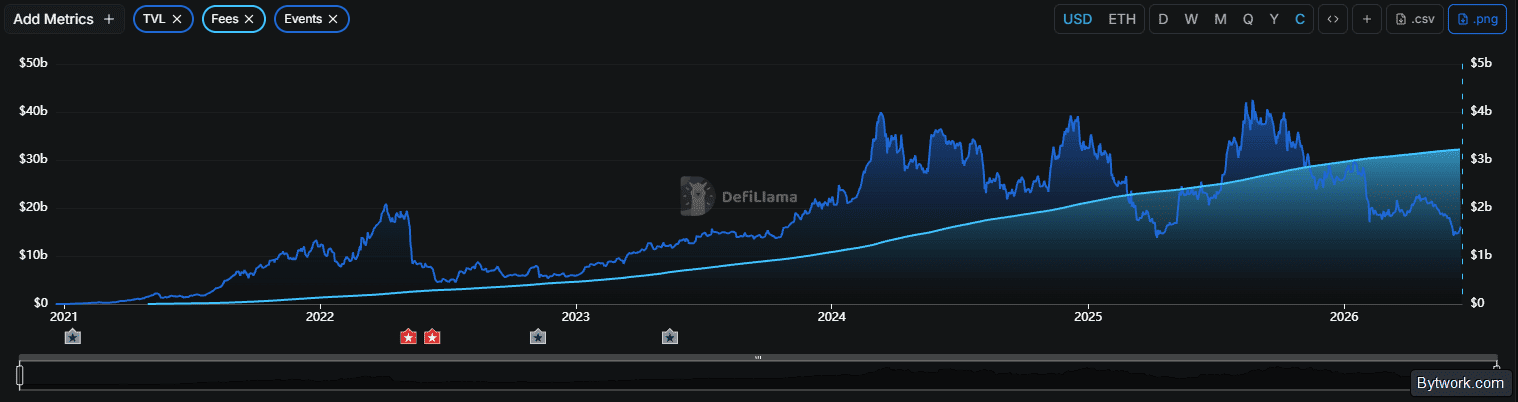
The protocol generates roughly $35–45 million in monthly fees (~$400–500 million annually), of which about $2.5–3 million per month (~$30–36 million per year) goes to the DAO treasury.
Who Dominates the Ethereum Staking Market?
Brief competitive analysis of ETH staking:
|
Metric |
Range |
Context and Trend |
|
Total ETH staked |
35–40 million ETH |
About 30–33% of supply; steady capital inflow. |
|
Lido's market share |
22–24% |
Market leader; share declining from peaks (>30%) due to DeFi competitors. |
|
Closest competitor (Binance) |
8–10% |
Leader among CEXs; lags behind the decentralised sector. |
|
Lido vs Binance gap |
2.4–2.6x |
Lido consistently holds more than a twofold lead. |
|
Restaking share (LRT) |
5–7% (ether.fi) |
Major market driver; capturing share from traditional staking. |
Lido maintains its leadership in Ethereum staking with a 22–24% share and a twofold lead over Binance, however its position is gradually weakening due to the growth of the liquid restaking (LRT) sector.
Security and Audits
Security is confirmed by the fact that the core Lido Finance smart contracts and user funds have never been hacked or stolen. The security measures in place include:
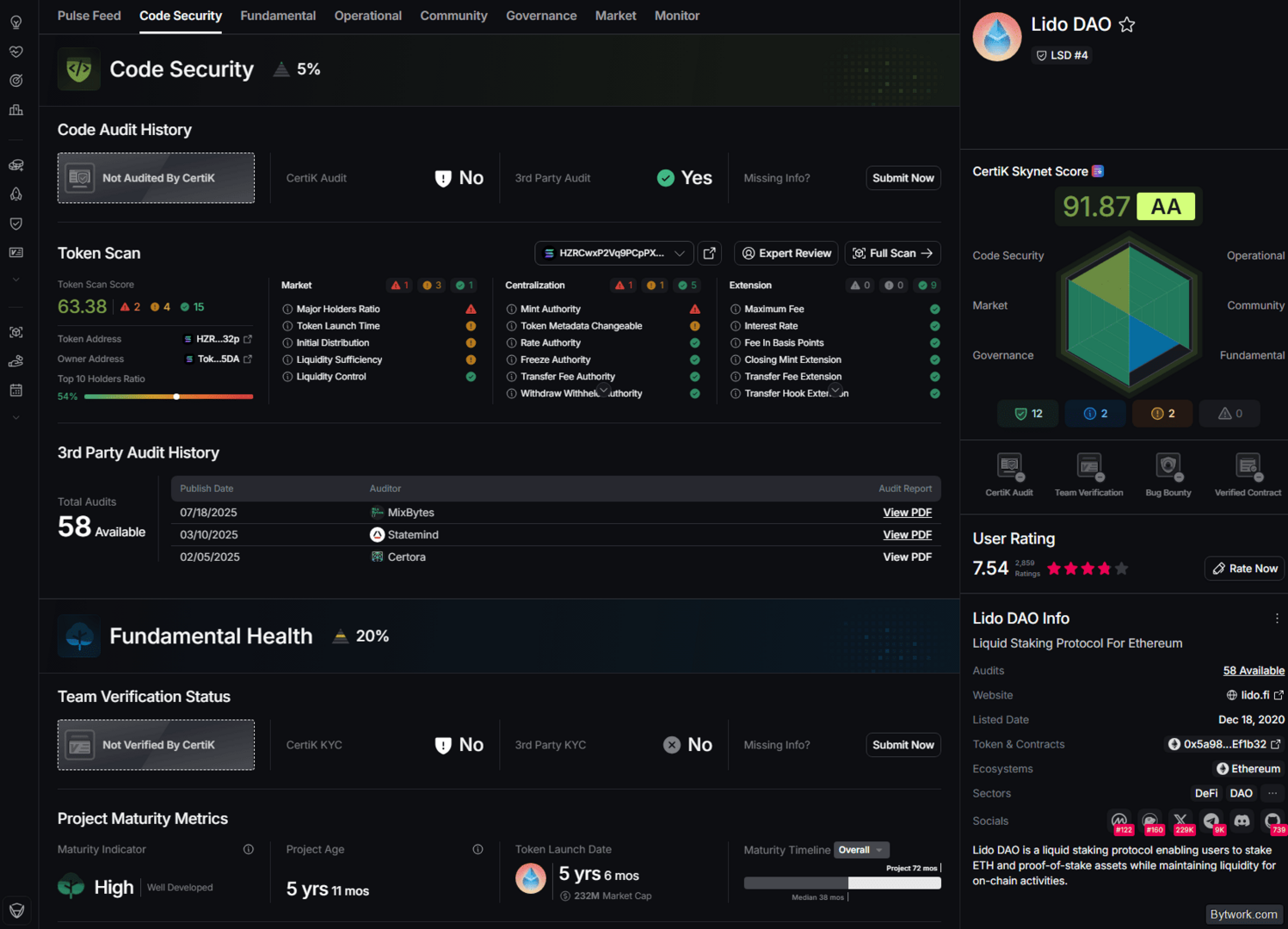
Summary table:
|
Security Metric |
Current Value |
Source |
Comment |
|
CertiK rating |
AA class (~91/100) |
Consistently ranks among the top‑40 most secure Web3 protocols. |
|
|
Number of audits |
70+ independent reviews |
Continuous auditing of all modules. |
|
|
Security expenditures |
> $8 million |
Cumulative amount includes compensation for 8+ audit firms and a permanent bug bounty prize pool. Maximum payout for a critical bug is $2 million. |
|
|
Institutional rating |
Web3SOC Certificate / A+ Level |
Lido successfully passed the Web3SOC compliance certification from Cantina. The risk profile of the stETH asset was rated A+ by Credora. |
|
|
Hack incidents |
0 incidents in 5.5 years |
On‑chain history of smart contracts (since December 2020) |
Since protocol launch, the core smart contracts on Ethereum have never been compromised, despite increasing architectural complexity. |
Thus, the protocol appears secure. Now, a brief look at the team.
Team and Investors
Founders
The project has no traditional owners or CEO. The protocol is fully governed by the decentralised autonomous organisation Lido DAO.

However, information about the founding team is available:
|
Role in the Project |
Verified Background |
What they do |
|
|
Konstantin Lomashuk |
Co‑founder, strategic ecosystem architect |
Founder of P2P.org (2018), co‑founder of Cyber•Fund (2014) and Satoshi Fund (2015). |
Combines Lido DAO development with his CEO position at infrastructure service P2P.org. |
|
Vasily Shapovalov (Vasa) |
Co‑founder, lead developer of the smart contract core |
Senior blockchain engineer, CTO of P2P Validator. |
Key technical expert and contributor to Lido protocol upgrades. |
|
Jordan Fish (Cobie) |
Early co‑founder, marketing and launch ideologist |
Well‑known crypto investor, blogger and co‑host of the popular podcast Up Only. |
Stepped back from operational management of Lido since 2021. Develops the Echo syndicate and media assets (X – >730K followers). |
In addition to the founders, major DeFi developers and venture funds played a huge role in creating Lido.
Investment Rounds
Between 2020 and 2022, Lido Finance raised about $170 million across 5 rounds, evolving from DeFi angel support to major investments from top funds like Paradigm and a16z.
|
Round Name |
Date and Amount |
LDO Price and Investors |
|
Seed Round |
December 2020 |
~$0.01 – 0.02 |
|
Venture Round |
May 2021 |
$0.73 |
|
Strategic Round |
May 2021 |
~$0.73 |
|
Strategic Investment |
March 2022 |
Price not disclosed |
|
OTC Round |
August 2022 |
~$1.45 |
Enough theory, let’s move to practice.
Step‑by‑Step Guide to Staking ETH via Lido
Step 1. Prepare your wallet
Install a Web3 wallet compatible with Ethereum. For example, MetaMask, Rabby, or OKX Wallet. Ensure you have ETH for staking and an additional ETH reserve for gas fees.
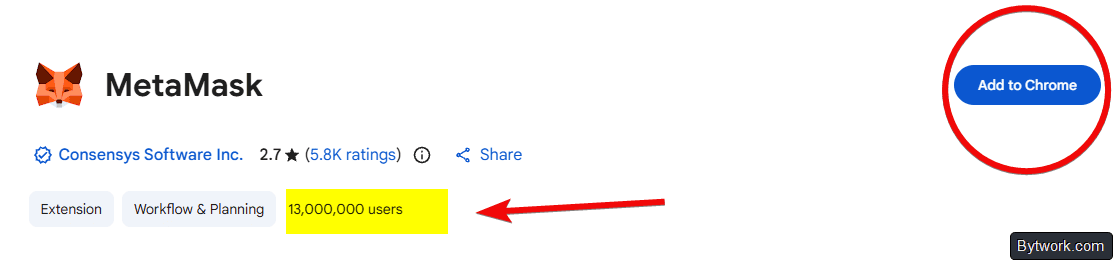
Step 2. Connect to the protocol
Go to the official website lido.fi. Click Stake. Select Connect Wallet and connect your wallet.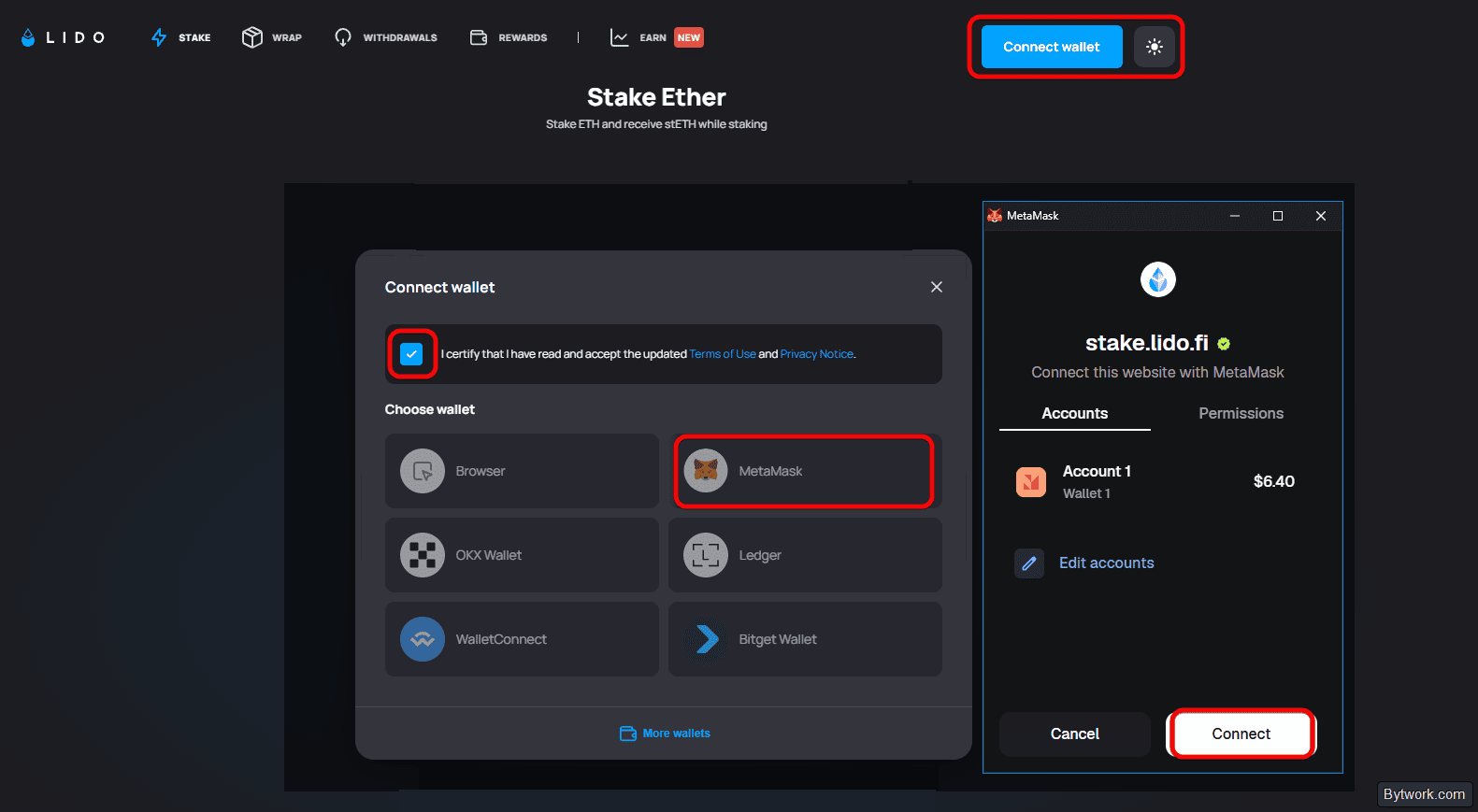
Step 3. Deposit ETH
Enter the amount of ETH you plan to stake. Then sign the transaction in your wallet.
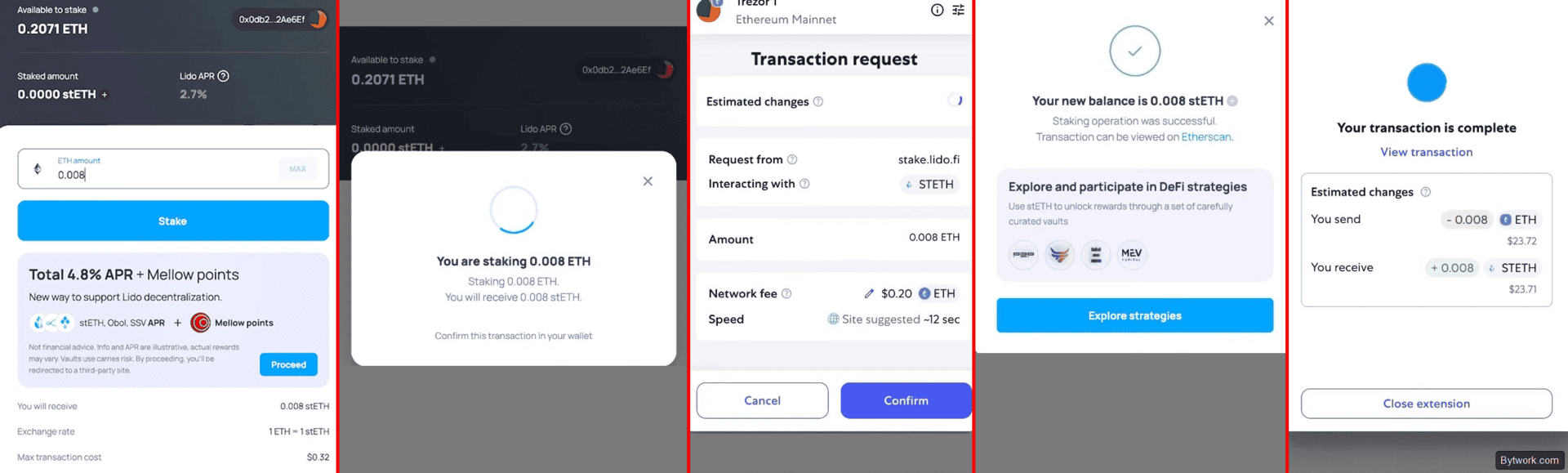
Step 4. Receive stETH tokens
After the transaction is confirmed, you will receive an equivalent amount of stETH tokens at a 1:1 ratio. If the token does not appear automatically in your wallet, import it manually using the contract address (available on CoinMarketCap or CoinGecko).

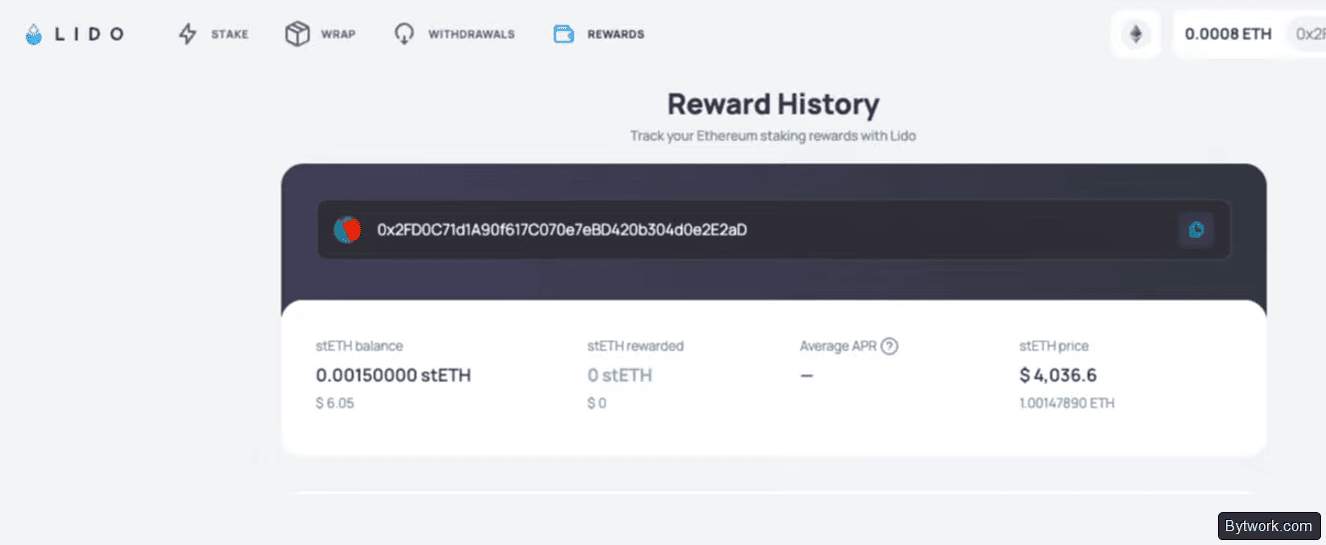
Step 5. Track rewards
Go to the Rewards tab on the Lido website. There you can see the history of daily accruals. Your stETH balance increases automatically; no separate incoming transactions are recorded in the wallet history.
Step 6. Wrap to wstETH (optional)
If you plan to use stETH in other DeFi protocols, wrap stETH into wstETH via the Lido interface. The transaction fee is minimal (~$0.14). wstETH is compatible with protocols such as Aave, Uniswap, Curve, and Layer 2 networks (Arbitrum, Optimism).

Step 7. Withdraw funds
There are two withdrawal options:
- Fast withdrawal – sell stETH or wstETH on a DEX (Uniswap, 1inch) at market price. The rate may deviate from 1:1, especially during volatile periods.
- Standard withdrawal – use the withdrawal function via Lido. The wait time is up to 72 hours for wstETH and up to 10 days for stETH, depending on the validator queue.
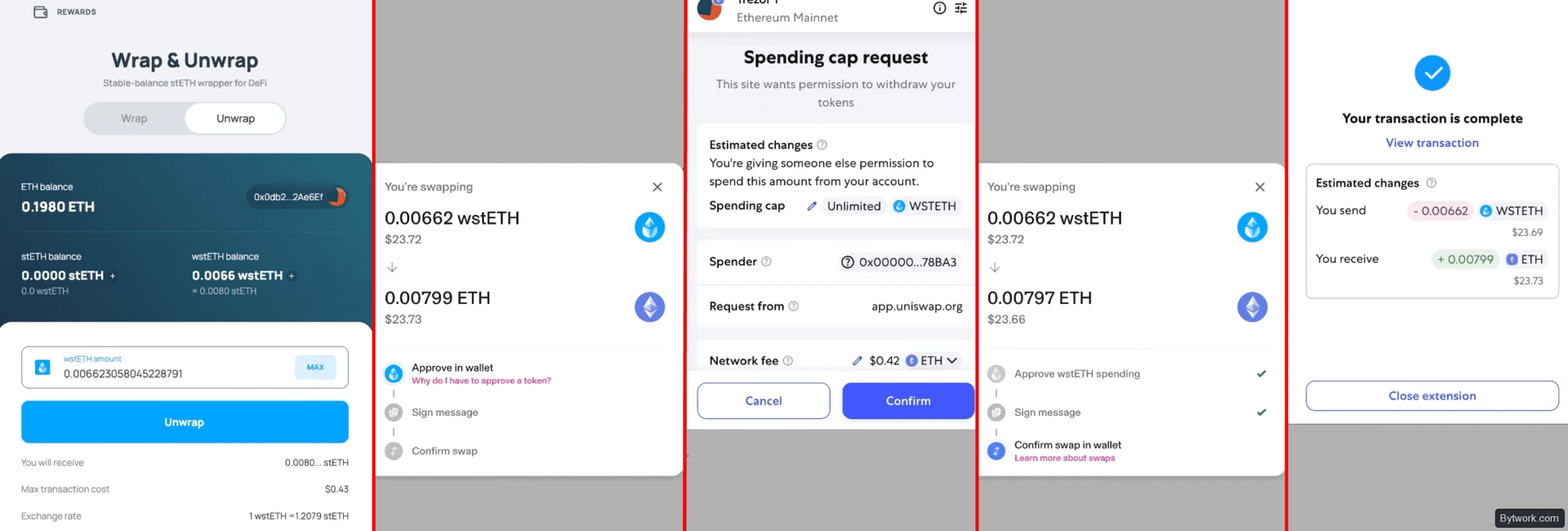
Before withdrawing wrapped ETH via the protocol, you must unwrap it back to stETH.
The withdrawal queue typically lasts 2–10 days, but under high network load or mass validator exits – up to 40 days or more.
Strategies to Boost Yields
We will cover 3 strategies to increase APY.
Strategy 1 – Dual Income (Staking + Lending)
- Stake ETH –> get stETH.
- Swap stETH to wstETH.
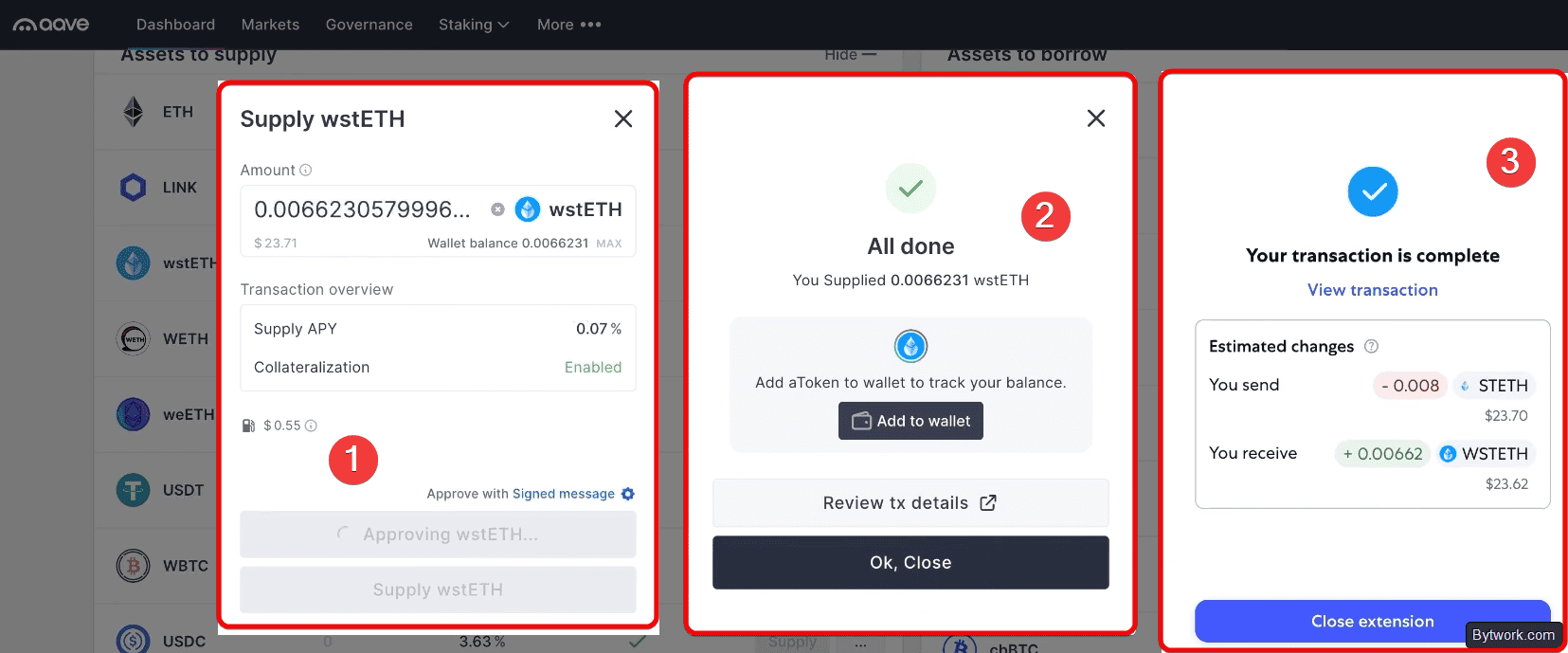
- Deposit wstETH into Aave or Compound as collateral.
- Earn additional APY from the lending protocol (~0.5–2.5%).
Below is our demonstration of depositing the wstETH received from Lido into the Aave protocol.
Total yield formula:
Total APY = APR_staking + APY_lending − APY_borrow (if using leverage)
However, remember that leverage carries risk.
Strategy 2 – Restaking via EigenLayer
- Obtain stETH or wstETH.
- Deposit into EigenLayer.
- Earn additional rewards for securing external protocols.
Here is the dashboard with our restaking position in EigenLayer:
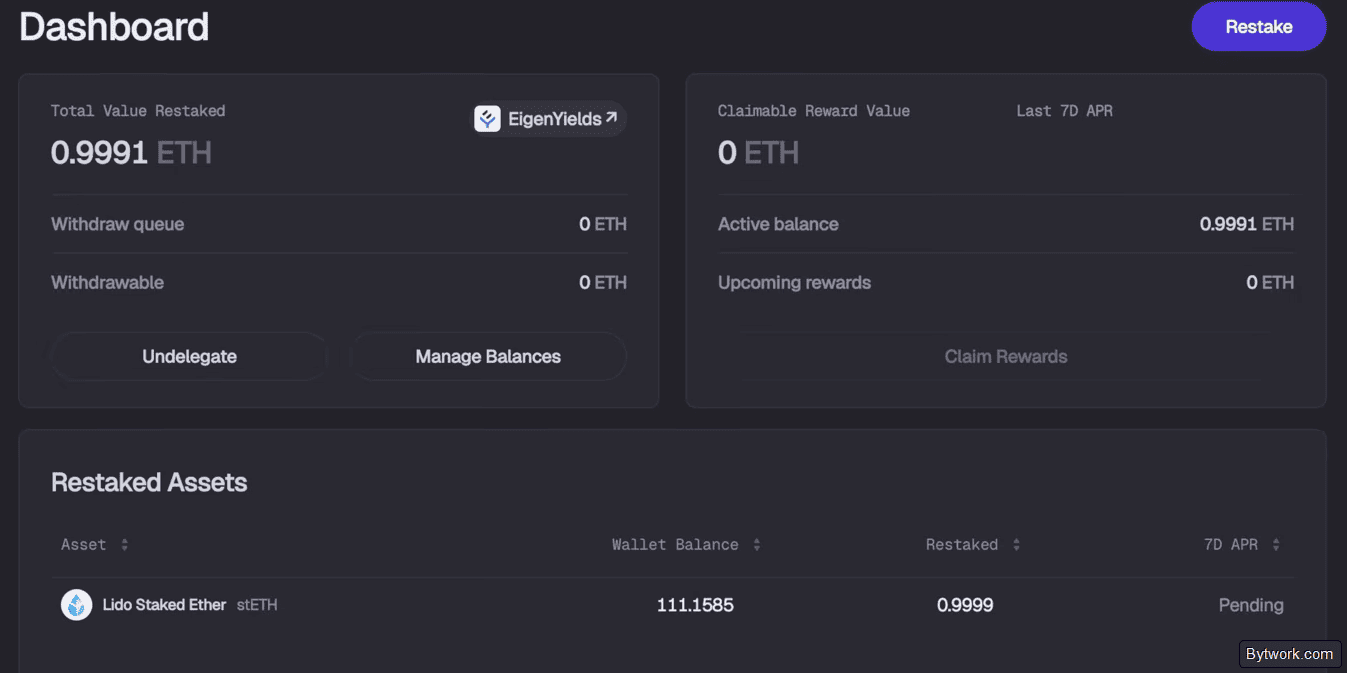
However, there is a risk that the slashing mechanism in EigenLayer could result in loss of part of the deposit if a validator violates protocol rules.
Strategy 3 – Liquidity + Leverage
- Stake ETH –> stETH –> wstETH.
- Deposit wstETH into Aave as collateral.
- Borrow stablecoins (USDC/USDT) at 60–70% LTV.
- Use the stablecoins to provide liquidity in an ETH/USDT pool on Uniswap V3 or Unichain.
Warning! This strategy may lead to liquidation risk. If the price of ETH drops, the Health Factor (HF) will decrease. Therefore, maintain HF > 1.25.
Formula:
HF = (Collateral value in ETH × Liquidation threshold) / Total debt
What are the Risks and Drawbacks?
Protocol Risks
|
Risk |
Description |
Mitigation |
|
Smart contract |
Vulnerabilities in Lido's code or integrated DeFi protocols. |
Regular audits, Bug Bounty, CertiK rating (AA). |
|
Slashing |
Network penalties due to node operator failures. |
DAO insurance fund, distribution of stakes (>1 million validators). |
|
Centralisation |
Concentration of power in protocol governance. |
Adoption of DVT technologies and decentralised modules (CSM). |
|
Regulatory |
Risk of LST being classified as securities. |
Legal compromise with SEC, compliance filters. |
Lido mitigates smart contract, technical, and regulatory risks through continuous audits, the DAO insurance fund, decentralisation via DVT, and legal compliance with the SEC.
Lido DAO Market Risks
During panic periods, the stETH exchange rate may temporarily deviate from ETH. Before large trades, it is advisable to check liquidity through aggregators (1inch, CowSwap, ParaSwap) rather than relying on individual pools.
Furthermore, the APR for staking Ethereum is not fixed. It depends on network activity and the total amount of ETH locked. In the long term, the rate has stabilised in the range of 2.3–3.5%.
DeFi Composability Risks
When integrating Lido liquid staking derivatives (stETH and wstETH) into third‑party DeFi platforms (e.g. as collateral in Aave and Compound, or in liquidity pools on Uniswap), a multiplicative risk effect emerges. The user assumes the risks of the entire chain of smart contracts.
Total risk = 1 − [(1 − risk_Lido) × (1 − risk_Protocol_A) × (1 − risk_Protocol_B)]
Each additional protocol increases the attack surface.
LDO Token
LDO is the governance token of the Lido platform, granting holders voting rights in the DAO to control protocol parameters, select validators, and allocate fees, but it does not generate income from staking ETH itself.
LDO trades significantly below not only the historical entry levels of funds but also its average values of previous years. Meanwhile, 100% of institutional and team tokens are already unlocked, and a large portion of the supply is in circulation – about 84–85% of its maximum.
It is worth comparing Lido with the competing staking pool Rocket Pool. Unlike LDO, which is primarily used for governance, the RPL token has direct utility. For instance, Rocket Pool node operators are required to stake RPL to participate in the network. This creates direct market demand for the token as the service grows in popularity.
Tokenomics
Refer to the table below to understand where LDO tokens are allocated and why.
|
Holder Category |
Initial Allocation |
Current Status |
Description and Mechanisms |
|
Lido DAO Treasury |
36.3% |
Community‑controlled |
Grants, marketing; diversification and buyback. |
|
Investors |
22.1% |
Fully unlocked |
Schedules completed, now in free circulation. |
|
Early Developers |
20.0% |
Fully unlocked |
Team shares unlocked after milestone achievements. |
|
Founders and Employees |
15.0% |
Fully unlocked |
Smart‑contract restrictions (cliff and vesting) have completed. |
|
Validators and Signers |
6.5% |
Fully unlocked |
Initial pool operators' assets are freely available. |
It is important to note that the distribution of governance tokens is highly centralised. Specifically, 64% of the initial supply was allocated to insiders, and the top 100 wallets hold over 90% of all LDO. This allows large holders (whales) to make unilateral decisions in the DAO.
For the LDO price outlook, this tokenomics means:
- No unlock pressure. No new investor coins are entering the market, eliminating planned price crashes.
- Treasury supports price. DAO tokens (36.3%) are used for development, and buyback mechanisms strengthen the price.
- Dependence on whales. 63.7% of coins are free; the price depends entirely on sales or accumulation by large funds.
LDO Token Price Forecast
Analytical overview of price targets and market metrics for the Lido DAO (LDO) token.
|
Metric |
Value / Range |
Comment |
|
Base market price |
In the range $0.20 – $0.50 |
Under pressure within the current crypto cycle. Fluctuates with overall DeFi segment volatility. |
|
All‑time high (ATH) |
$7.30 |
Record high reached during the protocol's peak popularity in 2021. |
|
All‑time low (ATL) |
Below $0.25 |
Local price bottom formed during a prolonged medium‑term downtrend. |
|
Market capitalisation |
About $200–$300 million |
Consistently ranks in the top 200 global crypto assets. |
|
All‑time high market cap |
~$2.5–2.6 billion |
Estimated value reached at peak circulating supply and price. |
Thus, the forecast can be summarised as:
|
Conservative price forecast |
From $0.25 to $0.45 |
Baseline scenario of analytical models, assuming moderate recovery within 12–18 months. |
|
Price relative to investor entry |
Critically below average |
Most institutional and venture participants are in drawdown territory. |
|
Current drop from ATH |
In the range 93–97% |
Dynamic indicator reflecting the depth of the asset's correction from its absolute peak. |
FAQ
How many days does it take for the first staking rewards to be credited via Lido?
Profit starts accruing within 24 hours after deposit, whereas with native staking the activation queue stretches to 53–54 days, and during that period you earn nothing.
How does Lido differ from exchange staking (Binance, Coinbase)?
Lido does not require KYC, gives you a self‑custodial stETH token, and lets you use stETH in other DeFi protocols. Exchanges keep your assets on their own accounts, block withdrawals during periods of high load, and may freeze your account under their internal rules. Moreover, the fees that exchanges charge for staking reach up to 25% of the rewards, while Lido takes only 10% – a 2.5‑fold difference for essentially the same service.
What happens to stETH if ETH drops by 50%?
The stETH balance in ETH equivalent will decrease proportionally to the market price of ETH, but the number of stETH tokens in your wallet will not change (rebasing depends solely on rewards, not on price). During a sharp drop, the stETH exchange rate may temporarily deviate from ETH due to panic selling, but arbitrageurs quickly restore the parity.
Is Lido a bubble or a sustainable business?
Lido generates real cash flows ($5–6 million in net profit per month) from fees. However, the LDO token is not directly tied to these cash flows, and its price depends on speculative demand. The business model is sustainable, but the investment appeal of LDO is driven by market sentiment.
How does Lido ensure the security of your ETH?
Lido distributes ETH among 22+ validators selected by the DAO to avoid a single point of failure. More than 58 audits have been conducted by leading firms (CertiK, Trail of Bits, and others). A Bug Bounty program is active for white‑hat hackers. However, there is no absolute guarantee of security.
Can you lose all your funds due to slashing?
Yes, if several validators chosen by Lido violate the rules at the same time, the protocol may apply slashing, which would reduce the stETH pool. However, such cases are extremely rare, and Lido has hedged the risks through DAO reserves (part of the funds are allocated for compensations).
Conclusion
The Lido team, including Konstantin Lomashuk, Vasily Shapovalov, and Jordan Fish, has created one of the most significant DeFi staking projects.
According to our rating system, it receives:
- 3/5 for investors,
- 4/5 for tokenomics,
- 5/5 for on‑chain analytics,
- 5/5 for security,
- and 4/5 for social presence.
Total 29 out of 35. Lido is a stable DeFi income generator, producing real profit and being an integral part of the Ethereum ecosystem. If Ethereum grows, Lido, as the current staking monopoly, will grow alongside it.
When using strategies, to reduce impermanent loss (IL), choose correlated pairs like ETH/stETH (1:1 movement) instead of volatile ETH/USDC. This nearly eliminates IL and allows you to keep all fees and staking income.
Finally, using stETH in dual‑income or leveraged staking strategies carries the risk of cascade liquidations in protocols like Aave during market volatility.
Maxim Anisimov, specifically for bytwork.com.
Disclaimer: all information provided in this article should not be taken as financial advice! The article was created for educational purposes.


