How to scale your balance from 1 to 100 SOL using Meteora DLMM liquidity pools

You will learn everything about the Meteora protocol: how much commission is paid, what liquidity pools exist, and how to professionally find coins and open positions. We will also touch on the risks.
What is Meteora?
Meteora is a decentralized liquidity protocol on Solana that allows you to swap tokens, launch coins, and earn passive income. Here, liquidity providers deposit one or a pair of coins within a specified price range and earn fees from trades made by other users.
Meteora has implemented DLMM (Dynamic Liquidity Market Maker) technology, which allows 100% of capital to be concentrated within narrow price bands. This multiplies capital efficiency and the amount of fees earned.
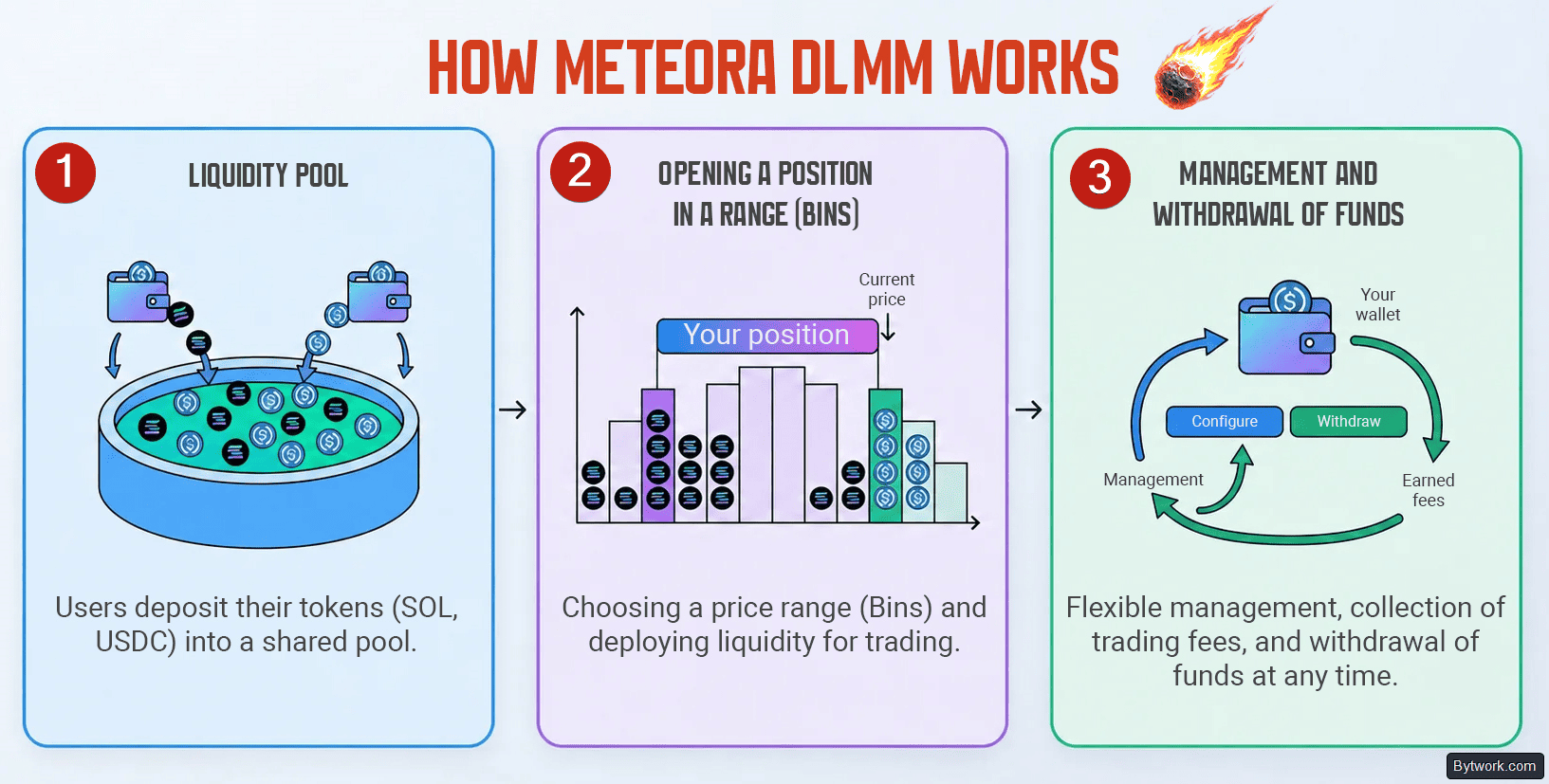
- You select a pool
- You deposit liquidity into it within a price range
- You manage the position, collect fees, and withdraw them
Differences from other protocols
It is precisely the DLMM technology that makes Meteora efficient in terms of yield.
|
Criteria |
Traditional AMM |
Meteora DLMM technology (with bins) |
|
Capital distribution |
Uniformly from $0 to infinity. |
Divided into thousands of isolated cells (bins). |
|
Capital efficiency |
1x (more than 95% of funds sit idle in the pool). |
Up to 100x–1000x (capital works at full capacity). |
|
Slippage |
Increases with every order (depends on pool depth). |
0% slippage inside the active slot. |
|
Price change step |
Smooth, continuous curve. |
Fixed |
|
Commission |
Fixed (standard 0.25% or 0.30%). |
Dynamic – base fee (mirrors |
|
Pool composition for LP |
Always strictly 50% token A and 50% token B. |
100% of one token in filled bins (or a mix in the active one). |
|
Trading volume per $1 of liquidity |
Low (volume-to-TVL ratio rarely exceeds 1:1). |
Extremely high ($1B volume was generated from only $12M TVL). |
Meteora was built as an analog of the Curve Finance protocol for Solana. However, over time, the protocol has grown thanks to the rapid launch of pools for memecoins, automatic escalation of commission fees up to 10% during periods of high volatility, daily yields of 50%–100%, and automatic overflow of idle funds into lending protocols like Kamino and Marginfi.
Real yield and myths about APR
We use Meteora as a high-tech commission printer. Yield here is distributed across 3 risk levels.
|
Category |
Daily yield |
Monthly potential |
Features |
|
Memecoins (high risk) |
5% – 15% |
100% – 300% |
Depends on Volume/TVL > 1. Possible profit of 100-150% within 1-2 hours. |
|
SOL / Blue Chips (medium) |
0.4% – 1% |
12% – 30% |
Relatively safe farming on SOL network volatility. |
|
Stablecoins / LST tokens (low) |
0.1% – 0.4% |
3% – 10% |
Conservative income. Curve strategy for 1:1 correlated pairs. |
Income directly depends on the trading volume of a particular pair. The ideal pool is when the daily trading volume (Volume 24h) exceeds liquidity (TVL) by 3–10 times. If the ratio is less than 1:1, fees may not cover the risk of impermanent loss.
During periods of high market turbulence, the base commission (e.g., 1% or 2%) is supplemented by a dynamic surcharge that can reach up to 10%. This mechanism allows you to stay in profit even during a drawdown.
Where do rewards come from?
When $100 in fees is collected from traders, the liquidity provider immediately receives $90, and the remaining $10 goes to Meteora.
From these 10% of protocol fees, the capital is distributed as follows:
- 10% (exactly $1) goes to the reward pool for staking MET tokens.
- Up to 8% (up to $0.80) is taken by the referrer – the crypto enthusiast who generated the referral code.
- 2% ($0.20) goes to the referred user themselves.

The key point is that not a single cent is deducted from your 90% share as a provider. All bonuses are paid strictly from the protocol's already retained margin, without cutting into the net profit of liquidity providers.
How do impermanent losses kill yield?
Impermanent losses are triggered when the price of coins deviates from the moment they were deposited into the pool. In the Meteora protocol, this mechanism devalues the position during a market drop, automatically buying the depreciating token using your SOL or USDC reserves. During a rapid dump, accumulated fees simply do not have time to offset the overall portfolio drawdown.

In practice, it works like an automatic asset rebalancer in the pool. When Solana's price rises above $100, the smart contract begins to gradually take profit on the rising Solana and convert it into stablecoins. This results in a smaller increase in the final portfolio value compared to a simple hold strategy.
In the opposite scenario, if the price falls below the set lower boundary of the trading range, the position becomes 100% allocated to the dropped token, and fee accrual stops entirely. That is the essence of "impermanent loss."
DLMM mechanics and bins for yield
In Meteora, there are so-called Bins – price ranges. The more trades occur within that price segment where our liquidity is placed, the more fees we can potentially earn.
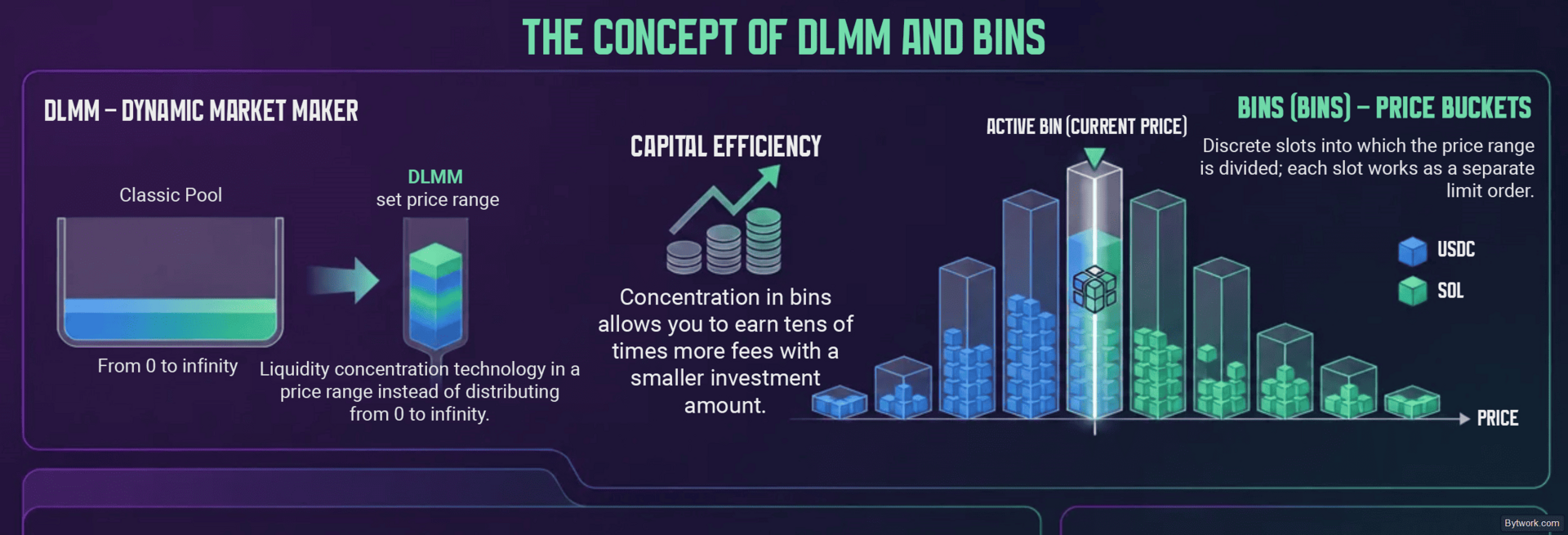
The essence:
- Bins – price ranges for placing liquidity. For example, a range for a SOL position from $205.5 (current price) down to $191.
- Income increases with trading volume in the selected bin.
- Competition reduces your share of profit if there is already a lot of other capital in the bin.
- Selection rule – evaluate the ratio of trading volume to the total TVL of the pool, not just the high APY.
- Zero slippage inside a bin attracts trading aggregators.
2 examples of different pools:
- Option 1 (good) – Volume $5M / Liquidity $2M -> high capital efficiency.
- Option 2 (bad) – Volume $20M / Liquidity $200M -> low fee share.
How does the price range affect income and risks?
When the price moves outside the selected range (bin), fee accrual stops, which requires risk diversification by splitting the deposit.

- Narrow range – maximizes fees, but requires constant monitoring because the price quickly moves out of bounds.
- Wide range – provides passive income and protection against volatility, but dilutes liquidity and lowers the daily percentage.
- Out of range – if the price exits the boundaries, farming stops, and you are left with a single asset (often the depreciated token on a drop).
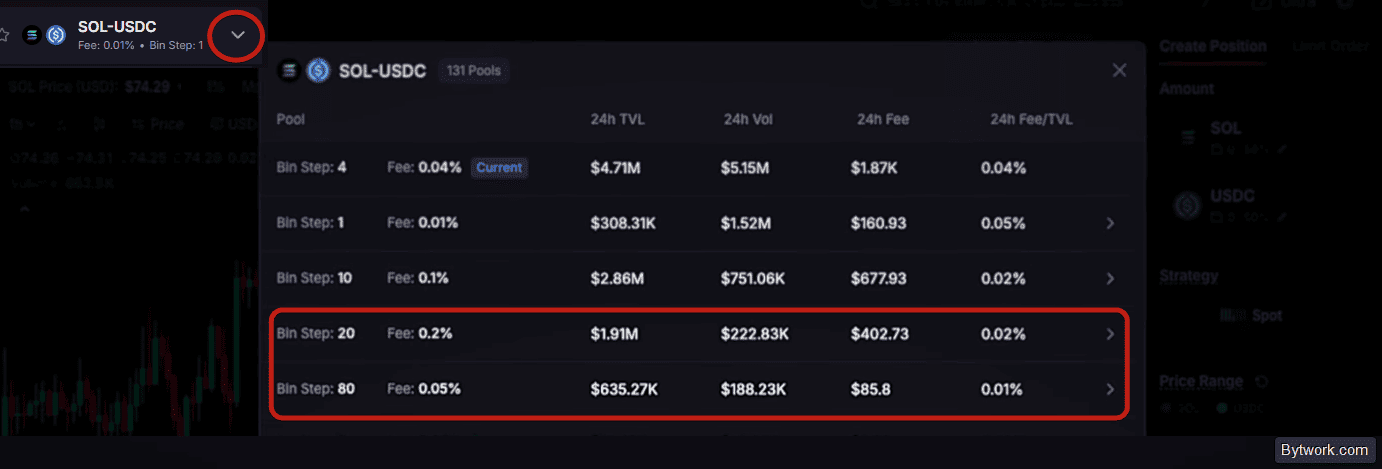
Finally, there is the parameter Binstep – the step between adjacent price levels (bins). A smaller step (4, 10) gives a narrower price corridor and maximum liquidity compression, but requires frequent monitoring. A larger step (20, 80) widens the range, trimming profit, but increases position stability.
We will cover all this in detail in the practice section.
Spot, Curve, Bid-Ask strategies
When opening a position, you will see 3 strategies to choose from.
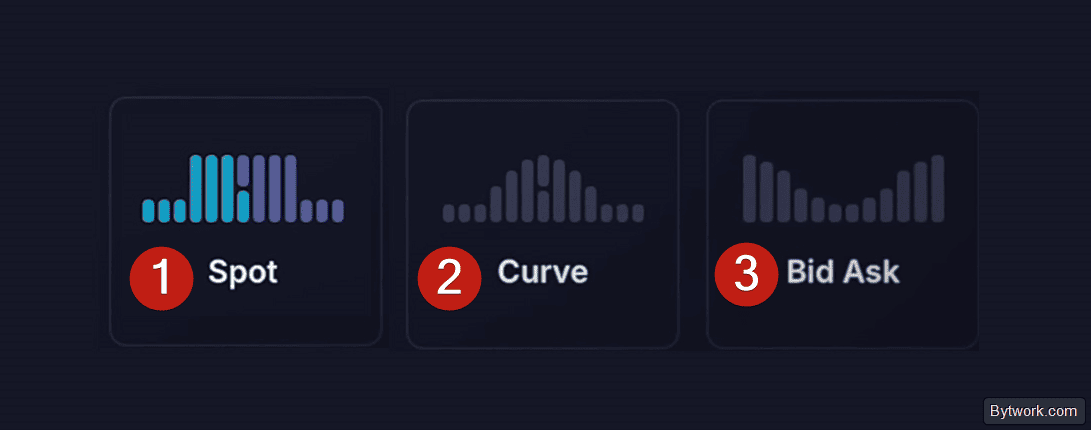
- The
Spotstrategy evenly spreads liquidity like a rectangle across all bins, ensuring a stable fee cap in flat markets for pairs like SOL/USDC. In a sharp dump,Spotbuys the asset in equal parts, which raises the average entry price. Curvepacks capital like a pyramid around the current price in the center of the range for extreme efficiency in a narrow corridor. This solution is only suitable for 1:1 correlated coins such as USDC/USDT or JitoSOL/SOL. For volatile pairs, this is the most dangerous strategy, because if the price moves away from the center, you are left with a depreciated asset at the worst price and no fees.Bid-Askleaves minimum liquidity at the current price and maximum at the edges of the range. This is a protective gold standard for memecoins and beginners, where the protocol aggressively buys the asset as it falls. Losses at the lower boundary are only about 22%, providing a low average purchase price. However, when the price is stagnant, fees will be minimal.
How to choose a strategy is shown in the table below.
|
Parameter |
Spot |
Curve |
Bid-Ask |
|
Chart shape |
Rectangle |
Pyramid |
Crater / Bowl |
|
Logic |
Uniform DCA |
Max efficiency for 1:1 |
Buy Low / Sell High |
|
When does it suit? |
SOL / Blue Chips |
Stables / LST |
Memecoins / Runners |
|
Fee income |
Stable across the whole range |
Maximum in a narrow center |
Minimal when flat in the center |
|
Risk level |
Medium |
High (for volatile pairs) |
Low (for SOL protection) |
Here is a final infographic on yield in DLMM.
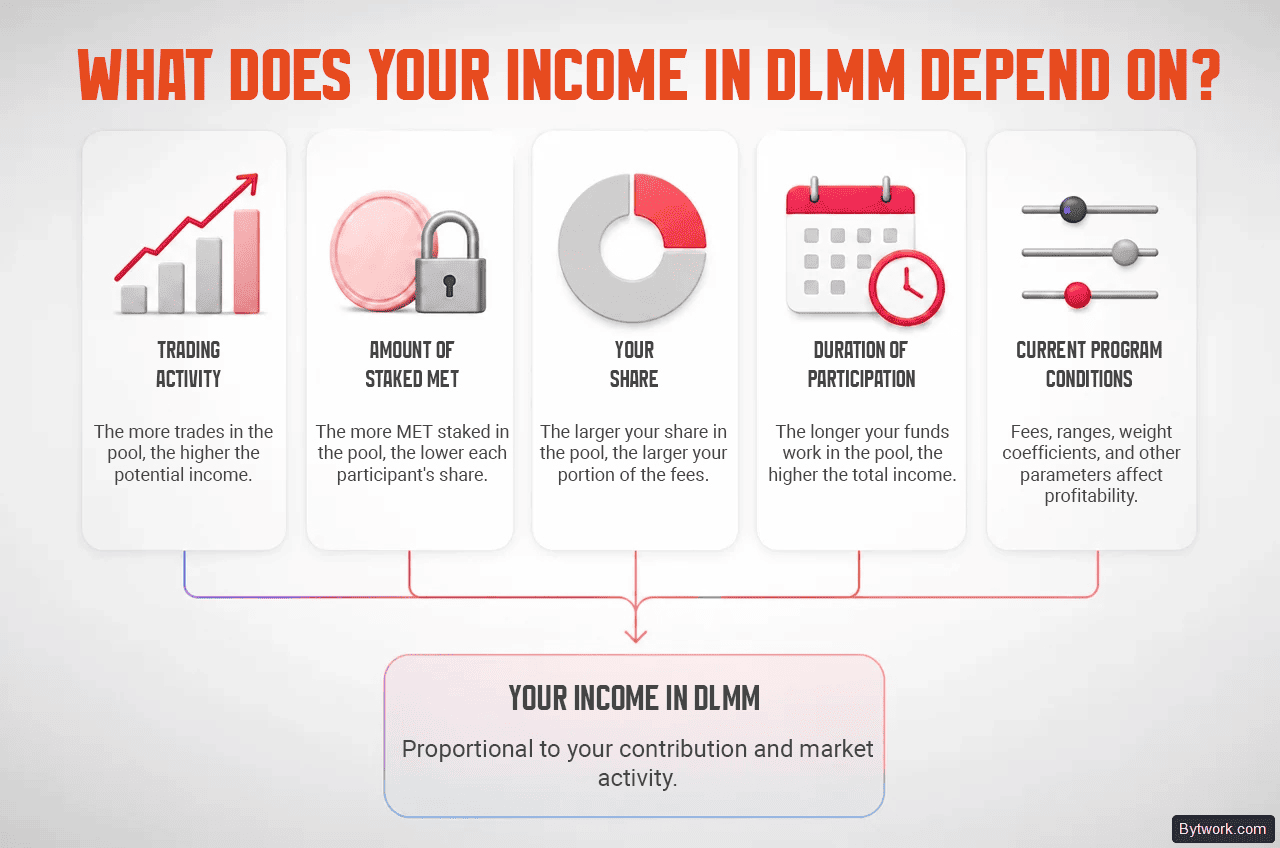
We have covered all the mechanics of the protocol. Now it's time for practice.
Simple start – pools for beginners
We will show 2 positions: a safe one in SOL/USDC and an advanced one with memecoins. Let's start with the safe one.
Step 1. Connect to the protocol
Connect your wallet (Phantom or Solflare). Transfer SOL and USDC to your wallet on the Solana network. Leave at least 0.05 SOL for fees.

Step 2. Choose a safe pair and pool
- Open the DLMM tab on the Meteora homepage.
- In the list of pools, find the SOL/USDC pair.
- Then select a pool based on safe parameters:
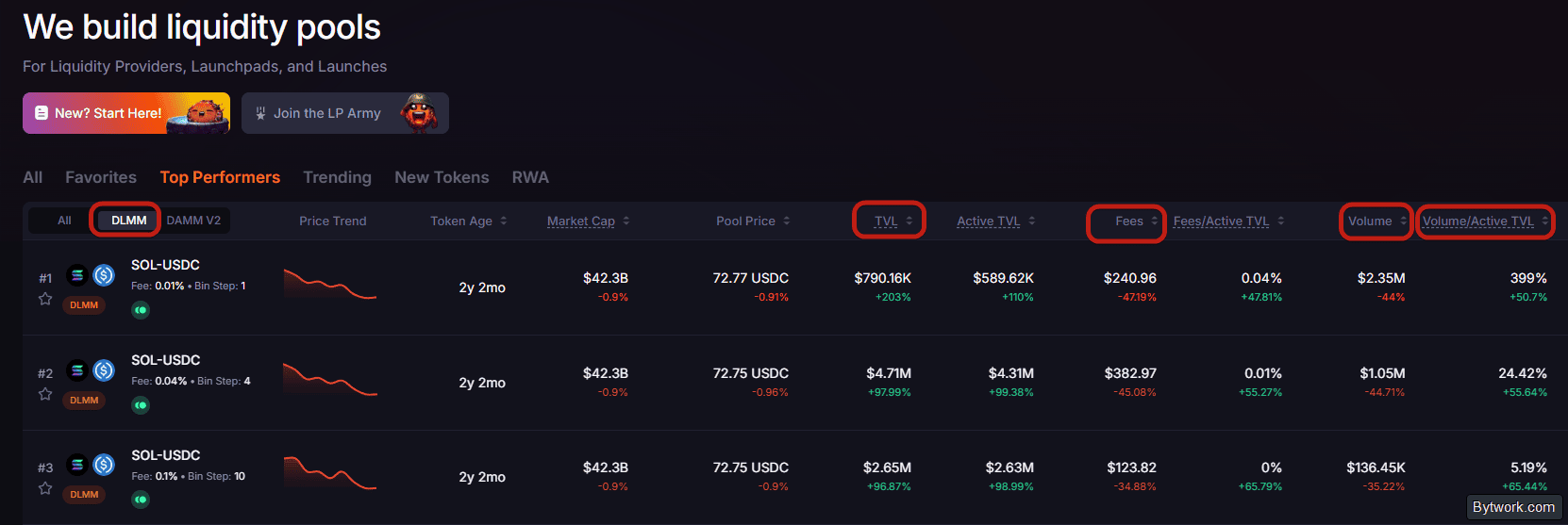
TVL– the total amount of funds deposited. A high value means a large, liquid pool but also more competition.Volume– trading volume. More swaps mean more fees. But we are not just looking for high volume; we want a healthy volume-to-TVL ratio. Volume should be at least 2 times TVL.Fees– collected fees. Past performance does not guarantee future returns. The most important factor is the current TVL-to-volume ratio.Binstep– the distance between price bins and liquidity density. Binstep is already set, but you always manually choose the price boundaries.
So, for a first experience, the Solana/USDC pair with Binstep 20 or 80 is suitable.
Step 3. Choose a price range
Now choose the range where you expect the most trading activity.
- Narrow range (e.g., 99–101$ at Solana price 100$) – maximum capital concentration and high yield per $, but a 1–2% price move knocks you out, requiring constant monitoring.
- Medium range (90–110$) – lower yield, but the position can withstand stronger market swings.
- Wide range (70–130$) – a calm strategy that does not require frequent checking, but some funds sit far from the current price and do not work.
In the end, there is no universal solution. A narrow corridor is for active management, a wide one is to avoid visiting Meteora 5 times a day. The high APR of a narrow range evaporates immediately when the price exits its boundaries.
It is better to set boundaries based on the chart, using support/resistance zones, reversals, and the price history of the last few days or weeks.
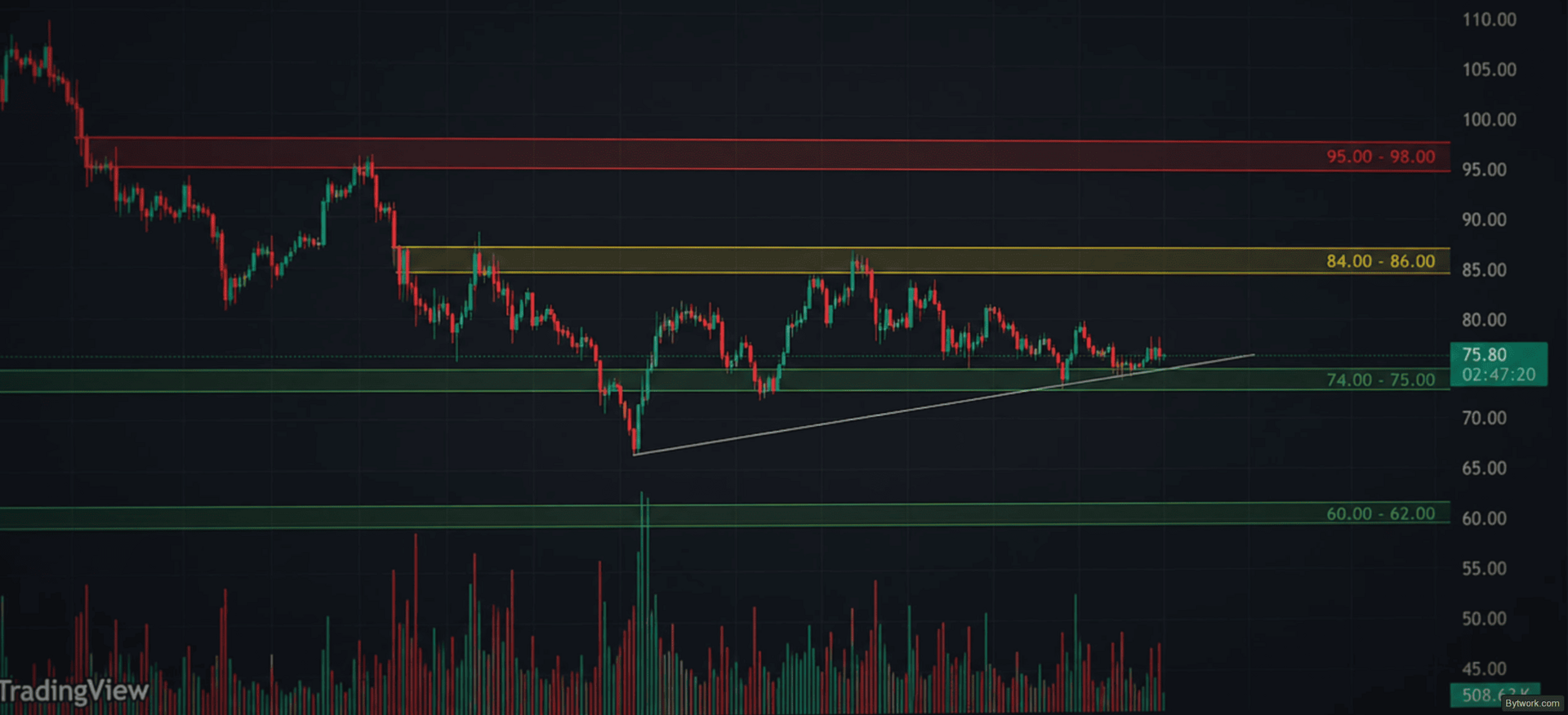
For example, with Binstep 80, you can enter a range from 59 to 101$ and sit there for half a year without exiting.
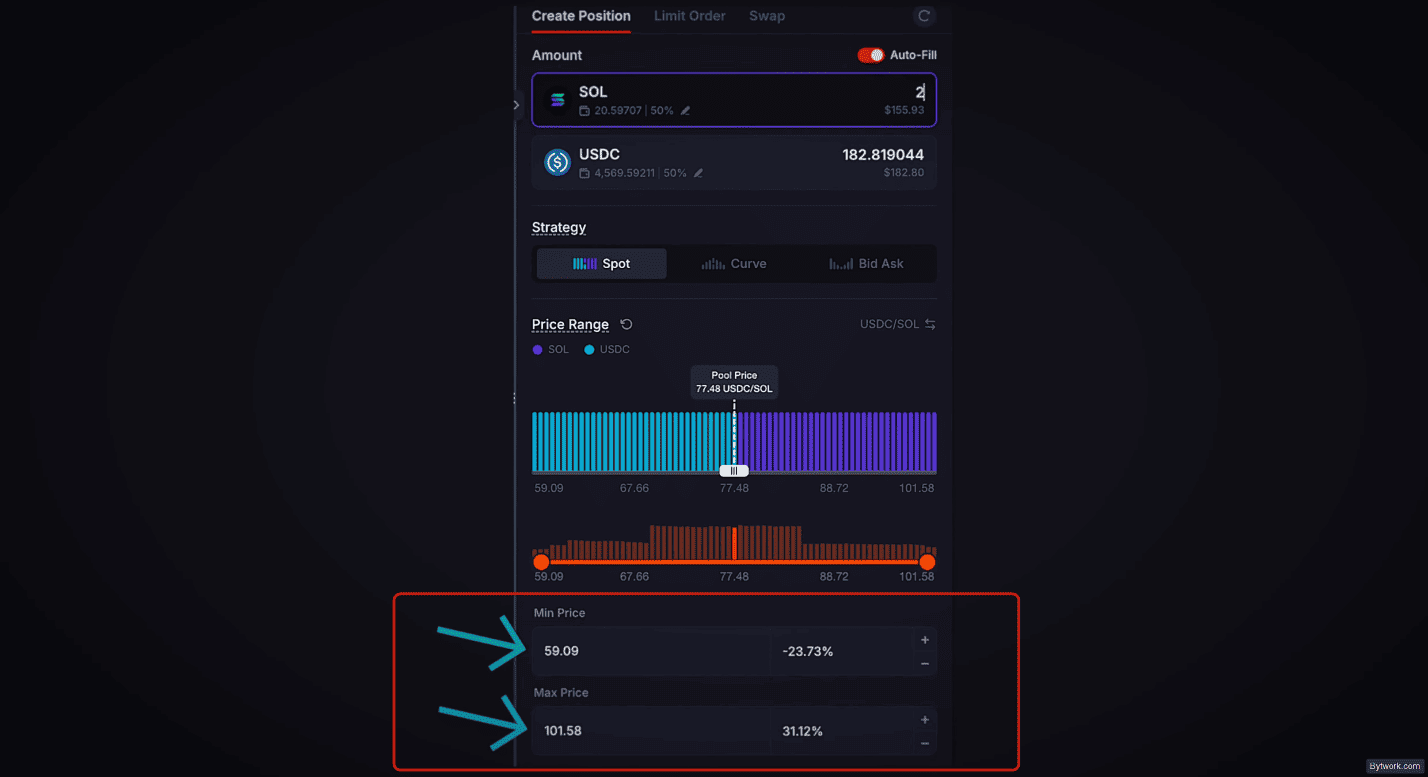
Earnings will be modest, but the goal of the first position is not to make maximum profit, but to understand how its composition changes.
Step 4. Choose a strategy and confirm
- Choose the
Spotstrategy, as it is evenly distributed across the range and suits a SOL/USDC position. - Enter the deposit amount (e.g., 1 SOL + the equivalent in USDC).
- Click
Add Liquidityand confirm the transaction.
Split your capital into several positions instead of placing it all in one range. For example, with $1,000, deposit some USDC below the current price to gradually buy Solana on dips. Deposit some Solana above the current price to take profits during upward moves.
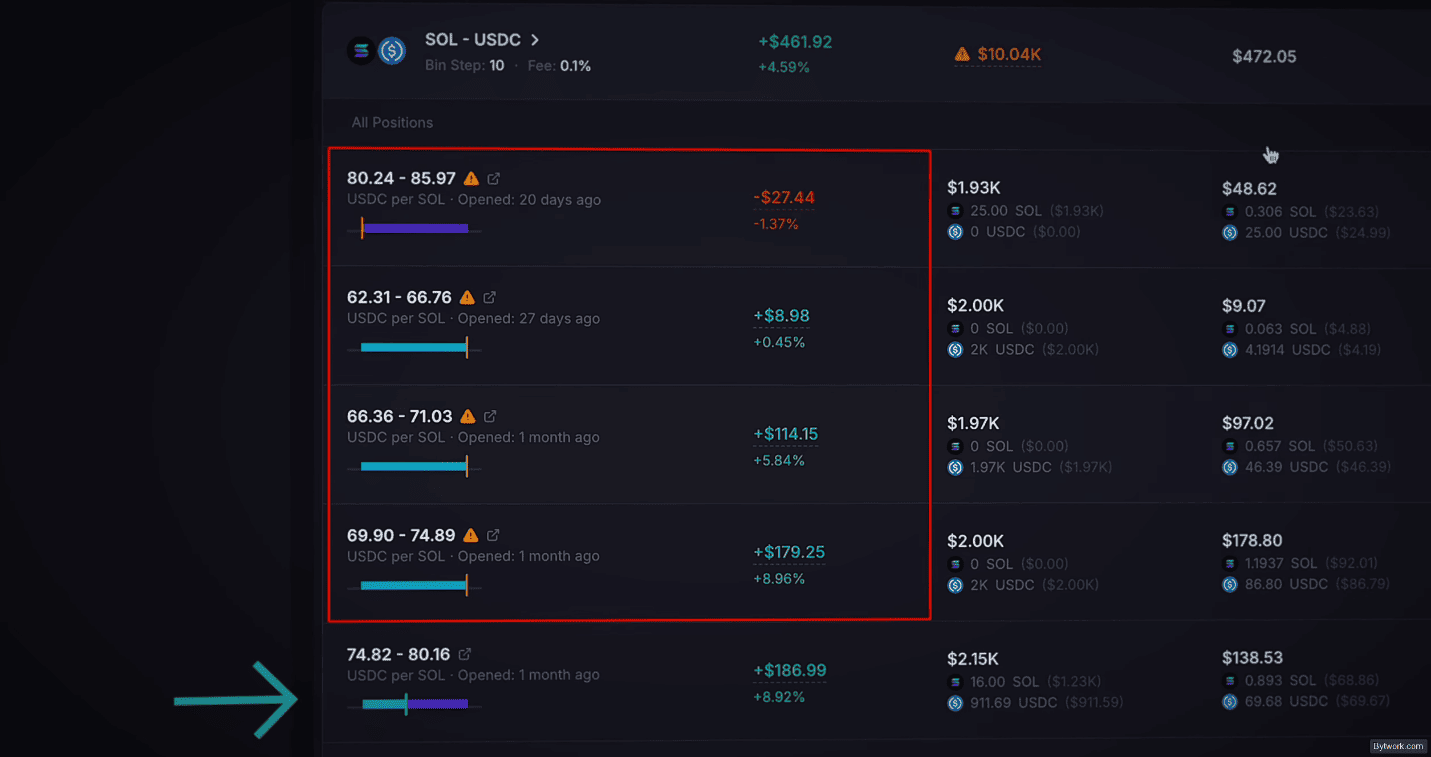
Such a ladder uses only the portion of capital whose price range currently includes the price. The other positions wait for market movement, eliminating the need to constantly monitor the chart if you have competently distributed the ranges in advance.
Step 5. Monitor positions and collect fees
- Check the position once a day. If the price is inside the range, fees accumulate automatically.
- To withdraw fees, click
Claim Fees(when the amount becomes noticeable, e.g., > 1% of deposit). - If the price moves out of bounds, fees stop accruing. In that case, either wait for a return or close the position and open a new one with an updated range.
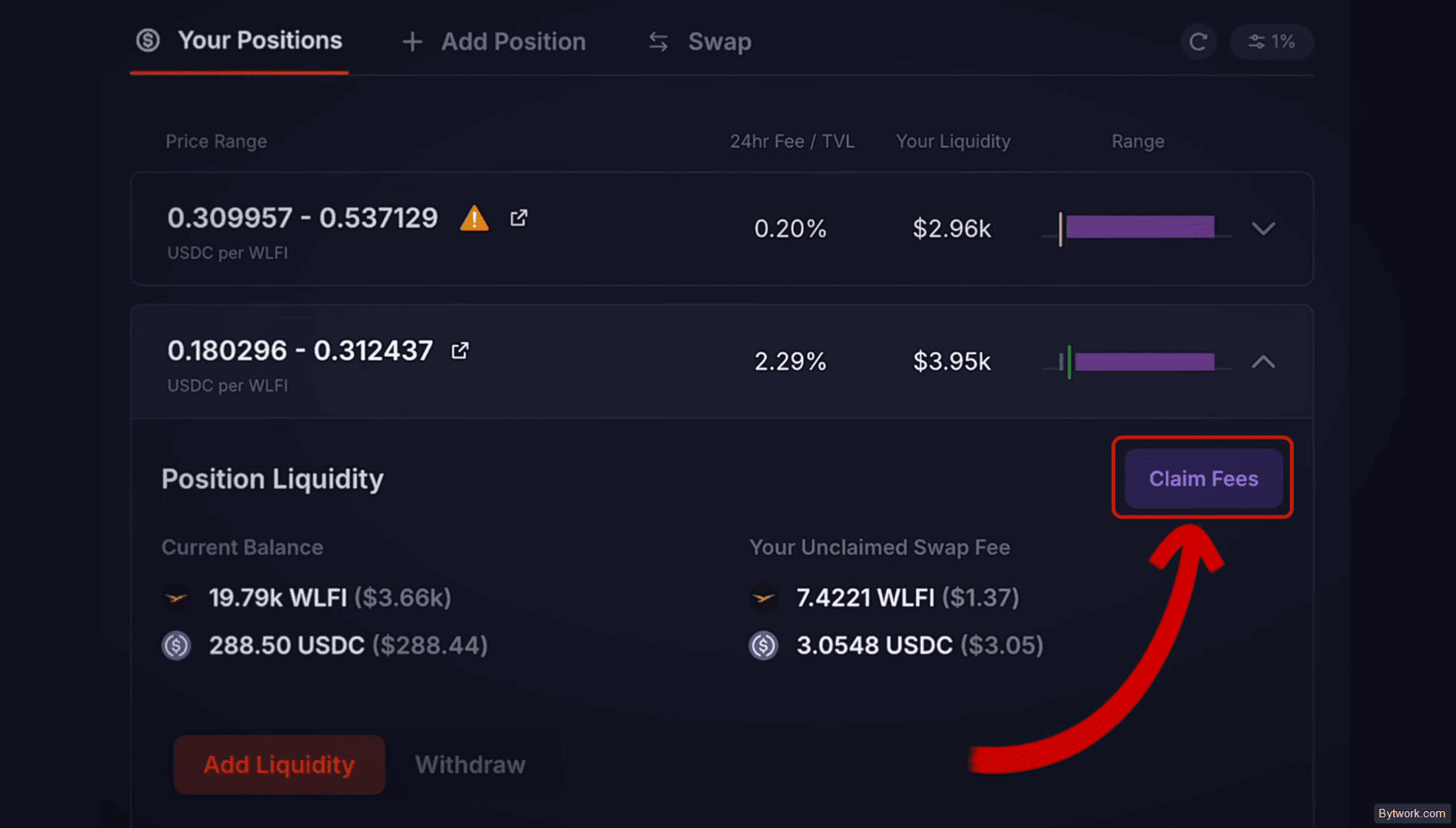
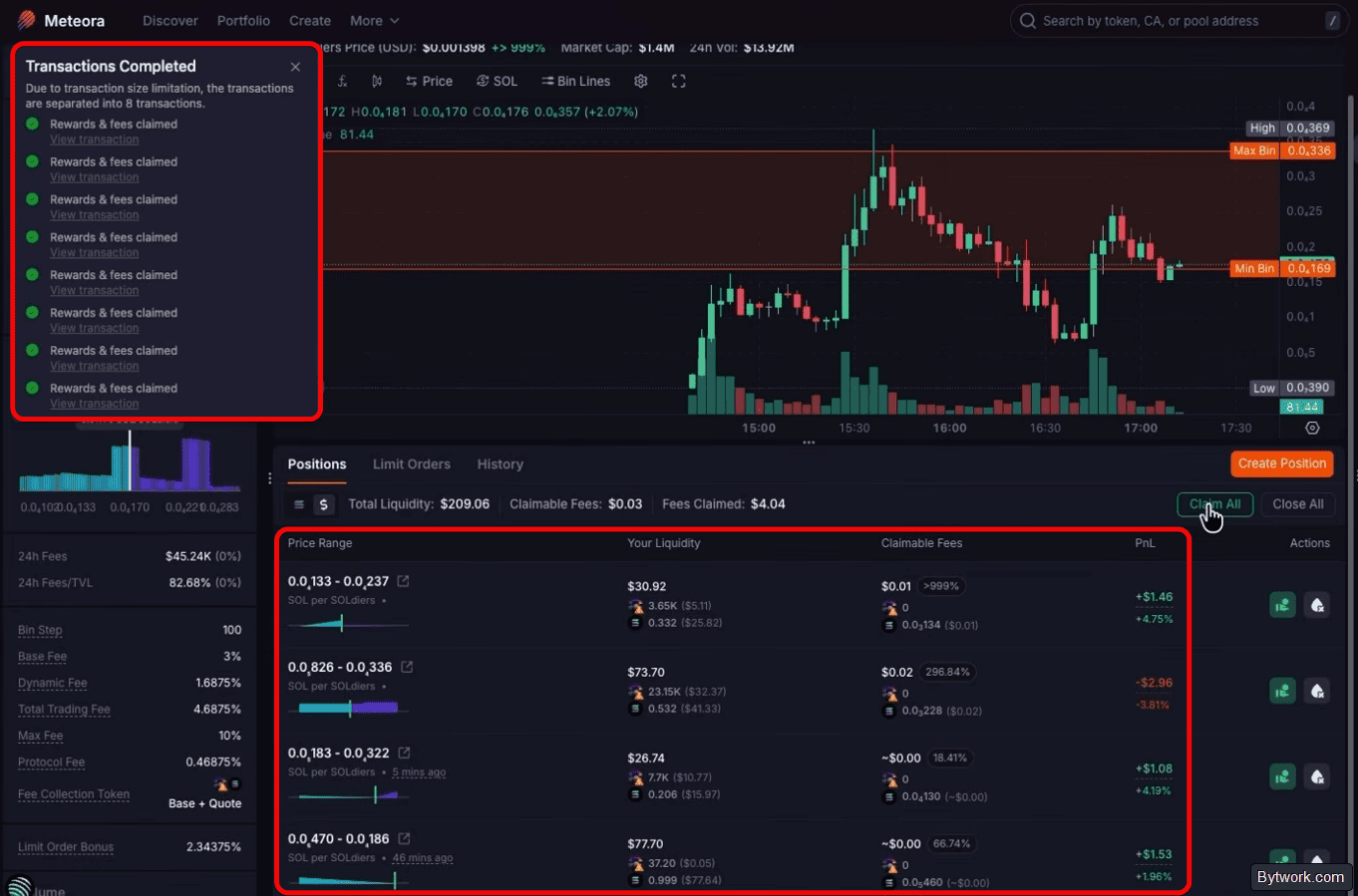
If multiple positions are open, a collective fee claim will be available. Do not click Claim after every dollar earned – even on the cheap Solana network, each operation requires a transaction, and too frequent actions only complicate accounting.
We have covered the basic and safe position. This is a good strategy.
Advanced farming – finding memecoins
For advanced users, there are expert combinations of various services to find promising positions. However, this requires active position management and the use of external analytical services.
Here we are talking about yields of tens of percent per day, not per month. But the risks are many times higher – a memecoin can go to zero in 10 minutes. Therefore, the advanced strategy is not built around guessing a coin, but around a combination of screeners, security checks, and strict risk management.
Below is an algorithm that allows you to select only those pools where high volume is backed by real liquidity, not preparation for a rug pull.
Step 1. Find the coin of the day using on-chain screeners
Do not start your search with Meteora. Start with external screeners that show which coin is gaining volume before it appears in the protocol's top lists.
- Open Jupiter, Metlex or BullX.
- Filter coins that have already migrated from Pump.fun to Raydium and show huge volume combined with buy pressure.
- Look for an entry point not at the peak of the impulse, but during a consolidation phase. Market cap around 20–50M$, daily trading volume above 50M$, the chart has transitioned from a sharp pump to a sideways move. This is when PvP begins, traders take profits, new buyers chase, and the pool processes the maximum number of trades. This helps us collect their fees.

Caution! If a coin has already pumped 300% in an hour and volume is falling, skip it. We need a hot but stabilized asset.
Step 2. Filter pools on DexScreener
After shortlisting 2–3 finalists, check them through DexScreener to assess the quality of pools on Meteora.
- Open DexScreener, set network to Solana, and go to the Meteora section.
- Click
Topat the top row, then sort by volume forLast Hour. - Click on the
Liquiditycolumn to sort values in ascending order. - Find the target token among the positions and evaluate three ratios:
- Trading volume exceeds liquidity (ideally by multiples or an order of magnitude).
- Market cap exceeds liquidity (preferably by 2–3 times).
- Trading volume exceeds market cap (the main marker of extreme hype).
- Ensure that the total pool liquidity exceeds $100,000. If the figure is lower, the risk of a rug pull skyrockets.
- Look strictly for DLMM pools, avoiding other types.

It is foolish to jump into a pool solely because of a gigantic APR. Analyze the Volume/TVL ratio. With high numbers, the lion's share of fees will go to your pocket, not be spread among other providers.
Step 3. Conduct a double analysis: GMGN + rug‑pull check
We move on to a detailed risk audit. External analytics show turnover but hide the distribution among large holders.
- Copy the token's smart contract address. On DexScreener, it is written right next to the trading pair.
- Paste the copied address into the search bar on GMGN.
- On the asset card, check important metrics:
- Market cap, liquidity, and turnover. Figures may differ from DexScreener, but the overall scale should match.
- FDV should be above $250,000; otherwise, you will simply lose your deposit on an illiquid shitcoin.
- Holder structure – if a couple of wallets hold the lion's share of the supply (critical – top 3 holding 10–15% or more), they can easily crash the price. Skip such scams immediately.
- Community activity – working links to X, Telegram, and a website. Only live activity generates real volume.

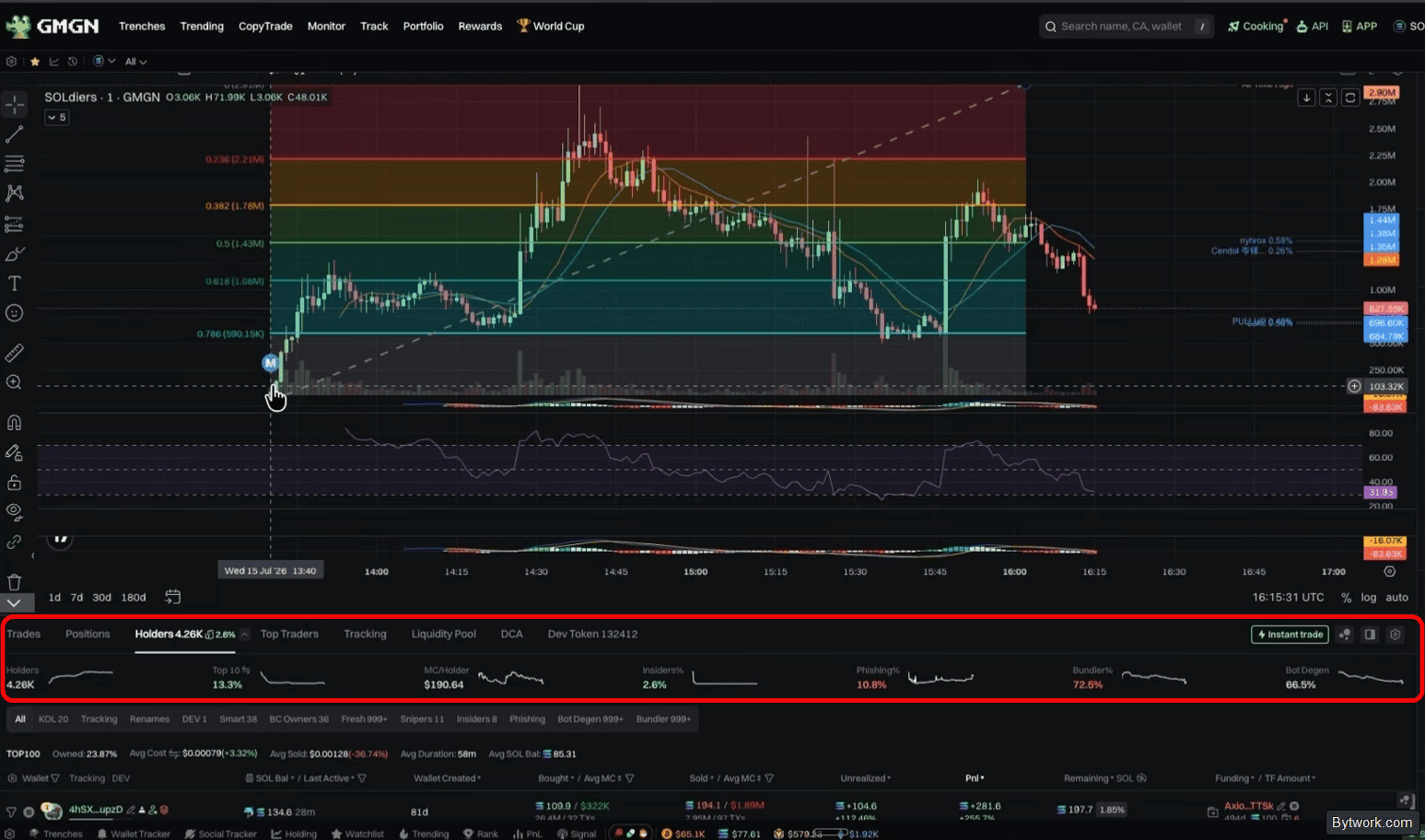
- Duplicate the check of the contract on RugCheck and CoinMarketCap. This will definitively weed out fake token clones.
- Pay special attention to the pool specifically in the SOL pair, putting USDC aside. In the Liquidity block on Meteora or GMGN, examine the daily turnover against SOL. With meager figures (e.g., $300 in 24 hours), fees will be tiny, and you will be stuck in the coin.
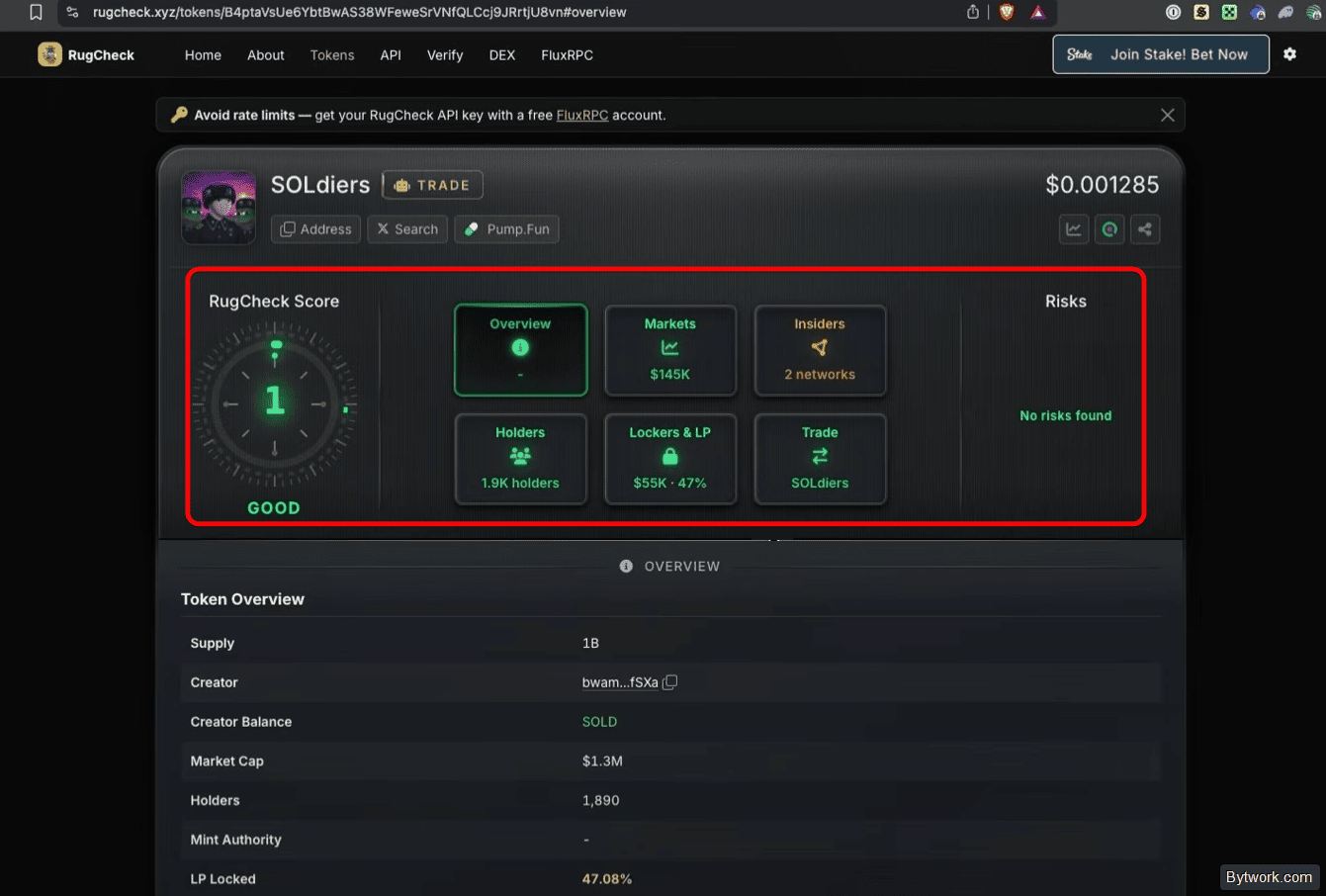
If the coin is squeezed by whales, social media is dead, and liquidity against SOL is laughable, move on, ignoring any tempting APR numbers on the screen.
Step 4. Choose the pool on Meteora
Close the analytics and move to practice.
- On Meteora, go to the
Discovertab or just paste the contract address into the search bar. - Pick the
SOL/your_tokenpool with the highest TVL. Such a safety cushion will protect against a rug pull and prove that real people are inside, not a bunch of arbitrage bots. - In the pool card, evaluate important parameters:
- Volume 24H / TVL ratio – great when daily turnover is several times higher than locked liquidity.
- Bin step – for volatile memecoins, choose a wide range (
Bin 200–400). A small step (Bin 10–50) will show crazy yield at the start, but the price will kick you out of positions in minutes. A wide bin smooths out price spikes and allows farming over time. - Commission size – it is floating here. For fresh coins, creators set 2% or higher, but keep in mind – high fees scare away traders, reducing volume.
- Look strictly for DMM pool format, avoiding DMM V2, because the second version is often used by teams for their own token launches.

In memecoins, it is wiser to take a stable 15% per day on wide boundaries than to chase 150% APR in a narrow corridor that will eject you in 10 minutes.
Step 5. Set the range and strategy
Entering memecoins through a classic 50/50 two-sided position is an unjustified risk. If the chart goes down, all your SOL turns into a depreciating token. It is safer to work only one-sided.
- Open the pool and click
Create Position. - Turn off the
Auto-filltoggle, because for this task it is useless, since we will be depositing only one asset. - Choose the
Bid‑Askstrategy. It works exactly the opposite of the classic curve. Liquidity density increases towards the edges of the corridor. When the price drops, you buy the coin in portions, so the average entry point is much lower than the middle of the range. For volatile assets, this is the safest shield. - Make a one‑sided entry strictly in SOL, without buying the memecoin in advance. In this configuration, you do not take the coin on spot, but simply place a liquidity grid for a drop. This manoeuvre cuts risks by 2–3 times compared to a standard entry.
- Set the price boundaries:
- Upper bound – the current market price (or slightly lower for maximum safety)
- Lower bound – at least –50% from current values, but for safety it is better to go as low as –90%
- A wide corridor requires more capital to open due to the many bins, but reliably protects against a sharp dump
- If the token is stuck in a flat, take the entire traded corridor from the local peak to the nearest strong support level
- Allocate no more than 0.3–0.5 SOL per position. This is an unbreakable risk‑management rule.
- Set
slippage– enter 1.5% in both fields. If the market goes wild and transactions start failing, increase slippage to 2–5%, but do not raise it higher.
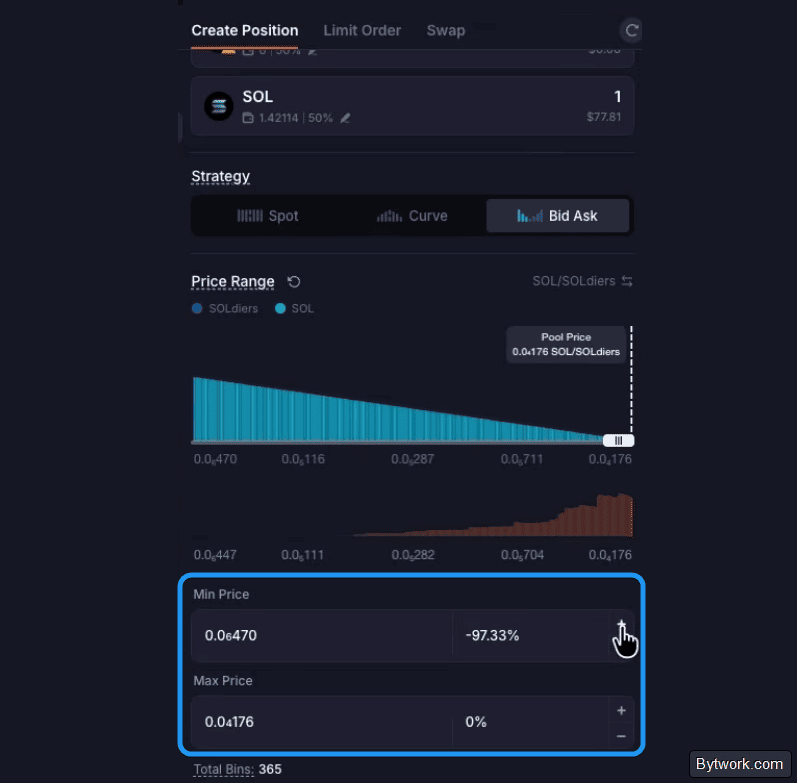
Never open a pool for upward movement; only work for downside. Memecoins are too unstable, so a long position is essentially a lottery, not systematic farming.
Step 6. Place a ladder of ranges
It is foolish to pour your entire deposit into a single pool. Split your capital into parts and place positions in a cascade.

This way you maintain continuous farming even if the chart dives deep.
- Divide the allocated working capital into 4–5 equal parts.
- The first position is spread from the current market price down to –50% or your local target.
- If the token rolls downward and breaks the lower boundary, immediately open the second position right below the first. For a prolonged drop, repeat this maneuver further down the chain.
- Each subsequent block is activated only after the previous one is 100% filled, i.e., when all your SOL has been converted into the memecoin.
- Move strictly from top to bottom. Forget about trying to catch the perfect bottom; simply add volume progressively as the price falls.
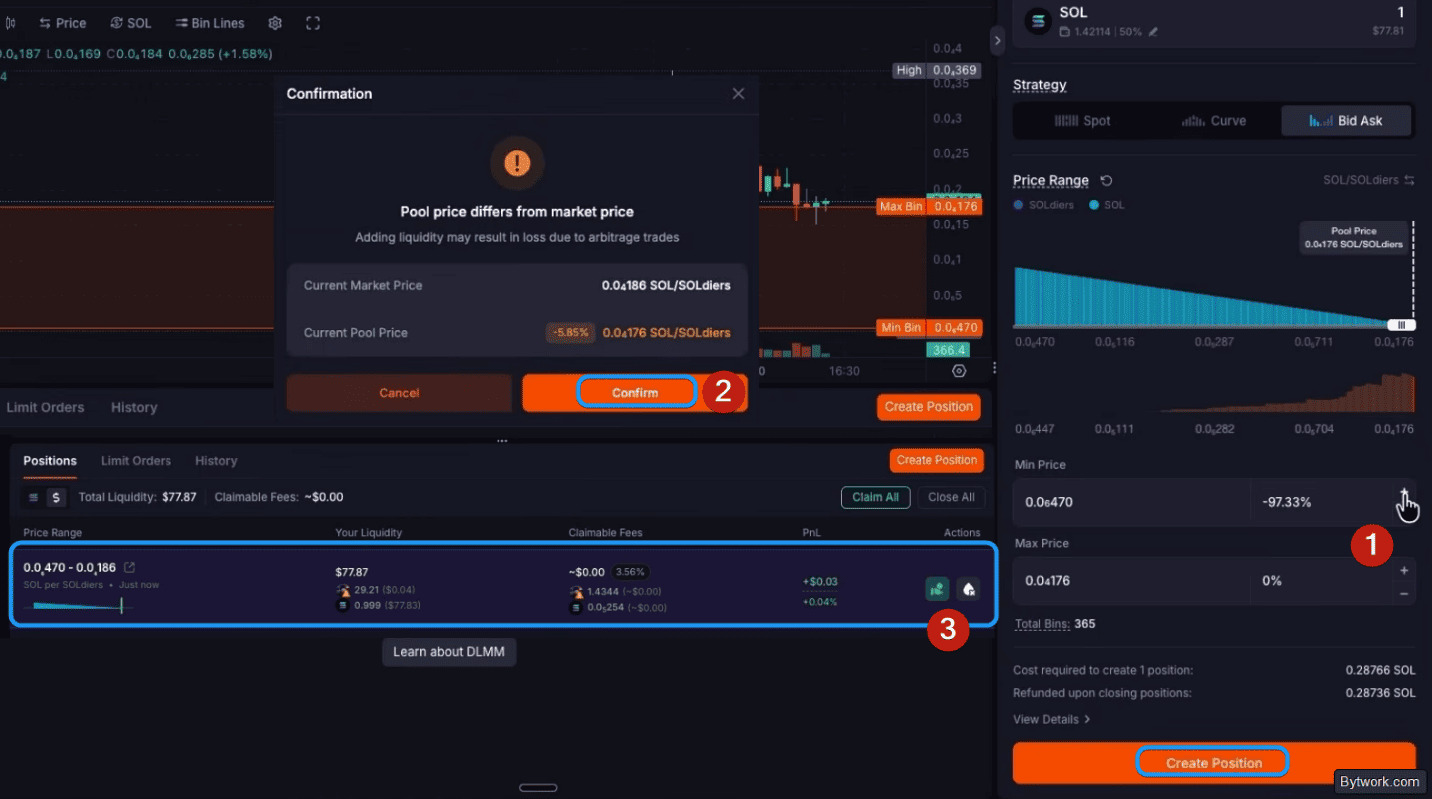
In this example, our open position in the SOL/SOLdiers pair worth $77.87 in the price range 0.04470 – 0.04186 has a yield of +0.04% and net PnL of +$0.03.
If the final order in the cascade is fully filled and the chart continues to plunge, do not panic. It is safer to wait for a technical bounce. However, if the total drawdown breaks –60% from your very first entry point, close the position, take the net loss, and switch to other coins.
Step 7. Monitor activity, collect fees, and lock in results
Memecoins should not be left unattended over the weekend. This is purely speculative and requires constant oversight.
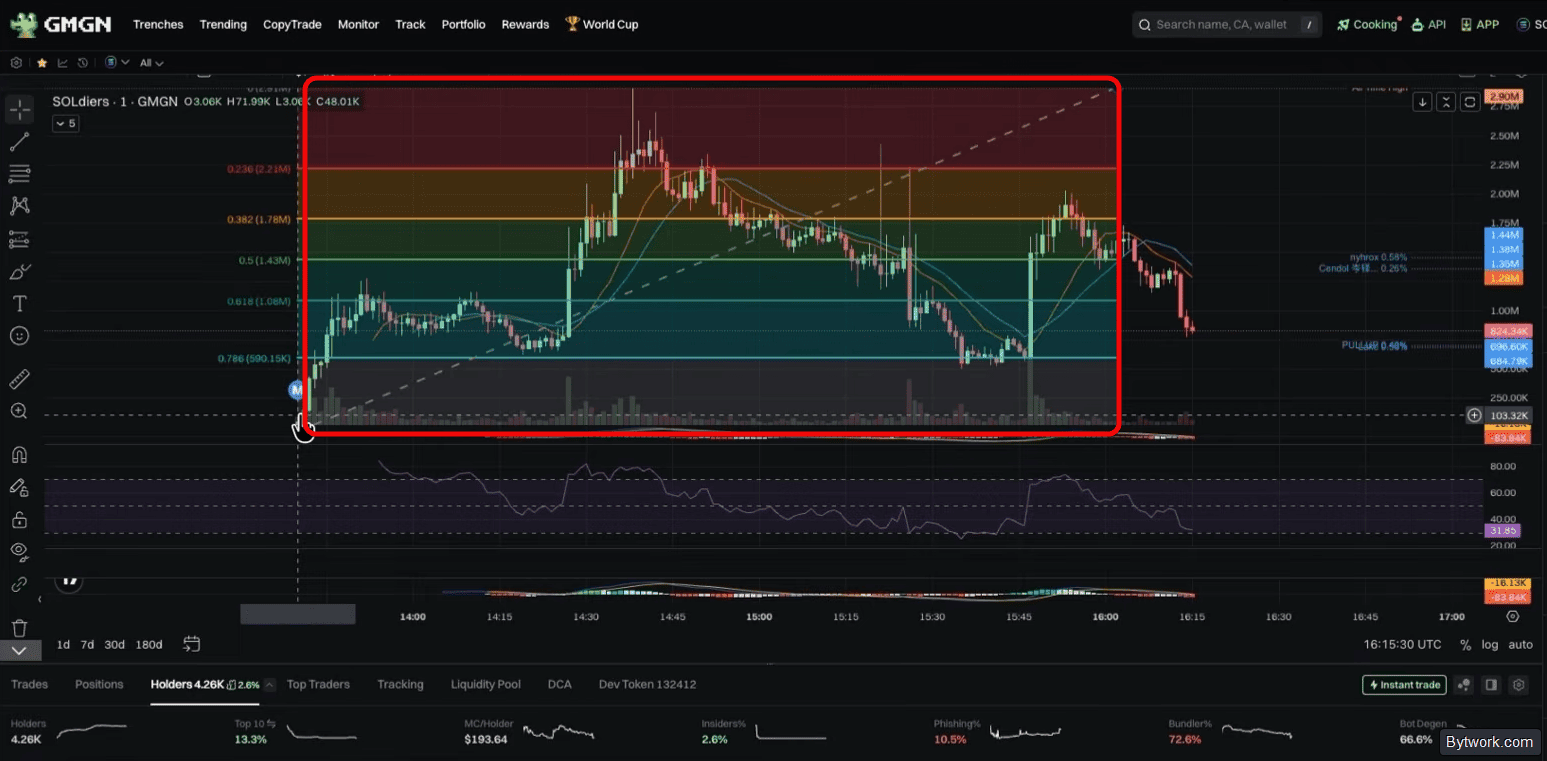
- Check GMGN or DexScreener several times a day. Track price dynamics, turnover, and social media activity. If trading activity drops significantly, it is a clear signal to exit. We draw Fibonacci for tracking.
- Click
Claimonly when a noticeable amount has accumulated. It is pointless to trigger the smart contract for every dollar, as Solana charges gas for every action. - As soon as a position yields +10% net profit on the initial deposit, close the pool completely and convert back to SOL. Forget about dreams of x's. Take the systematic 10% and roll into the next asset.
- It is dangerous to stay in fresh memecoins for more than 4–8 hours. If during that period the chart has not produced a technical bounce and trading is fading, close the shop even before reaching the +10% target.
- Exit technique:
- Click
Withdraw→Withdraw and Close Position– this way you take both the initial capital and the farmed fees in one click. - Activate the
Zap Outfunction so that Meteora automatically converts the remaining tokens into pure SOL upon withdrawal. - Monitor the
Price Impactduring the conversion of junk coins. If slippage jumps to tens of percent, skip the internal swap in the pool. It is better to withdraw tokens to your Phantom wallet and route them through Jupiter or Raydium aggregators.
- After the final settlement, click
Generate My PNL. This will load a detailed breakdown of net yield, drawdowns, and time spent in the pool. This will allow you to tweak settings for the future.
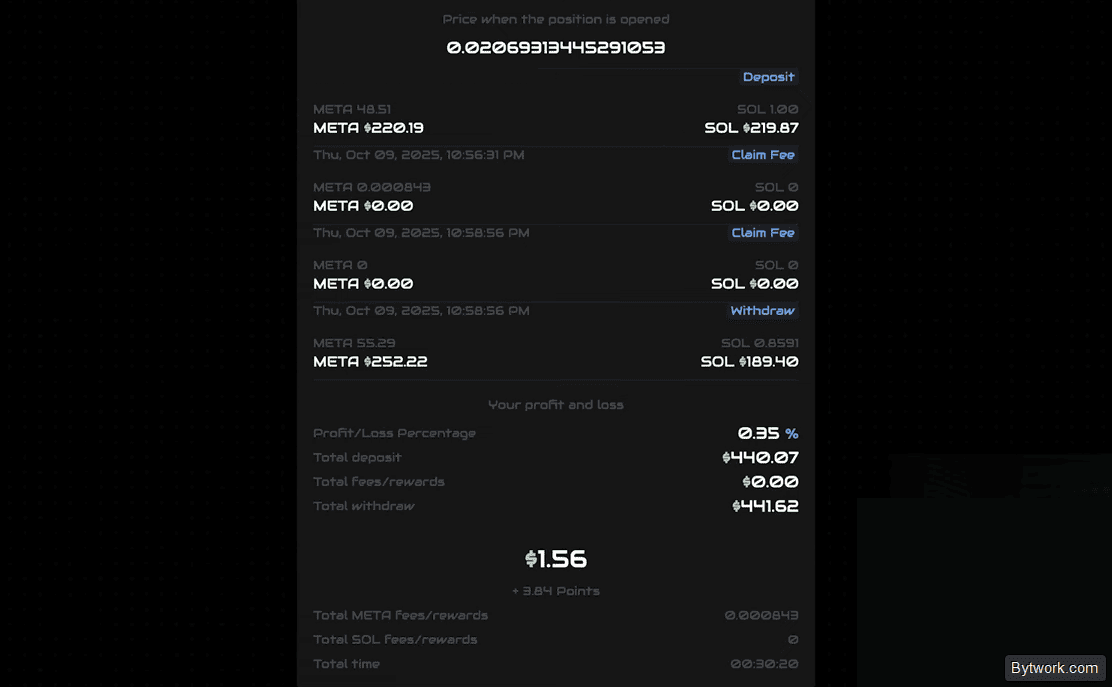
Catching the perfect peak is impossible. Taking 10–20% profit from the market is always a win. It is safer to exit early and switch to a fresh trend than to stay too long and fall into deep loss.
Final checklist for the advanced strategy
Here is what you need to understand from the advanced strategy overall.
|
Stage |
Service |
What to check? |
|
Asset search |
Jupiter / Metlex / BullX |
Migration to Raydium, daily volume $50M+, holding $20–50M market cap. |
|
Pool filtering |
DexScreener |
Trading volume strongly exceeds TVL, total liquidity from $100k, DLMM label, strictly SOL pair. |
|
Security |
GMGN + CoinMarketCap |
FDV above $250k, no whale concentration of supply, active social media, healthy SOL volume. |
|
Pool selection |
Meteora Discover |
Highest TVL, high Volume/TVL ratio, wide Bin step 200–400 for volatility. |
|
Configuration |
Meteora DLMM |
Bid-Ask (BASK) strategy, one-sided entry with SOL, |
|
Risk management |
- |
Strictly 0.3–0.5 SOL per pool, cascade of 4–5 positions in a ladder, hard stop at –60% drawdown, take profit at +10%. |
|
Exit |
Meteora + Jupiter |
|
It looks complicated, so you need practice with all these services.
MET token, referrals, and passive income from fees
The protocol has its own token – MET. The practical use of this token is to gain access to a share of the protocol's fee collection through referral staking.
What are the percentages? 90% of fees go to the liquidity provider, and 10% goes to the protocol. These 10% are distributed as follows:
- 10% – to MET token stakers.
- 8% – to the referrer (the one who invited).
- 2% – to the referee (trader) as cashback.
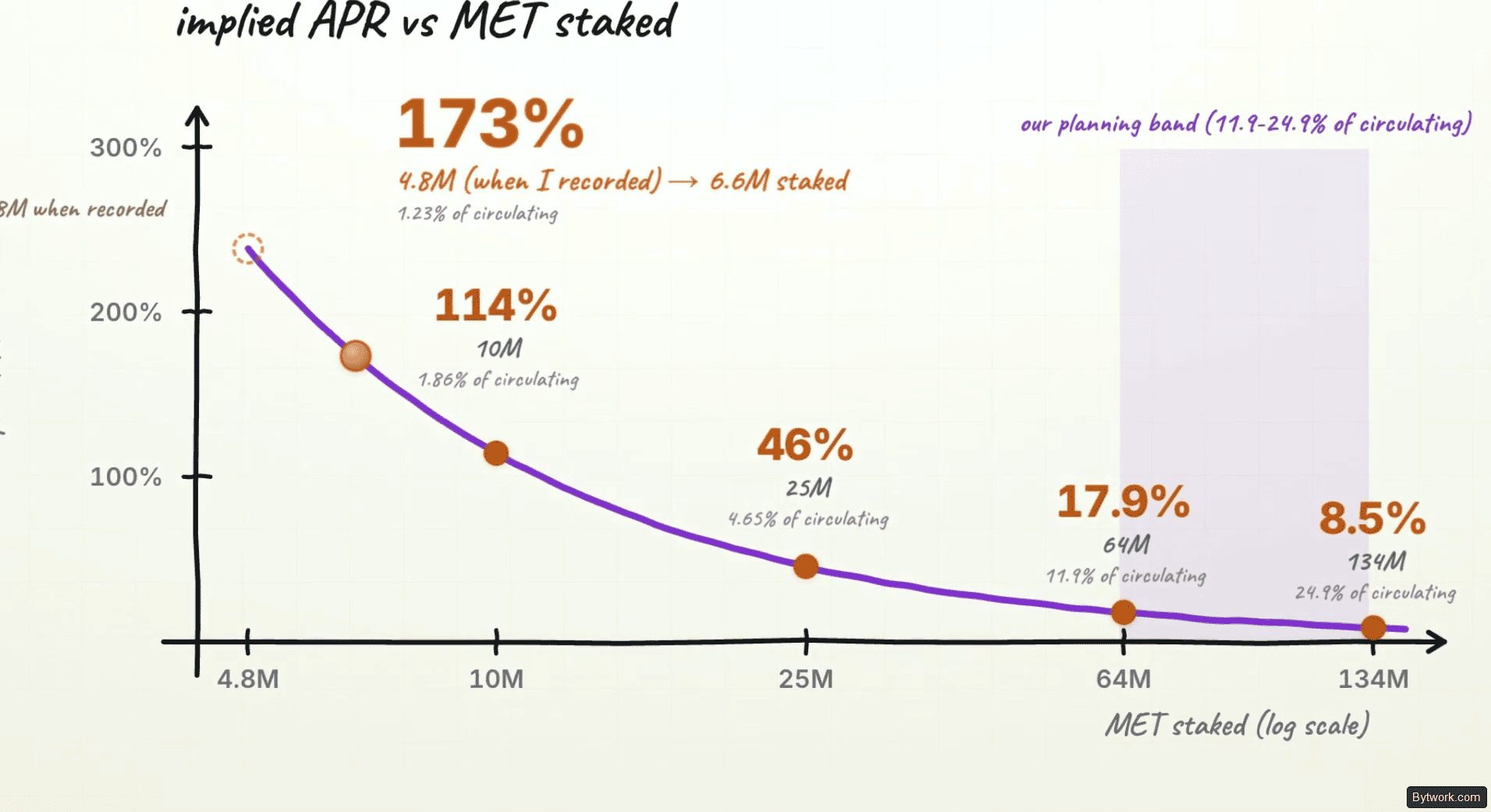
The chart below clearly shows the estimated staking yield of Meteora dropping from an initial 173% to a modest 8.5% APR, as locked volumes grew from 4.8M to 134M MET (which absorbs 24.9% of the circulating supply).
The minimum stake to activate a referral link is 200 MET.
Our staking experience is based on 4 approaches.
- To diversify risks and bypass hard limits for airdrops, we connect 10 or more wallets.
- If the goal is not to save, but to compound, you can claim accumulated fees daily, which reinvests at compound interest and protects profits from sharp price swings.
- Referral cashback of 2% is strictly tied to the staked amount of the inviter, so it makes sense to attach yourself to large players with a hefty bag of staked MET.
- Due to delays and lag in the native Meteora interface for honest PnL audits and accumulated points, we use external trackers like Metlex, Ultra LP, or Track LP.
Our active referral staking position holds 19.50K MET locked in the initial round (30 days remaining until unlock). The rate is 19.92% APR.

If you withdraw MET from staking before the end of the vesting period, you will lose all accumulated rewards!
Here is the essence of MET tokenomics:
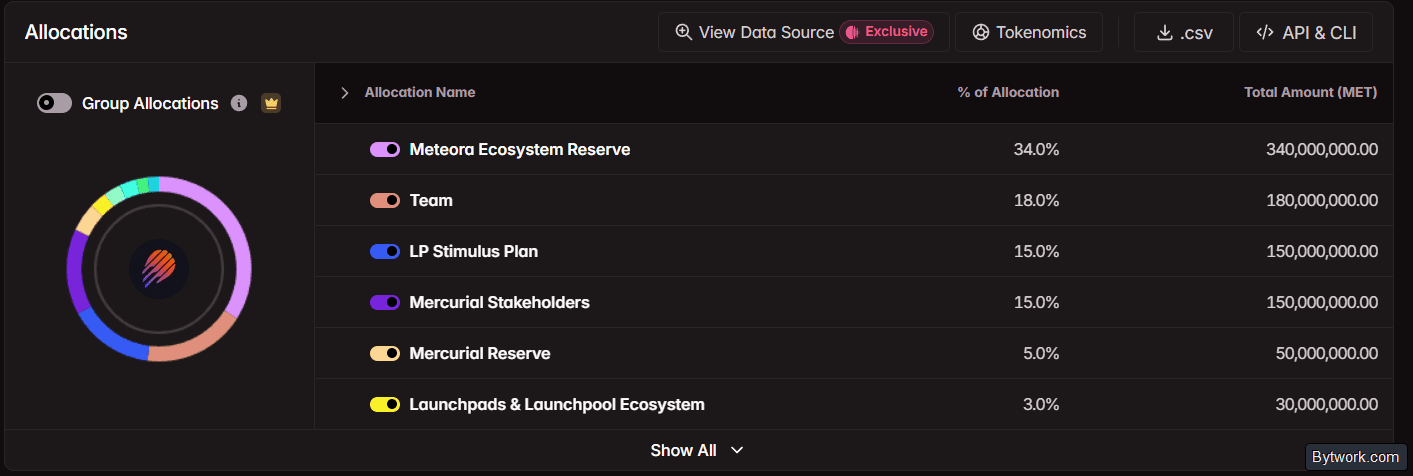
- Supply – total 1 billion MET.
- Airdrop – 45% retroactive to the community, 3% to JUP stakers (linearly by weight/duration).
- Market makers / CEX – 3%.
- Inflation – 20% per year for the first 6 years (linear unlocks without cliffs).
Point farming is the basic way to earn MET in future activity epochs. One dollar of locked liquidity per day generates 1 point, while one dollar of earned fees brings 1000 points. This math makes volume farming via fees 1000 times more effective than passive liquidity holding.
Points are earned for activity inside DLMM, dynamic pools, and multi‑token baskets. At the same time, classic dynamic vaults are completely excluded from point distribution.
Q&A about Meteora
Your questions will not go unanswered. We are here to share our experience working with Meteora.
Yield, myths about high APR, and real earnings
- Why can the high APR shown in the interface be misleading?
- APR is calculated for a narrow range. When the price exits that range, fee accrual stops.
- Why can’t you just enter any pool with high yield?
- About 90% of memecoin pools lead to deposit loss. It is safer to choose reliable pairs like Solana/USDC with a wide range.
- Why should you avoid pools with the highest commission (e.g., 5%)?
- High commissions scare away traders and reduce trading volume. You will earn less than in a pool with 0.2% commission and high volume.
- Why aren’t fees accrued immediately after opening a pool?
- Accrual starts only after the market price enters the set range, which can take 5–10 minutes to 1 hour.
- What commission is best for a new pool?
- A commission of 2% or higher is recommended. Pools with 5% and 400 bins have been successfully launched to attract arbitrage bots.
Managing positions and saving funds
- What to do if the position goes out of range?
- Close the position to collect fees and open a new one in the current range. Without regular monitoring, yield drops to zero.
- What loss occurs when the price falls below the lower boundary of the pool?
- The loss depends on the bin width – for Bin 100 it is about 10%, for Bin 200 – 20–22%, for Bin 400 – roughly 40%. Exiting above the upper boundary involves no loss.
- What is Zap Out and when to use it?
- Zap Out withdraws all funds in a single currency even if the pool is paused, to lock in profit, but the exchange rate may differ due to slippage.
- How to distribute a deposit to reduce risk during a price drop?
- Split the deposit into 4–5 equal parts. As the price falls, open a new range below the previous one along the trend, using USDC.
How to protect against an instant rug
- How safe is it to invest in shitcoins on Meteora?
- The risk is extremely high. The average holding time of a shitcoin on Solana is about 30 seconds, which leads to rapid capital loss.
- How to protect against losses when farming?
- Use only Solana for entry to reduce risk by 2–3 times. Choose the Bid Ask strategy, set boundaries using support/resistance levels, and constantly monitor the chart.
- What is the maximum safe position size?
- No more than 0.5 SOL (about $40–50) per order, with an overall limit up to $85.
How to find coins and entry points correctly
- How to tell if a pool is suitable for entry or for exit?
- Use BullX and Pump Vision to find coins with a market cap of 40–60M$, migrated to Raydium, and with daily volume over 50M$. Enter during price consolidation with high volume.
- Which memecoin selection criteria are truly important and which are misleading?
- Important: pool age from 5 to 24 hours and social media activity. Formal metrics like market cap over $100k and liquidity of 1:2–1:3 often confuse.
Secrets of choosing pools and coins
- Which binstep to choose for volatile pairs?
- For volatile pairs, choose bin 20+, and for stable pairs, bin 4–10.
- Which gas setting is critical to minimize costs?
- Manually set Priority fee to Ultra and Max compute unit to 0.002 SOL. Default settings are inflated and eat into profit.
- Which pools on Meteora should be used and which should not?
- Use only DLMM and DAMM V2. DAMM V1, multi‑token pools, and farms with TVL below $1M are not recommended due to low liquidity.
- Which assets do experienced users prefer?
- Most choose Solana and stablecoins, completely avoiding shitcoins because they tend to rug in less than 30 seconds on average.
- What exact numbers should be checked before entry?
- Check on CoinMarketCap and the Liquidity section on Meteora in the SOL pair – FDV strictly above $250k, liquidity from hundreds of thousands, daily volume from $100–200k.
- What is the real commission charged when opening a pool, and is it refunded?
- About $5 in SOL is deducted and fully refunded when the pool is closed.
We have covered all the questions; now it is time to consider Meteora's drawbacks.
What are the drawbacks of Meteora?
Although Meteora uses advanced DLMM technology, there remain 3 groups of risks.
1. Losses and missed opportunities
|
Issue |
Nature of the risk |
Example / Figures |
|
Liquidity concentration |
Narrow bin ranges accelerate the speed and scale of impermanent loss (IL) compared to AMM V2. |
Losses hit harder with even small price movements. |
|
Complete devaluation |
When the price falls below the lower boundary, the position becomes 100% allocated to the dropped asset. |
In the Spot strategy (Bin Step 100), a ~28% drop means a net loss of 28%. |
|
Profit limitation |
During a sharp price rise (pump), the position is completely sold into stablecoins or the base asset. |
The crypto enthusiast misses the main market move. |
Therefore, it is important to manage the position range and monitor the market.
2. Hidden fees
|
Expense type |
Purpose of payment |
Fee amount |
|
Bin rent |
Refundable deposit for opening a standard position (69–70 bins). |
~0.05–0.06 SOL |
|
Bin array creation |
Non-refundable fee for adding liquidity in a new price range. |
~0.07 SOL per array |
|
Entry costs |
Slippage when buying tokens in volatile pairs. |
From 3.5–5% up to 50% on hype launches |
|
Entry threshold |
Network fees make farming unprofitable for small deposits. |
Critical for small deposits |
Solana seems cheap, but hidden fees can eat into your yield.
3. Risks of 99% drops in new memecoins
|
Risk factor |
Nature of threat |
Technical conditions |
|
Dev scam |
Developers use wallet bundles to control more than 20% of the supply. |
Allows them to instantly crash the pool price. |
|
Yield trap |
Anomalously high APY (from 1000%+) is used as bait before a rug pull. |
99% of new tokens are created for scams. |
|
Infrastructure and speed |
The average holding time of a memecoin in a pool is less than one minute (58 seconds). |
Requires private RPC ($50/month) and bots. |
|
Interface limitations |
The Meteora website lags in PnL data; automatic rebalancing does not work as intended. |
Requires manual 24/7 monitoring and external trackers. |
In practice, it is difficult to place more than $10,000 efficiently in young pools, as that dilutes yield and complicates exit. Also, working with memecoins requires experience and attention.
Conclusion
After 2 years of working with the protocol, our experience has been positive. This is largely thanks to choosing Solana and stablecoins instead of speculating on memecoins. It is profitable, but complex.
Let's recap. Meteora allows you to provide liquidity in DLMM pools and earn fees from other users' swaps. You set the price range yourself. Inside it, the asset converts as the market moves (on a rise – into stablecoins, on a fall – into the token).
A narrow range generates more fees but requires attention, while a wide range is calmer but less efficient.
One-sided positions allow you to average down or take profit on rises. Multiple ranges distribute entries and exits at different prices, but do not eliminate market risk.
Holders of the MET token can participate in the distribution of DLMM fees, create referral codes, and receive rewards from the activity of their invitees, who in turn get cashback from part of the protocol fee.
Risks. Neither pools, nor staking, nor the referral program guarantee profit. The outcome depends on asset selection, trading volume, range width, capital management, and understanding which coin you will be left with after market movement.
On Meteora, you can also create your own token – large volumes and an audience simplify the launch. For entries, use Fibonacci levels and RSI; for capital protection, use the bid-ask strategy.
We believe that if Solana stays in a sideways range for a long time, it is better to put it to work in a pool and earn interest rather than let it sit idle.
Your editor – Maksim Anisimov for bytwork.com. Checked by Pavel Grachev.


