Inside Robinhood Chain: A Comprehensive Breakdown of the New RWA Blockchain

Robinhood Chain is an L2 blockchain on Arbitrum Orbit, launched in July 2026 with a base of 27 million potential users and a daily DEX volume of up to $877 million. However, behind the impressive numbers lies a problem — 95% of this volume comes from the race for memecoins, not tokenized stocks, for which the network was supposedly created.
What is Robinhood?
Robinhood is a licensed stock broker launched in 2013.
Financial and operational metrics:
- about $100 billion market capitalization
- 27.7–30 million verified clients with a balance
- $377 billion in assets under custodial management (AUC), with over $56 billion held in crypto
- $1 billion annual revenue run rate
Robinhood consists of 3 digital products:

- App (Robinhood App) - a brokerage platform for trading traditional stocks, options, and custodial crypto.
- Wallet (Robinhood Wallet) - a self-custodial wallet for storing assets and interacting with decentralized services.
- Crypto Network (Robinhood Chain) - a proprietary Layer 2 blockchain built on Arbitrum Orbit architecture to combine stocks with DeFi via RWA.
Projects are flocking to the Robinhood network, with decentralized exchanges (Uniswap, Curve DEX, PancakeSwap, RobinSwap, and others) and lending platforms (Morpho Blue, Native Credit Pool) dominating the scene. ETH is used for gas fees within the network.
Network Express Assessment
| Parameter | Rating | Comment |
| Fault Tolerance | 40% failure rate | 40% of Uniswap transactions are reverted due to memecoin volatility, wasting gas completely. |
| Accessibility (UX/UI) | 0 seed phrases / in-app | Seamless integration into the Robinhood app; key generation and storage are automated within the app. |
| Architectural Security | L2 Arbitrum / 1 Sequencer | The network uses Ethereum consensus via Arbitrum Orbit, but relies on a single centralized validator. |
| Capital Density | Volume-to-TVL disparity | The network's trading turnover far exceeds the locked funds, maintaining a ratio of ~26:1. |
| Fees | <$0.01 | Base gas cost is less than one cent; the operator fully subsidizes fees for fresh wallets. |
| Block Time | 0.1 seconds | This is 120 times faster than Ethereum (12 seconds) and 20 times faster than the Base L2 network (2 seconds). |
Robinhood's servers are physically located in the US. With a block time of 100 ms, traders from Asia experience a ping of 200 ms, which is equivalent to a lag of 2 full blocks. This gives American players a solid advantage in order submission speed. And having just 1 sequencer allows centralized network shutdown.
Legal Entities and Licenses
In the US market, the company secured SEC backing, registered as an FCM with the CFTC, and obtained a strict BitLicense from NYDFS. At the same time, for global expansion, the broker fully aligned its processes with European MiFID directives and the new MiCA regulation.
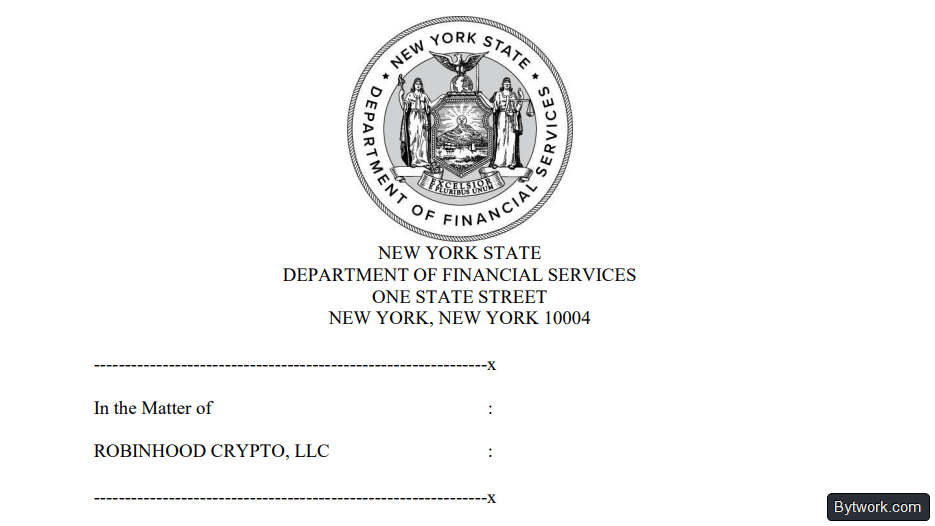
Security has also been upgraded. Client funds are protected by Lloyd's of London insurance program. But that applies to stocks.
Crypto Network Security
Crypto is protected by a Crime Insurance policy from Lloyd's of London against hacking, but the terms are vague. The company is trying to sit on two chairs – combining the reputation of a traditional broker with the chaos of crypto markets.
The Robinhood network has absolutely no preliminary smart contract checks. As a result, the on-chain space has been flooded with honeypots and drainers, and the Relay protocol has already recorded mass token theft.
Centralization is present. The project team retained the right to freeze transactions via the sequencer to comply with regulatory requirements.
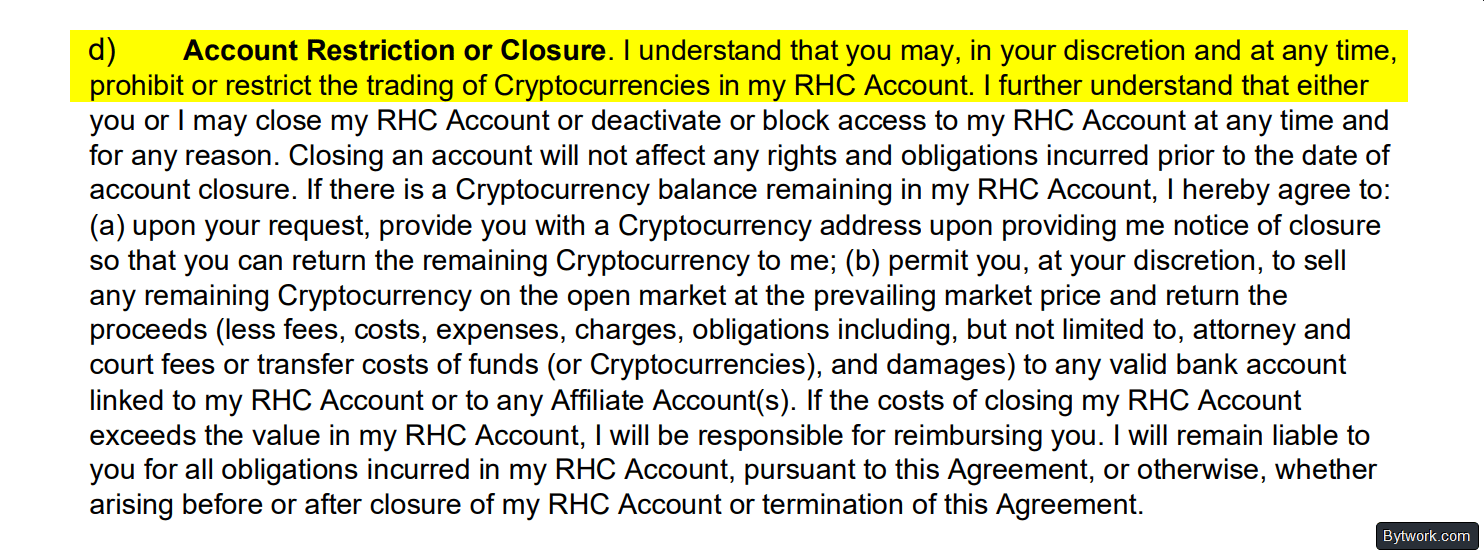
However, the broker technically refuses to filter scams, ultimately shifting security checks to the personal responsibility of holders.
What are the earning schemes on the Robinhood network?
There are 4 earning directions on Robinhood:
- Through the official brokerage app (stablecoin, indices)
- Through DeFi protocols (lending, borrowing, and providing liquidity)
- Through memecoins (chasing hype and speculation)
- Through airdrops
Let's look at the numbers for these directions.
Scheme 1. Official Directions (Low/Medium Risk)
The index mechanics include a 3% tax on every Index token trade, which automatically buys a basket of stocks (Nvidia, Tesla, SpaceX, etc.). These stocks are airdropped to holders of more than 10,000 tokens every 15 minutes. Over $155,000 was sent to wallets as RWA assets during one of the dividend distributions.
|
Program |
What do we grow on? |
Yield and conditions |
Insurance and reward |
|
Robinhood Earn |
USDG stablecoin (Paxos) |
7% APY (real-time accrual) |
Insurance from Lloyds and Realm (smart contract hacks) |
|
Indices |
Tokenized stocks (Apple, Nvidia, SpaceX) |
Pool distribution from 3% of fees |
Payouts every 15 min (threshold: 10,000 Index tokens) |
The official Robinhood Earn program works only in the US.
Scheme 2. DeFi Mechanics (Uniswap LP)
90% of all transactions on Robinhood Chain go through ETH, making liquidity provision in pairs with Ethereum the most profitable strategy.
|
Category |
Protocols |
Profit ceiling |
|
DEX |
ETH / USDG and ETH / memes on Uniswap V3 |
Up to 1000% APY in early stages; 90% of network transactions are routed through ETH. |
|
Lending and DeFi hubs |
Lending against stocks via Arrow Finance |
100% exposure to stock growth + Arrow Pad launchpad for direct token issuance within the network. |
|
Lending |
Morpho |
5-6% via special vaults. |
Therefore, in DeFi, we use Uniswap and Morpho.
Scheme 3. Speculation on Memecoins (Extreme Risk)
Primary offerings and early entry are provided by launchpads Pons and Flap (where 9 out of 10 top memecoins are traded).
|
Coin |
Growth rate |
Initial deposit |
Profit and timing |
|
Cash Cat ($CASHCAT) |
Multiple growth (from 15x to 40x) at early hype stage |
Initial capital (around $500–$1000) |
Historical peak - up to $1,000,000 at the first wave peak |
|
Speculative tokens via launchpads |
Ultra-early entry effect in first minutes of listing |
Micro-deposits (within $100) |
Cases of extreme profitability - up to several hundred thousand $ in the first weeks of the network |
|
Sniping, one-click memecoin trading |
Any working balance in ETH |
Allows timely entry into trends and quick profit taking |
|
|
Launch platforms (launchpads) |
Primary token issuance on Pons, Flap |
Although launchpads give cosmic returns, they drop just as fast. |
|
In memecoin speculation, hyper-volatility is the norm. Most people simply won't have time to sell their memes at the peak.
Scheme 4. Airdrop Farming
To hunt for the potential HOOD airdrop, you can regularly generate volume on Robinhood Chain. Bridging ETH into the network can be done via Relay or Across bridges. You can swap tokens on Uniswap, and for daily activity, you can warm up wallet activity through Onchain GM.
|
Exchange |
Total allocation wallet |
How to farm points? |
Boosts |
|
Lighter (Perp DEX) |
$11,000,000 in LIT tokens |
Points awarded for each futures trade |
x2 when trading via Robinhood Wallet |
|
Arcus (DEX) |
Not disclosed |
Closed waitlist + points for early users |
Priority for degen community |
At the same time, participate in confirmed programs. Trade on Lighter via Robinhood Wallet to double your points for the LIT token distribution. Secure a spot on the Arcus waitlist by completing tasks and inviting friends.
However, the airdrop has not been officially confirmed.
Who is the Robinhood network suitable for?
The network is not for everyone. Experience in memecoin trading is needed. And the RWA sector is negligibly small.
|
User type |
Suitable? |
Why? |
|
Memecoin trader |
⚠️ Yes, with caveats |
High volatility + low entry threshold. Beware of scam contracts. |
|
Liquidity provider |
⚠️ Yes, short-term |
Above-average yield, but risk of being the last in the order book = impermanent loss risk. |
|
Airdrop farming |
✅ Yes |
10+ protocols for activity, but the HOOD drop may not happen. |
|
RWA investor |
❌ No |
Real volume of tokenized stocks is around $10–15 million. Hyperliquid has over $3–4 billion in RWA without positioning as an RWA network. |
So, we've covered all the ways to work with the network. Now let's test it experimentally.
How to get started with the network?
Step 1. Wallets
Robinhood Chain is integrated into MetaMask, Rabby, Trust, Zerion. Adding via chainlist.org is automatic, without manual RPC address entry.
1.1 How to add the network via Chainlist?
- Go to chainlist.org
- Connect your wallet (e.g., MetaMask)
- Type Robinhood Chain into the search bar
- Click
Add to MetaMaskand confirm in the wallet.
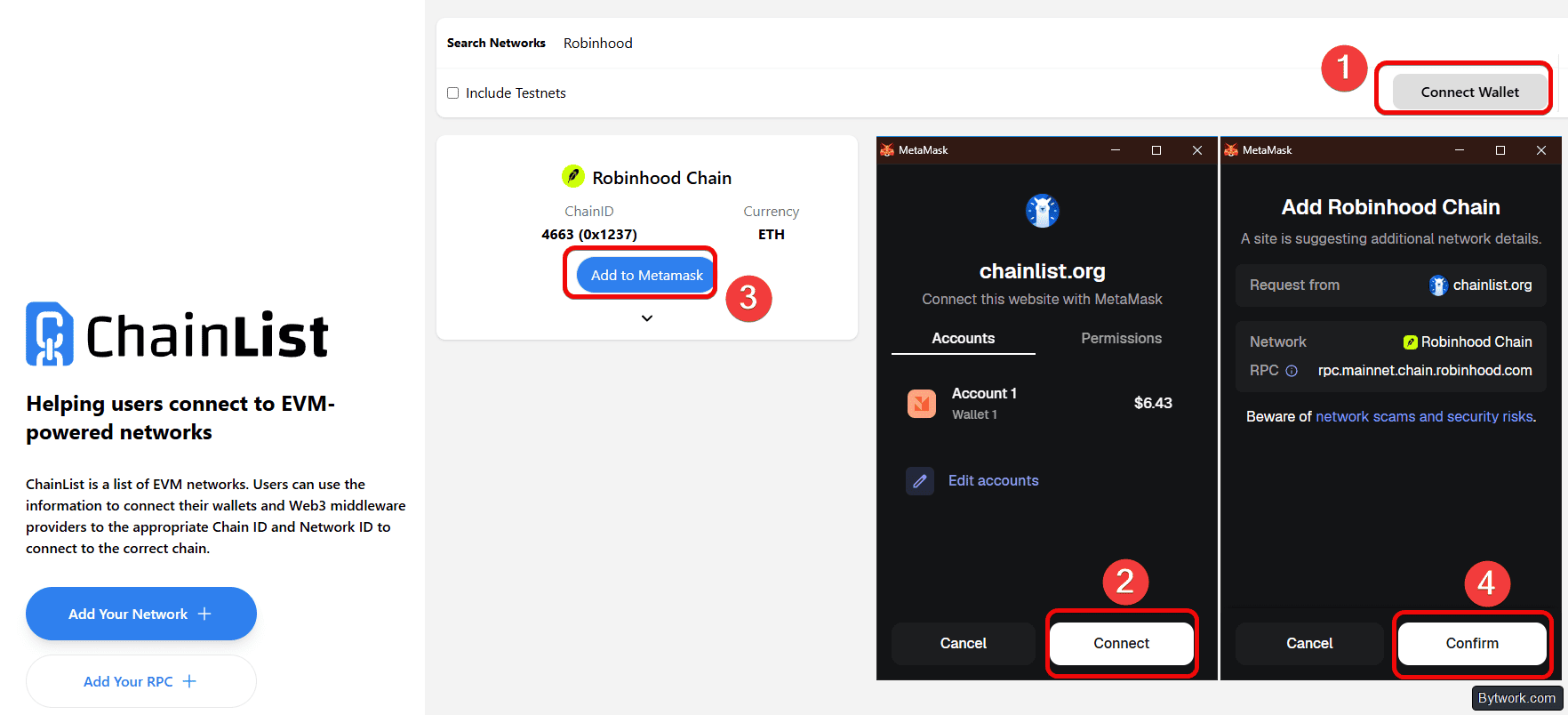
The network can also be added manually.
1.2 Adding the network manually
Go to MetaMask, open the network list, click Manage Networks and select Add a network manually. Enter the network settings:
|
Parameter |
Value |
|
Network Name |
Robinhood Chain |
|
RPC URL |
|
|
Chain ID |
4663 |
|
Currency Symbol |
ETH |
|
Block Explorer |
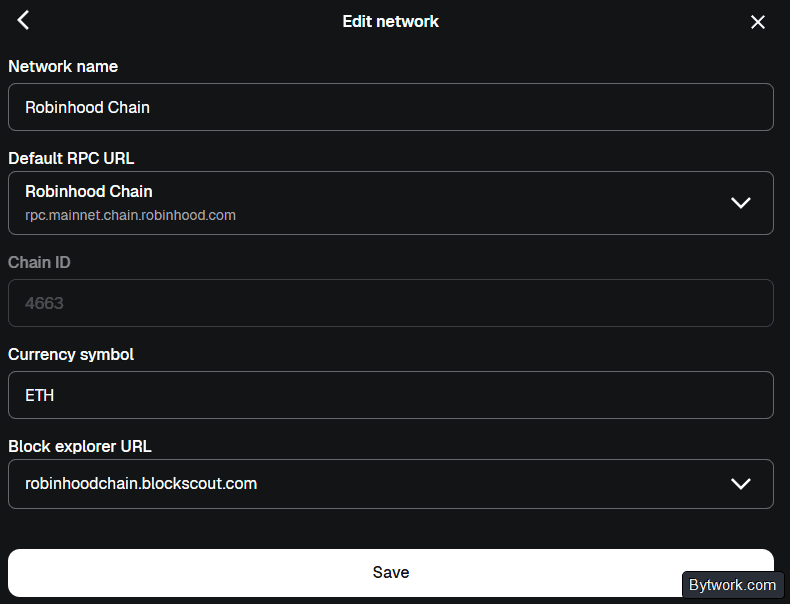
Save and switch to the Robinhood Chain network. ETH coins in this network will be visible separately.
Step 2. Bridging and funding the balance
For funding, use cross-chain bridges. The most popular option is Across on Uniswap, which is fast and convenient.
|
Bridge |
Type |
Feature |
|
Across (built into Uniswap) |
Cross-chain |
Direct transfer of ETH from Arbitrum/Optimism to Robinhood Chain |
|
Aggregator |
Connects 30+ networks, fast processing |
|
|
Aggregator |
Native and cross-chain swaps |
|
|
Native |
Official Arbitrum gateway |
Note that you won't find native USDC/USDT stablecoins in the network. Robinhood works with the USDG stablecoin.

Step 3. Choosing a usage scenario for the network
After you have coins in the network, you need to decide what to do with them. We covered 4 schemes above. Here are our real actions:
- Decentralized exchange via Uniswap, PancakeSwap, GIGA
- Lending on the Morpho protocol (Stakehouse USDG pool). Earns ~5-8% APY in passive income on USDG
- Liquidity farming on Uniswap V3/V4
- Memecoin trading via GMGN, hood.fun, PONS.
Let's briefly look at these options.
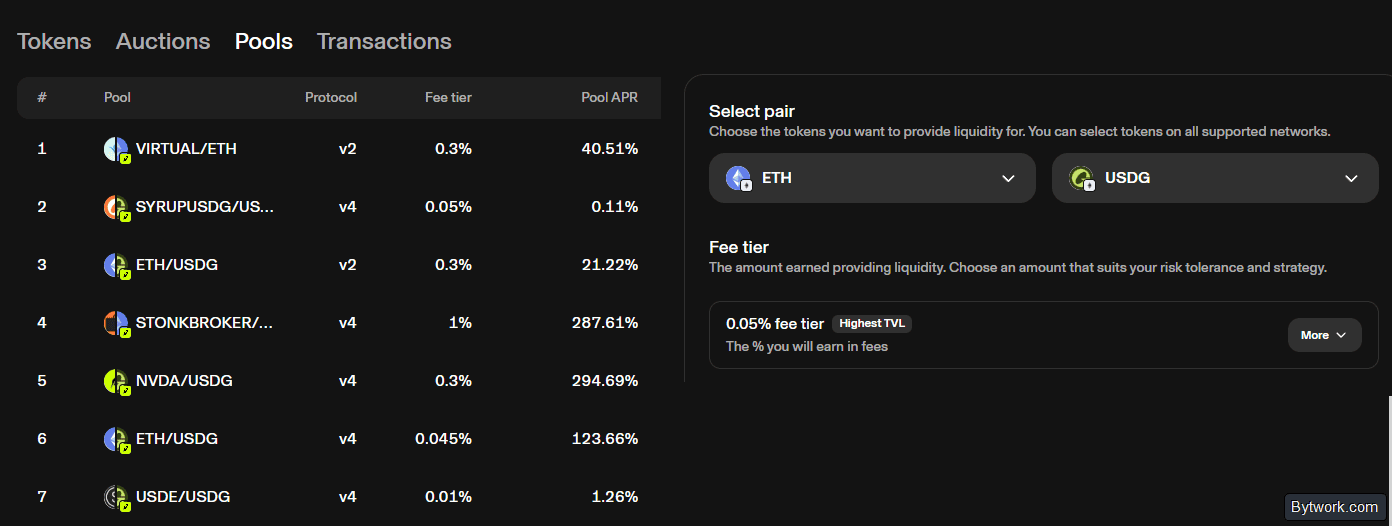
Providing liquidity on Uniswap:
- Go to Uniswap, connect your wallet, and select Robinhood Chain network.
- Add liquidity to pools, e.g., ETH/USDG or ETH/USDC.
- Use V2-V4 pools with a narrow range to boost yields, but be aware of impermanent loss risk.
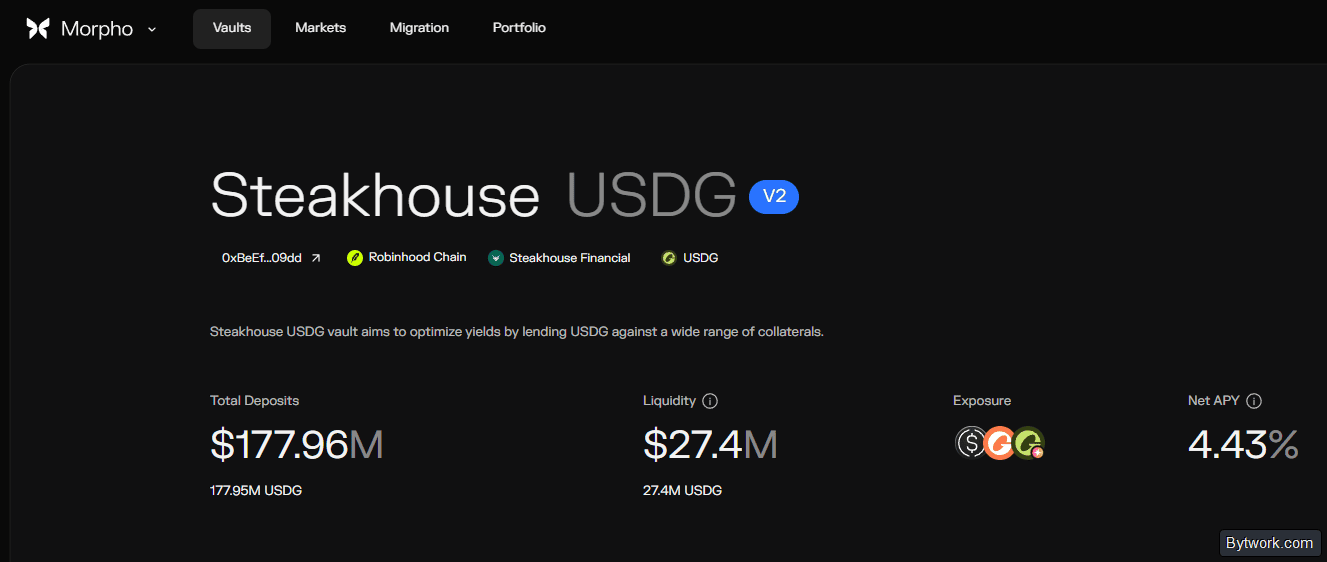
Lending on Morpho:
- Morpho (similar to Aave) supports Robinhood Chain.
- You can deposit USDG into the Stakehouse USDG pool to farm profits.
Here's how we trade on GMGN exchange:
1. Preparation
- Log in to GMGN via Google/Telegram/Web3 and connect MetaMask.
- Copy the GMGN address and transfer ETH from MetaMask to it.
- Enable 2FA, link your email, and whitelist the withdrawal address (3-hour hold).
2. Trading
- Set
Slippage 10%andGas Autoon the right panel. - Choose
Market(fast) orLimit(at your price). - Paste the token contract, enter the ETH amount, and approve the purchase.

Now let's see what tokens are available on the network.
What tokens are there on the Robinhood network?
The network is young, but there are already 4 categories of tokens:
- ETH and stablecoins
- Tokenized stocks (RWA)
- DeFi protocol tokens
- Memecoins
Let's review the most significant tokens.
Stablecoins and base assets
|
Token |
Type / Project |
Purpose |
|
ETH |
Native token |
Base settlement coin. Used for transaction fees. The network is built as a Layer-2 solution on Arbitrum Orbit architecture. |
|
USDG |
Stablecoin (Paxos) |
Main fiat gateway of the network, backed by US Treasury bills. Used in Robinhood Earn program with ~7% APY. |
|
AUSD |
Stablecoin (Arrow Finance) |
Decentralized stablecoin. Minted via CDP Alpha v0.1 protocol backed by USDG, WETH, and tokenized stocks. |
The USDG stablecoin is issued by Paxos for the Robinhood Chain network, and this asset is 100% backed by US Treasury bills and cash at a 1:1 ratio. This coin is also used in Uniswap pools and as collateral in Arrow Finance.
However, USDG is not insured by the FDIC, and due to weak trading volumes, a de-pegging from the dollar is possible. In addition, the smart contract itself supports fund freezing and blacklisting.
Tokenized Stocks (RWA)
RWA tokenized stocks are backed 1:1 by real securities.
|
Category |
Available assets |
Essence |
|
Volume leader |
SpaceX |
Absolute liquidity leader. Access to a private company via on-chain derivatives. |
|
Tech giants |
Nvidia, Apple, Alphabet, Tesla, Microsoft, Amazon |
Assets integrated into DeFi ecosystem – e.g., NVDA, AAPL, and GOOG tokens are allowed as margin collateral. |
|
Full catalog |
Over 2,000 US stocks and ETFs |
24/7 access. Products aimed at the global market (with filters for US residents due to regulatory oversight). |
Chainlink oracles synchronize quotes, and owners automatically receive dividends. Over 2,000 tickers are available for 24/7 trading.
The blockchain eliminates T+2 clearing and the ACATS system, providing instant settlement, fractional ownership, and free transfer of assets.
Infrastructure and DeFi protocols
As crypto enthusiasts, we are interested in protocol tokens.
| Token | Project | Role |
| ARROW | Arrow Finance | Governance token of the native CDP protocol. Allows issuing stablecoins backed by tokenized stocks. Market cap peaked at $35 million amid liquidity hype. |
| INDEX | The Index | Native tokenized index product. Automatically accumulates and distributes profit from a basket of traditional stocks directly to holders' wallets. |
| LIT | Lighter | DEX token for perpetual contract trading. The platform is backed by Robinhood Ventures and allows tokenized stocks as margin collateral. |
| PONS | Pons | Token of the leading infrastructure memecoin launchpad on the network. Handles primary token launches and allocations for young projects, having taken the lead in the ecosystem. |
| NOXA | Noxa | Incubator, news hub, and early-stage launchpad. Focused on launching ecosystem services and memecoins (including CASHCAT), but competes for volume with Pons. |
| VIBE | Vibe (Vibe-Trading / Code) | Token of the AI-agent and automated trading ecosystem. Linked to integration of AI connectors for trading via Robinhood API (within the AI development trend led by Vlad Tenev). |
| VIRTUAL | Virtuals Protocol | Token of the decentralized protocol for creating and tokenizing AI agents. On Robinhood Chain, it is used in conjunction with creating custom AI-managed index baskets. |
| B | Baseline Markets | Automated market-making (AMM) protocol without order book burn. Forms liquidity pools with guaranteed floor value for tokenized real-world assets (RWA). |
The Arrow Finance protocol allows issuing the AUSD stablecoin backed by securities. Platforms like Archus and Lighter offer futures with leverage from 20x to 50x, while the Fletch protocol splits a stock into price and dividend tokens.
Memecoins
Immediately after the network launch, memecoins generated more than 85% of the volume on Robinhood DEX, contrary to its initial focus on RWA.
|
Token |
Status in the network |
Origin and concept |
|
CASH |
Main heavyweight and liquidity marker |
First viral memecoin on the network. Peak market cap broke $200 million with daily DEX trading volume over $40 million. |
|
TENDIES |
Cultural token for retail |
An asset oriented toward everyday traders and the community in the spirit of the legendary WallStreetBets subreddit. |
|
IF (What If) |
High-risk hype asset |
Speculative low-cap coin that managed to ride the early memecoin season wave in the first weeks of the L2 launch. |
|
Others (Hoodie, Hoppy, etc.) |
Initial mass and shitcoins |
A mixed bag of small tokens (Hoodie, Dogging Hood, Hood Rat, etc.) that simply filled liquidity pools at the early stage. |
How to independently discover tokens on the Robinhood network?
The Robinhood network has become a haven for memecoins. Manually tracking new launchpads is unfeasible, so workflows are streamlined through specialized trading terminals such as GMGN.
|
Platform |
Launches / Mints |
% of Successful Missions |
Facts |
|
12,960 / 5,785 |
44.6% |
Earnings of $200K over 4 days, 18.35% burned. Developing V2 on Uniswap V4. |
|
|
3,800 / 1,300 |
35% |
The X profile has been compromised – there is a risk of phishing. |
|
|
7,500 / 13 |
0.2% |
Onboarding RWA, but 99.8% of launches are scams. |
|
|
2,100 agents |
- |
AI agents, with developer royalties amounting to $1.3M. |
Official statistics indicate that 7,500 coins were created on the network, yet only 13 of them actually made it to the open market. The real success rate for new projects stands at 0.2%. To simplify this, a consolidated table of platforms is provided, allowing for timely and efficient analysis of newly launched tokens.
Additionally, leverage the dexscreener service for token analysis, which helps flag assets less than a day old with a market cap of around $200,000 – unlike major aggregators.
Icons with boost up to 500 indicate marketing investments of up to $4,000.
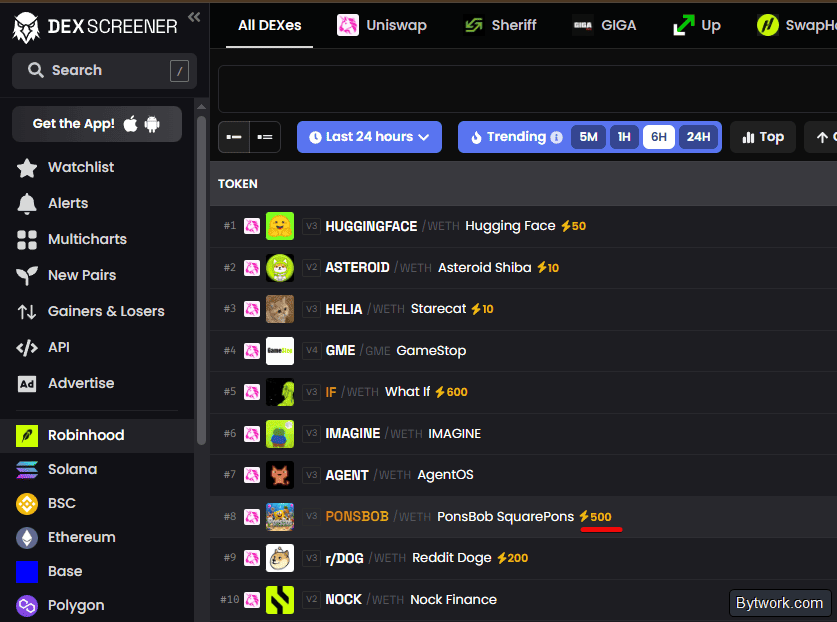
Anomalously high activity with a small number of holders helps identify pump-and-dump schemes. The platform also shows market depth.
For deeper memecoin analysis, we use services like GMGN.ai, FOMO, and Talk Chain.
Network Comparison
Alongside Robinhood are networks like Base and Solana. All these networks are fast. Solana's block time is ~400 ms, Base has dropped to ~200 ms, and Robinhood delivers ~100 ms. They have negligible fees ~$0.01 per transaction and target millions of retail users.
However, behind the surface speed lie fundamentally different business models.
|
Criteria |
Robinhood Chain |
Base (Coinbase) |
|
Core advantage |
24/7 trading of RWA assets like Apple, Tesla, or gold |
AI-agent economy and focus on autonomous AI bots |
|
Onboarding for newcomers |
One‑click fiat onramp for 28 million US users |
Smart wallets without seed phrases with biometrics via FaceID or Passkey |
|
Earning opportunities |
Yield farming on USDG stablecoin, memes, stocks |
Farming on deep liquidity pools (Aerodrome), memecoin trading, p2p USDC transfers, and creating autonomous AI agents. |
|
Centralization |
Dependent single sequencer under the SEC and CFTC with wallet blocking |
Coinbase servers with censorship risk despite open architecture |
|
Community |
Traditional retail investors from the classical stock space |
Content creators, AI app developers, DeFi enthusiasts |
Ultimately, the corporate system of Robinhood Chain is built under US regulatory oversight for legal tokenization of stocks and RWA assets, offering legal security at the cost of total centralization.
Base network combines Ethereum security with Coinbase infrastructure for p2p payments in USDC, liquidity pools, and AI agents. Meanwhile, the independent Solana blockchain offers traders, developers, and NFT collectors maximum speed without corporate rules.
DefiLlama can help explore TVL and network activity of Robinhood.
What are the drawbacks of Robinhood?
The speculative frenzy around Robinhood Chain, reminiscent of the influx of retail investors during major pop-culture events, is drastically different from the operation of trading bots on Solana with their predictable cycles.
The main uncertainty factor is the behavior of the broker's management, including CEO Vlad Tenev, whose social media posts break conventional technical analysis. Traders' fear of being left out before a potential listing on the main app causes chaotic capital flows.
And, as always, there is spam on the network. The leading launchpad Noxa has halted new launches due to inability to scale the architecture against spam. This created artificial scarcity and pumped existing tokens, bringing the creator $2 million in fees overnight. Bridge failures like Relay cause funds to get stuck, and infrastructure projects disable launches due to spam.
Centralization contradicts the very essence of cryptocurrencies. For instance, Robinhood Chain is managed by a single centralized sequencer that can exclude transactions for compliance reasons.
The idea of combining stocks and crypto seems good, but 24/7 trading of stocks on the blockchain while the NYSE is closed creates a risk of a Monday gap that burns leveraged positions in Arrow Finance.
Finally, the native USDG stablecoin has low liquidity compared to USDC or USDT, includes freeze functions, and carries de-peg risks. The stated yield rates like 7% APY in Robinhood Earn are not fixed and may drop.
Q&A
- Why isn't the token showing up in MetaMask?
- The wallet doesn't pull assets automatically. Copy the smart contract address and add it manually via the Import Tokens tab.
- Is it risky to pour large sums into liquidity pools?
- Yes, it hurts yields if the platform has low trading volume. This effect is clearly visible on tokenized stocks like SpaceX, with a daily turnover of just $1 million. Allocate positions proportionally to the total pool volumes.
- How to assess network activity if the TVL metric is misleading?
- Look at the daily exchange turnover, not the locked liquidity. The Plasma network with TVL of $5.5 billion shows a turnover of only $4.5 million, while Robinhood Chain with TVL of $161 million turns over $800 million, which is far more profitable for liquidity providers.
- What is the long-term problem with Robinhood Chain?
- The network needs to redirect speculative interest from memecoins into real protocols like lending and futures. Without that, after the hype fades, volumes will collapse immediately.
- Why isn't the issuance of a Robinhood token guaranteed?
- The broker already has stocks trading, and a separate coin might simply be unnecessary for it. The case of the Base L2 network clearly confirms that a blockchain can successfully develop without its own token at all.
- How does the tokenization process for stocks work on Robinhood Chain?
- Stocks are tokenized just-in-time – the token is created only when a buy order is placed. This approach saves market makers from having to lock up capital and helps maintain liquidity without upfront collateral.
- Why might a stock withdrawal be paused even if it appears in the portfolio?
- When trying to sell small positions (AMD, MU), the system throws an error: "Price moved too much for a safe withdrawal." The culprit is price volatility during processing – withdrawal becomes impossible, and the platform suggests simply cashing out the trade.
- What real problem arises when trying to deposit funds into Robinhood Chain during a token pump?
- Liquidity bridges "dry up", the transfer stalls for several hours, causing the trader to miss the peak move and fail to enter the asset at a favorable price. Then, the delayed deposits, arriving to the network with a lag, create a pent‑up demand effect, which triggers a sharp price pump above previous highs.
- Why can't tokenized stocks on Robinhood Chain be considered full‑fledged stocks, despite the 1:1 backing?
- Although they are backed 1:1 by real securities and protected by an agency mechanism, these digital receipts do not confer ownership rights, voting rights, or legal claims against the issuer. These tokens are not available to residents of the US, Canada, the UK, and Switzerland, and the issuer itself has the right to freeze assets at the request of regulators.
- What drawdown is considered critical for a meme coin to survive on Robinhood?
- The range of 70–85% from the all‑time high. In practice, coins like iF ($35M -> $6M) and PON ($50M -> $13M) broke through that bottom and recovered. Meanwhile, Hood Rat crashed from $16M to $1M, eventually turning into a complete scam.
Conclusion
The Robinhood network is even faster than Solana (100 ms vs 400 ms). This means that memecoin activity could flow into this network. Although it claims to focus on the RWA sector, in reality, as usual, crypto is filled with memes and speculative coins.
The backing of the multi-billion dollar company Robinhood reduces the risk of network scams. As always, early participants earn super profits, as confirmed by Cash Cat's 64,000% growth in 12 days. High yields of new blockchains come with severe volatility, fraud risks, and liquidity withdrawal schemes.
The arrival of major players signals the maturity of DeFi, so it's important to study protocol mechanics for future opportunities. Share your opinion in the comments on whether this is hype or the future of finance.
Your favorite editor - Maksim Anisimov for bytwork.com. Checked by Pavel Grachev.
Disclaimer: all information provided in this article should not be construed as financial advice! The article was created for educational purposes.


