Aerodrome Finance insider secrets – unlocking the pool, staking, and 3 proven strategies that work

You will learn how to become a liquidity provider on Aerodrome. We will break down the 3 pool types, open your first position, stake it, and go over 3 compound strategies for passive income. We will also cover the risks and the protocol’s security.
Protocol Overview
Aerodrome Finance is a decentralised exchange (DEX) and liquidity protocol on Base, where liquidity providers deposit paired assets into pools, earn fees and rewards, and then convert them back into original assets to lock in profits.
On this exchange, you can do two main things:
- First, swap tokens if you need to,
- and second, farm liquidity fees.
By adding liquidity, you earn swap fees from other traders.
When evaluating the protocol’s popularity via TwitterScore, Aerodrome scores 174 (green zone, but modest). For comparison, Uniswap is near the maximum.
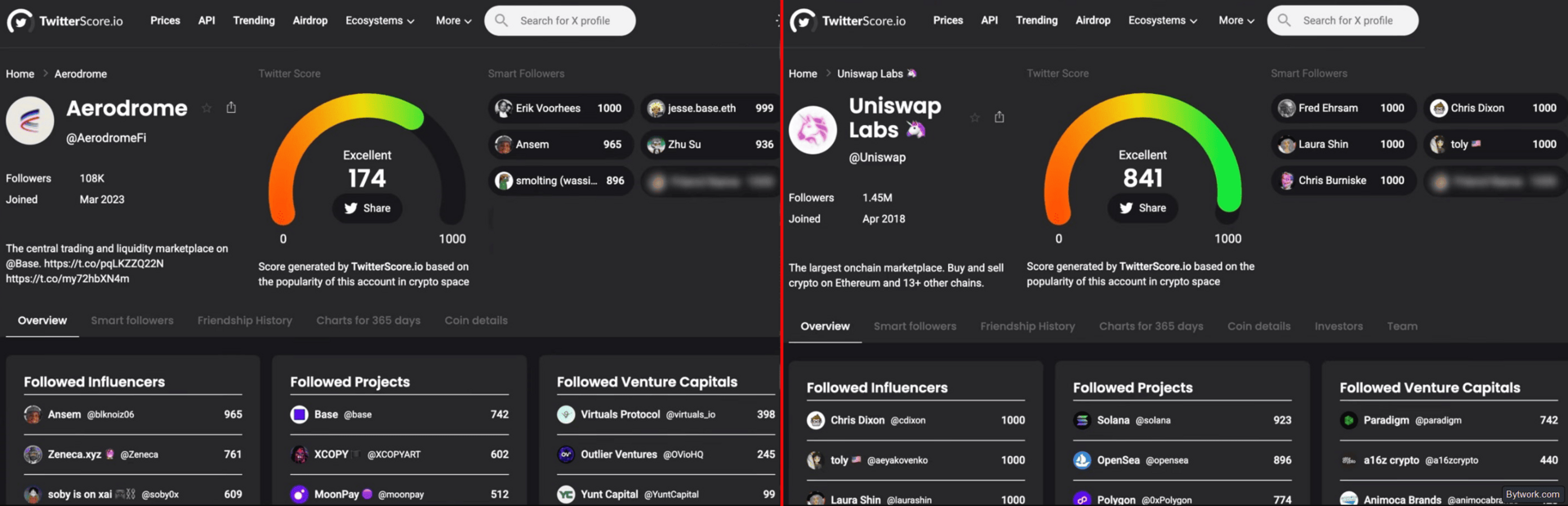
The low score (relative to giants) is because Aerodrome is a relatively young project that hasn’t yet stood the test of time. This confirms its status as a promising but developing protocol on Base. Check the protocol’s TVL dynamics, volumes, and average yield on DeFiLlama.
Is Aerodrome safe?
Aerodrome Finance’s codebase is inherited from Velodrome V2. The core code was audited by Spearbit, which found 119 vulnerabilities (1 critical, 8 high-risk), all of which have been fixed. Additional checks were done by Chainsecurity, Code4Rena, and Sherlock.
The smart contract audit was performed by EtherAuthority. Only 3 vulnerabilities were found in the smart contract. Of these, 0 critical, 0 high-risk, 0 medium, 1 low, and 2 informational:
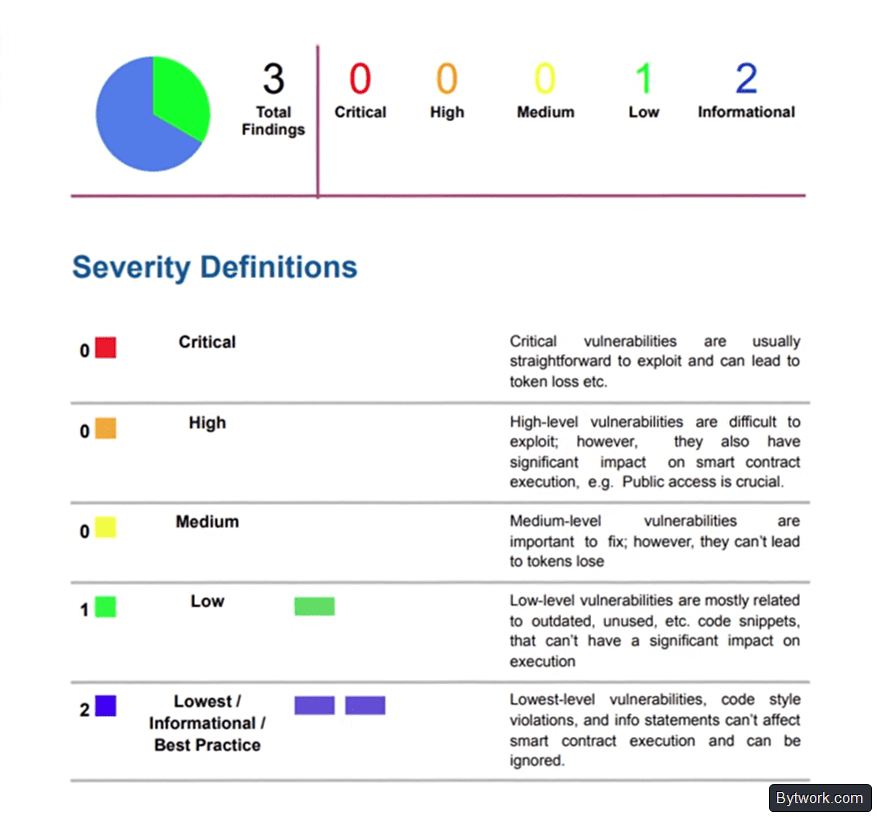
All vulnerabilities have been fixed, but at the end of 2025 the protocol suffered a DNS hijack. Attackers replaced the frontend and stole user funds via phishing. The smart contracts themselves were not compromised, confirming their reliability. Since then, the team has implemented decentralised ENS-based mirrors.
How does Aerodrome Finance work?
Aerodrome Finance works through the interaction of 3 participant groups:
- liquidity providers,
- token holders,
- and third‑party protocols.
Yield farming consists of 4 stages:
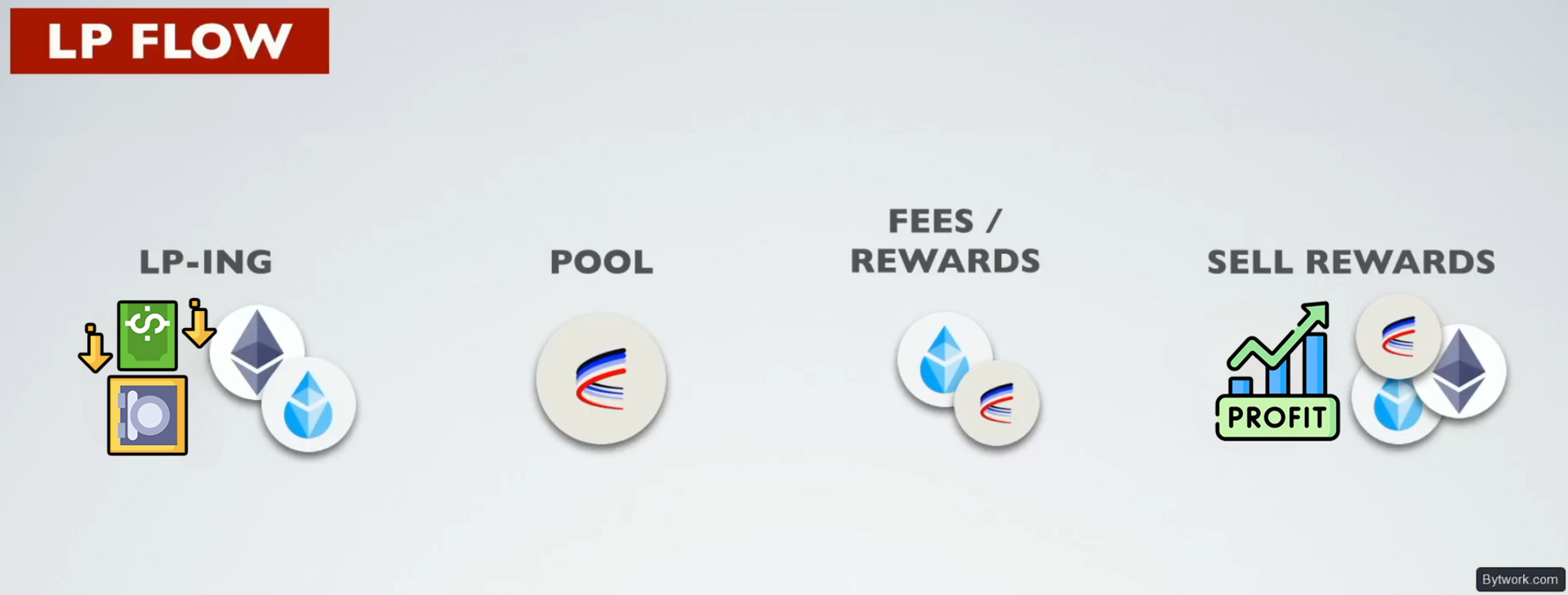
- Providing liquidity (LP-ING) – you take 2 assets 50/50 (e.g. $ETH and $cbETH).
- Pool placement (POOL) – tokens are placed into an Aerodrome liquidity pool, and in return you receive LP tokens.
- Rewards (FEES / REWARDS) – swap fees are accrued in the pool’s tokens ($cbETH) and native rewards in $AERO.
- Locking in profits (SELL REWARDS) – earned $AERO are withdrawn and sold back into $ETH/$cbETH. This locks in profit, but creates constant sell pressure on the governance token.
It is important to note that an unstaked position deprives the provider of up to 10% of fees, and that revenue goes to veAERO holders (staked AERO). Voting holders distribute weekly reward emissions among pools and take 100% of trading fees and bribes (external incentives) of the chosen pairs. Therefore, staking is mandatory.
Choosing the pool is another important feature of Aerodrome.
Types of liquidity pools – which one to choose?
Aerodrome has Volatile, Stable, and Concentrated pools.

Volatile pools
Designed for uncorrelated assets that move independently (e.g., ETH and USDC, BTC and ETH). They use the constant product formula. In this pool, you provide liquidity across the full price range.
Impermanent loss (IL) risk is high when prices move asynchronously. Choose this pool type if you believe in the long‑term value of both assets and cannot actively manage the position.
Stable pools (V2)
Optimised for pegged or highly correlated assets (USDC/USDbC, stETH/ETH). The algorithm minimises slippage on assets trading close to 1:1.
Here fees are lower (~0.04%), volumes are higher, and risks are lower. Impermanent loss is minimal as long as the peg holds. For conservative strategies, V2 stable pools show yield dynamics of 15–30% APR without the need to reposition ranges.
Concentrated liquidity pools (Slipstream)
Concentrated pools (also called Slipstream or CL pools) work on the Uniswap V3 principle. You set a price range within which liquidity is active. A narrower range increases capital efficiency and APR, but also increases the risk of going out of range.
It is important to know that when the price leaves the range, the position stops generating fees until it returns within the range. For stablecoins, CL pools require narrow ranges that are often breached. In such cases, V2 pools turn out to be more effective.
|
Feature / Property |
Volatile (V1) |
Stable (V2) |
Concentrated (CL/Slipstream) |
|
Assets |
Uncorrelated (ETH/USDC) |
Pegged (USDC/USDbC) |
Any |
|
Price range |
Full |
Optimised 1:1 |
Custom |
|
Fee |
~0.3% |
~0.04% |
0.05–1% |
|
IL Risk |
High |
Minimal |
Variable |
|
Management |
Passive |
Passive |
Active |
Now it’s time to open a real position.
Step‑by‑step guide to opening a liquidity position
Below is the full cycle of creating a position using the WETH/USDC pool with concentrated liquidity as an example. All actions are performed on the Base network.
Step 1. Wallet and asset preparation
- Add the Base network to MetaMask or Rabby (it is detected automatically when connecting to Aerodrome).
- Transfer assets to Base. Withdraw USDC or ETH from the exchange (Bybit, OKX, Coinbase) via the Base network.
- Make sure your wallet has $5–10 worth of ETH to cover all gas fees.
Step 2. Choose a pool and set the range
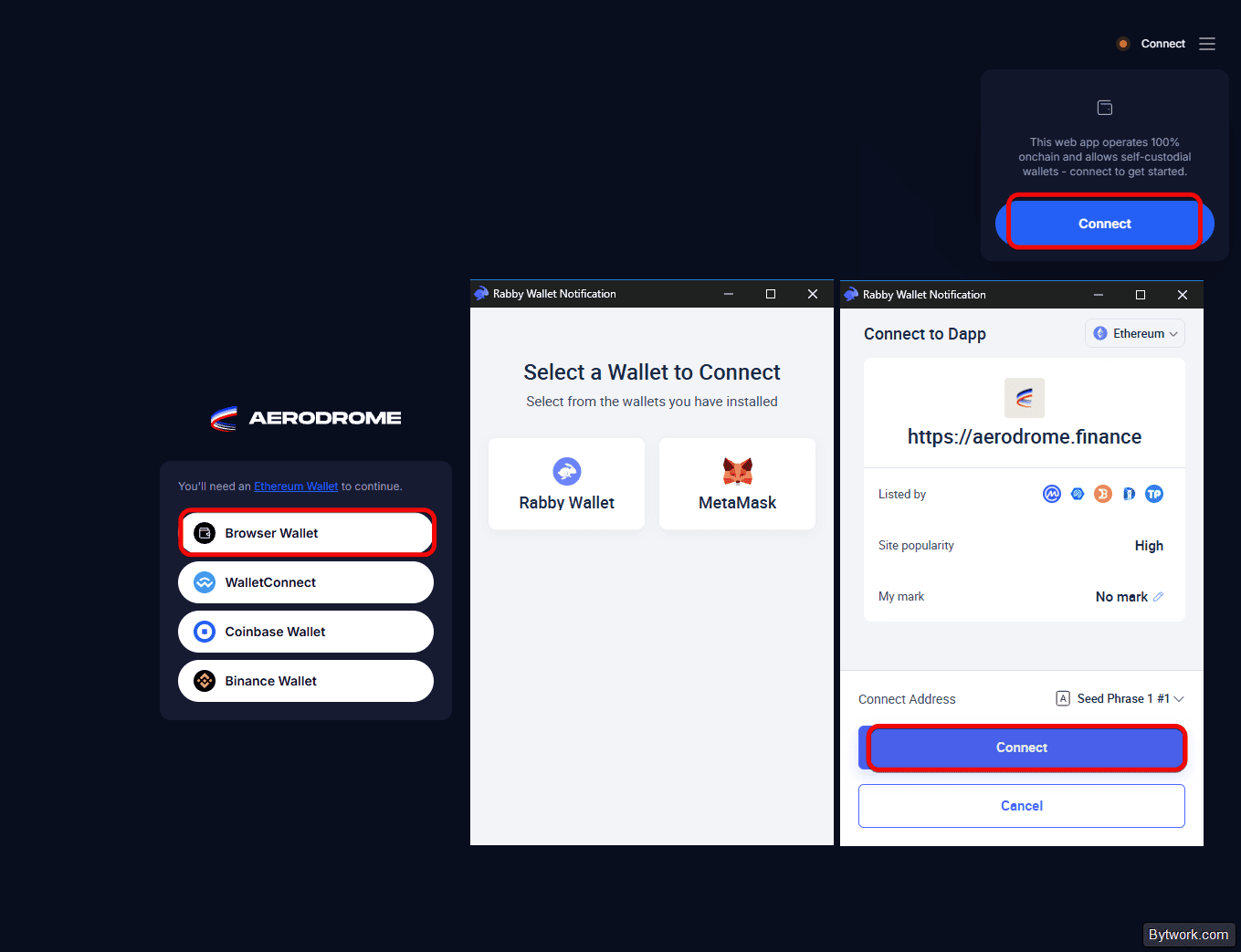
- Go to aerodrome.finance and connect your wallet (button
Connect->Browser wallet). Confirm the connection in your wallet.
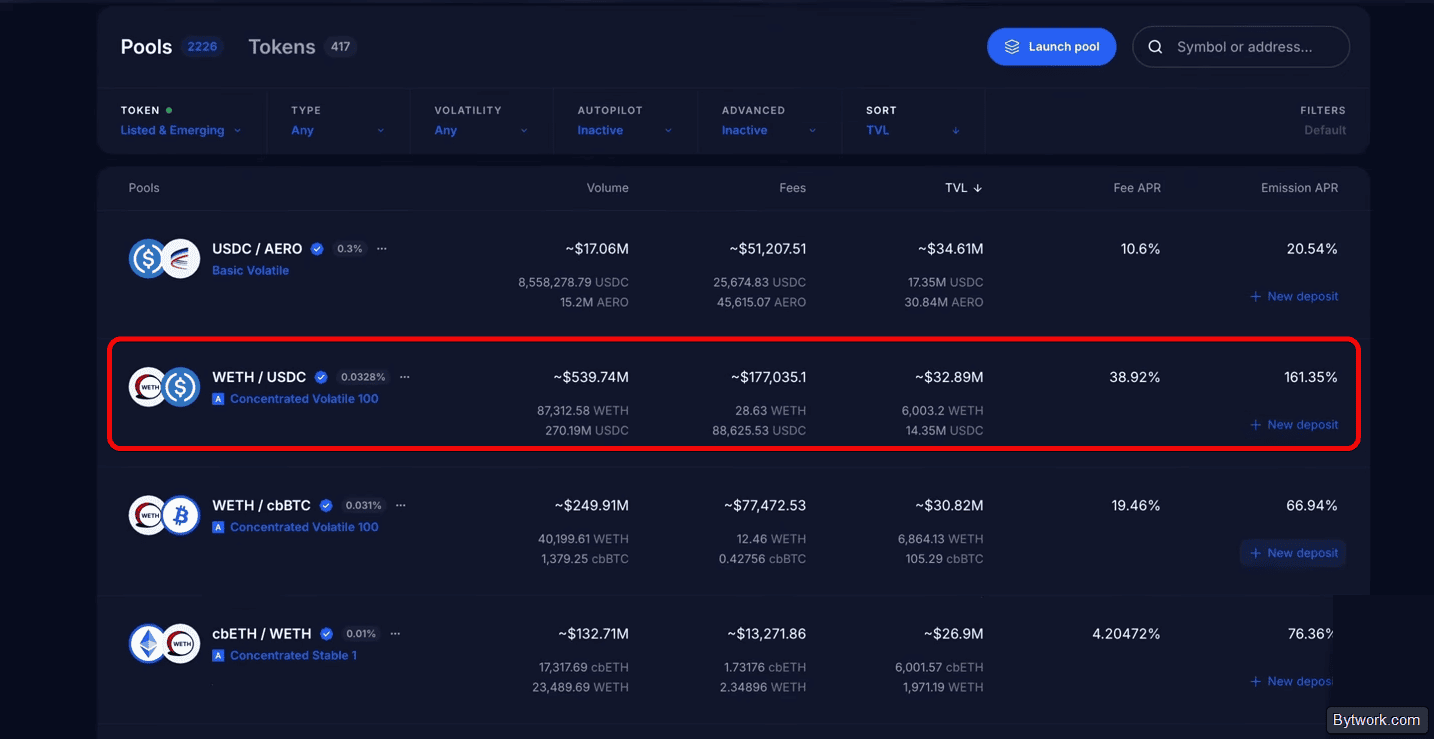
- In the Liquidity section, select the WETH/USDC pool with type
Concentrated (Slipstream). - Define the lower and upper price boundaries. For example, set a range of $2,900 – $3,200.
- The range calculator will show the expected APR. A narrow range (e.g., $3,000 – $3,400) gives a higher APR (up to 400% annualised), but increases the risk of going out of range (impermanent loss or becoming 100% in one asset).

Step 3. Deposit liquidity
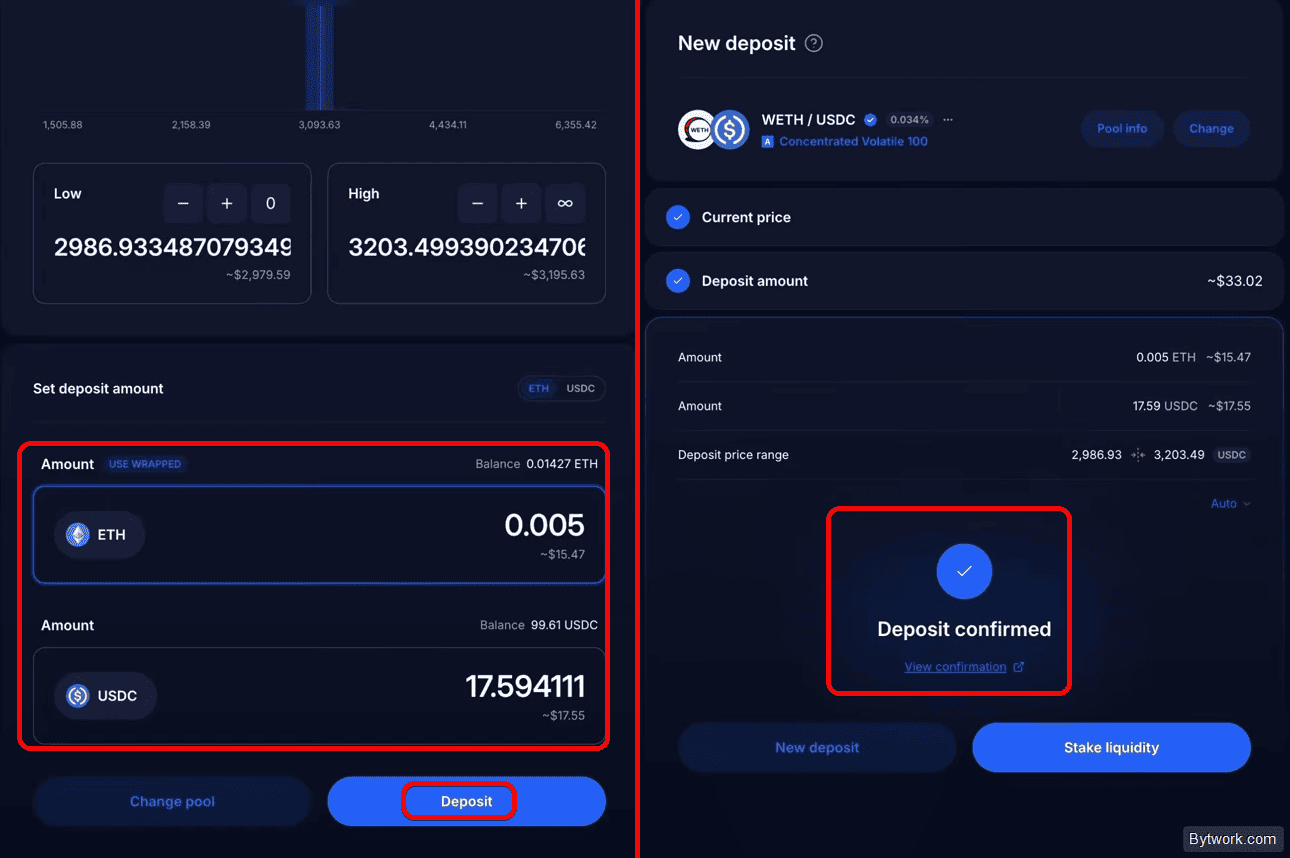
- In the
Depositfield, specify the amount of ETH and USDC (the proportion will be calculated automatically). - The
Use nativeoption if you want to use native ETH (not wrapped). - Click
Deposit, sign the approval, and confirm the transaction in your wallet.
Step 4. Stake the position (mandatory)
If you don’t stake the position, the protocol withholds 10% of fees in favour of veAERO holders!
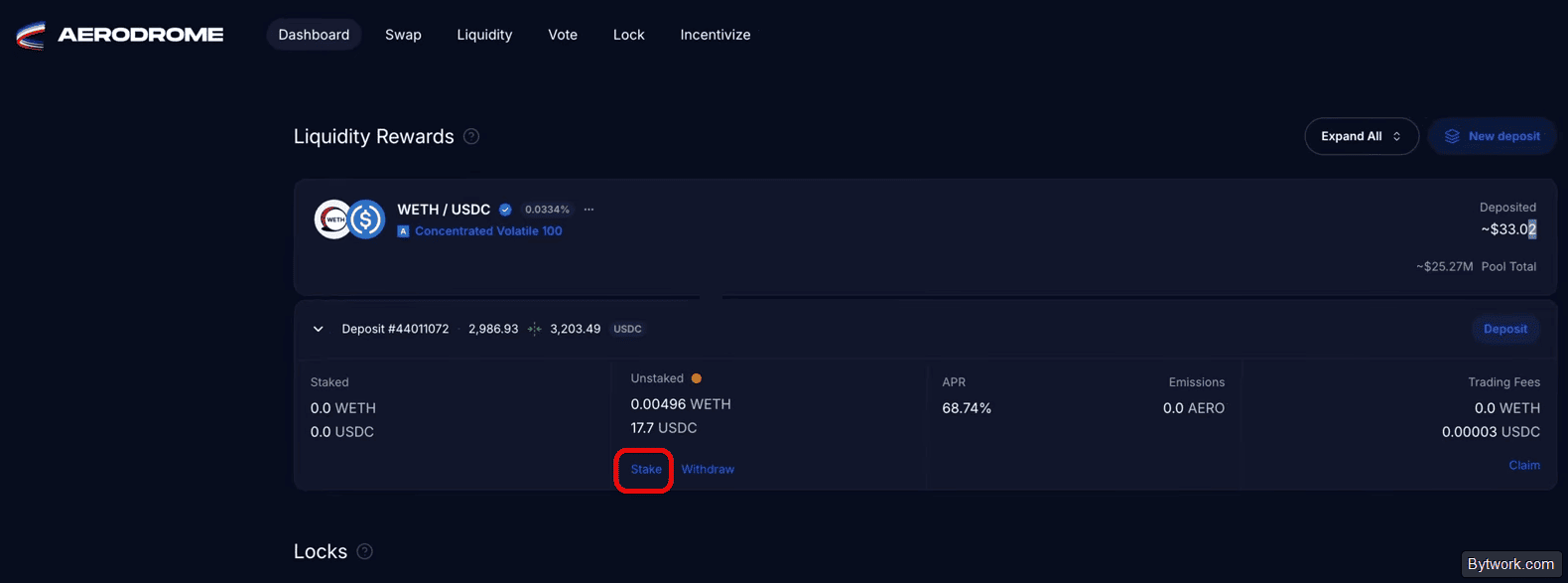
- After depositing, on the dashboard (dashboard), click
Stake.
2. Select the amount and confirm the transaction. 
3. The staked position starts earning:
- Trading fees in ETH and USDC.
- AERO emissions (new token compensation).
- Additional rewards (bribes) from voting.
Step 5. Voting with veAERO (optional, to boost yield)
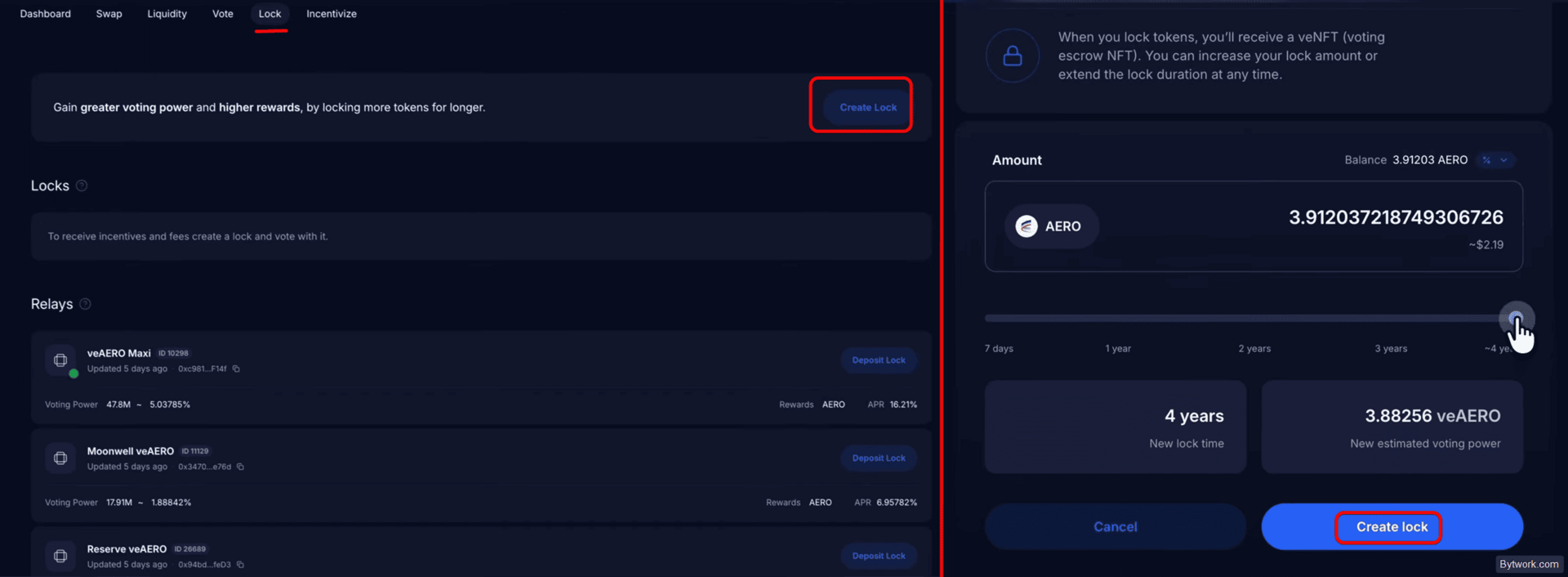
- Go to the Lock section.
- Create a lock (
Create lock) – lock your earned AERO for the chosen period. The longer the lock, the more voting power. For example, locking for 4 years gives about 3.88 veAERO, while 7 days gives only 0.01. - Get the veAERO governance token.
- In the Vote section, distribute your votes for the pools where you provide liquidity (or for any other pools with high bribes).
- Every Wednesday, collect rewards (
claim) in the form of AERO and bribes.
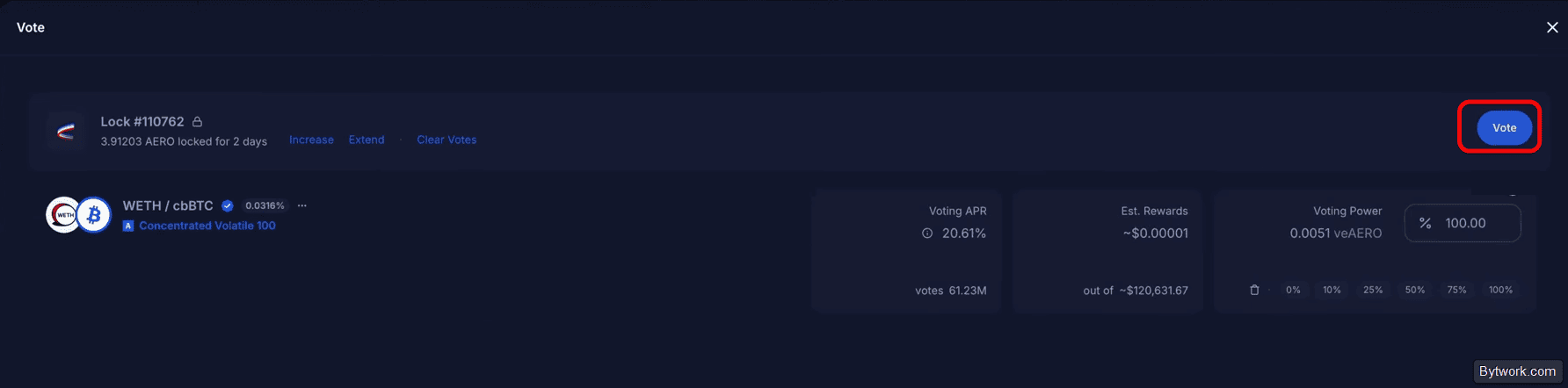
You have successfully opened a WETH/USDC position, staked it, and voted for certain liquidity pools to receive 100% of the trading fees they generate.
How to calculate impermanent loss?
Impermanent loss (IL) is the most important risk in DeFi. To calculate real profit, you need to understand this mechanism, not just look at APR.
IL occurs when the price ratio of the 2 assets in the pool changes after your deposit. You lose compared to simply holding the assets in your wallet. The loss is impermanent – it disappears if prices return to the original ratio. But at the moment of withdrawal, it becomes real.
Your net income = fees + rewards − IL
Beginners often focus only on APR. For example, a pool gives 80% APR, but due to volatility you incur 90% IL. The result is a 10% loss.

Risk per pool type is as follows:
- vAMM (volatile) – highest risk, because assets move independently.
- sAMM (stable) – minimal risk. Stablecoins tend to 1:1.
- Slipstream (concentrated liquidity) – variable risk. The narrower the range, the higher the yield, but also the stronger the IL if the price moves out of bounds.
How to reduce IL?
- Choose correlated pairs. For example, ETH and cbETH/wstETH. With a price difference of 3% per year, IL would be 0.01% – easily covered by yield.
- Combine wide ranges (for sideways markets) and narrow ones (for trends).
- Use automation like Autopilot to manage ranges. But remember that Autopilot adds the risk of a third‑party smart contract.
- Be careful with aggressive rebalancers. They may sell the falling asset and buy the rising one, locking in and increasing losses.
However, impermanent loss is not the only risk.
What are the risks and limitations?
The protocol requires assessing the following risks:
Risks and their mitigation in Aerodrome pools
|
What is the risk? |
Description |
Solution (Mitigation) |
|
Impermanent loss (IL) |
Asset prices diverge. In narrow ranges, losses are higher. |
Choose correlated pairs or wide ranges. |
|
AERO volatility/inflation |
High token emission devalues rewards. |
Regularly lock in profits into stablecoins, BTC, or ETH. |
|
Going out of range |
Price outside the range – no fees accrue, position becomes 100% in one asset. |
Widen ranges or choose V1 pools (full range). |
|
Smart contract hack |
The protocol is young (since 2023), a fork of Velodrome. Vulnerability risk exists. |
Only invest risk capital (up to 10–20% of portfolio). |
|
veAERO power decay |
Without weekly renewal of the 4‑year lock, yield drops. |
Enable auto‑renewal via scripts or veAERO maximisers. |
Having reviewed the risks, we now move to strategies.
3 strategies for managing AERO rewards
A liquidity provider on Aerodrome receives 2 income streams:
- trading fees in base assets (ETH, USDC),
- and emission rewards in AERO tokens.
The strategy determines what to do with accumulated AERO after clicking the Claim button.
Here is a brief summary of the strategies, and below you will find the details.
|
Source of income? |
What to do with AERO? |
Time for management |
Risk level |
Number of income sources |
|
1. Reinvest into LP |
Convert into pair + increase position |
15–30 minutes per week |
Medium |
2 (fees + emissions) |
|
2. Lock into hard assets |
Sell AERO, withdraw to stablecoins/ETH |
5 minutes per claim |
Low |
1 (locked profit) |
|
3. Lock and vote |
Lock -> veAERO, vote for the pool |
30–60 minutes per week |
High |
4 (fees + emissions + bribes + rebase) |
The most profitable is Strategy 3. But it is also the riskiest.
Strategy 1 – reinvest into the liquidity pool
Goal. Increase the size of your LP position so that the next epoch brings more fees and AERO thanks to a larger share.
Step‑by‑step strategy:
- Claim your AERO rewards in the
Dashboard->Rewards->Claimsection. - Split the amount in half. If you received 100 AERO, keep 50 AERO, and prepare the other 50 AERO for swapping.
- Swap half of the AERO for the second token of your pair (e.g., USDC for the ETH/USDC pool). Use the Swap function on Aerodrome.
- Add liquidity. Deposit 50 AERO and the equivalent in USDC into the same ETH/USDC pool at a 50/50 ratio at the current price.
- Stake the new position via the
Stakebutton. Unstaked funds lose ~10% of fees to voters.
Example calculation.
A position in the ETH/USDC pool earns 100 AERO. At an AERO price of $1.27, that’s $127. Swapping 50 AERO for $63.5 USDC and adding it to the pair increases your capital in the pool by approximately $127. If the pool’s APR is 20%, the next week will bring fees from a larger base.
Risks.
The price of AERO may fall between the claim and reinvestment. Increasing the position raises your exposure to impermanent loss (IL) if ETH moves sharply.
When to apply?
In an upward or sideways trend for AERO, and when you are willing to increase your long‑term exposure in the pair.
Strategy 2 – lock profits into hard assets
Goal. Turn volatile AERO rewards into stable income, reducing dependence on the protocol token’s price.
Step‑by‑step strategy:
- Claim your AERO rewards.
- Swap 100% of AERO for stablecoins (USDC, USDT) or Ethereum using the Swap function.
- Withdraw the funds to your wallet or exchange for storage. Alternatively, send them to Ethereum staking (e.g., cbETH or wstETH) to earn a base yield of ~3% per year.
Example calculation.
You received 100 AERO. At a price of $1.27, you lock in $127 of net profit. If AERO drops to $0.50, you have already preserved the value. If AERO rises to $2.00, you miss out on additional growth.
What are the risks?
Missed opportunity if AERO appreciates. Swap fees reduce the final amount by 0.3–1%.
When to apply?
In a bear market for altcoins. When you need a regular cash flow. Also suitable when your desired share of AERO in the portfolio is exceeded.
Strategy 3 – lock AERO and vote via veAERO
Goal. Maximise yield from multiple sources simultaneously and strengthen control over emissions in your own pool.
Step‑by‑step strategy:
- Claim your AERO rewards.
- Go to the Lock section. Create a lock – deposit AERO and choose a lock period from 1 week to 4 years.
- Receive veAERO. At the maximum 4‑year term, the ratio is 1:1 (100 AERO = 100 veAERO). At 2 years, ~48 veAERO; at 1 year, ~25 veAERO.
- Vote for the pool in the Vote section. Direct 100% of your veAERO to the pool where you provide liquidity (e.g., ETH/USDC).
- Renew the lock weekly. veAERO voting power decays linearly with each epoch (week). To maintain maximum power, you need to renew the lock to 4 years every week.
Income sources under this strategy:
|
Source |
Mechanism |
Approximate size |
|
Pool trading fees |
100% of fees from the pool voted for |
Depends on volume |
|
Bribes |
Protocols pay for votes in favour of their gauges |
$20–200/week with $10,000 capital |
|
Rebase (anti‑dilution) |
Compensation for inflation of new AERO |
Proportional to veAERO |
|
AERO emissions in LP |
Increased AERO flow into the pool thanks to votes |
Raises the pool’s APR |
Example calculation.
Locked 1000 AERO for 4 years -> 1000 veAERO. Voting for the ETH/USDC pool with $10,000 LP activity brings ~$20/week in calm periods, up to ~$200/week during high volumes. Bribes are added on top in tokens from third‑party protocols.
What are the risks?
Capital is effectively locked for an indefinite period. Maintaining voting power requires constant renewal – otherwise yield drops every week. If the price of AERO collapses, the value of locked capital declines without a quick exit option. Smart contract risks are higher than with established protocols.
When to apply?
Long‑term confidence in Aerodrome’s growth; large capital ($10,000+); willingness to spend 30–60 minutes per week on managing votes.
Combined strategy
Best practice involves mixing strategies to balance growth and capital protection:
|
Proportion |
Action |
Result |
|
50–70% of rewards |
Reinvest according to Strategy 1 |
Growth of LP position, increased future fees |
|
30–50% of rewards |
Lock in according to Strategy 2 |
Reduced concentration risk, regular cash flow |
Strategy 3 is recommended as a separate direction for capital not involved in LP reinvestment. Allocate a portion of AERO to an initial lock without touching the main trading fees.
Which strategy to choose?
- If your priority is maximum position growth, choose Strategy 1. It gives compound interest in LP, but increases IL risk.
- If your priority is a stable cash flow, choose Strategy 2. You get predictable income and protection against AERO price drops.
- If your priority is maximising governance income, choose Strategy 3. You unlock income from 4 sources at once, but note that capital will be locked.
- If your priority is a balance of growth and safety, choose Combination 1+2. This allows you to combine a growing position with fixed profits.
What is the essence of the AERO token?
Role and functions
AERO is the utility and governance token of Aerodrome Finance. It is used to reward liquidity providers (LPs) and to govern the protocol. LPs receive AERO emissions when they stake their positions in gauges. To participate in governance, tokens are locked (locked) for a period from 1 week to 4 years in exchange for veAERO (NFT) – the longer the lock, the greater the voting weight.
What is the yield of veAERO?
veAERO holders do not receive direct emissions, but earn through:
- 100% of the trading fees of the pools they vote for;
- bribes from third‑party protocols for directing emissions to their pools;
- rebases – protection against dilution of share during inflation.
What is the tokenomics?
The project was initially hyper‑inflationary (tens of millions of tokens per quarter in 2024), but since the end of 2025, Dromos Labs has been reducing emissions and introducing sustainable mechanisms (including MEV auctions).
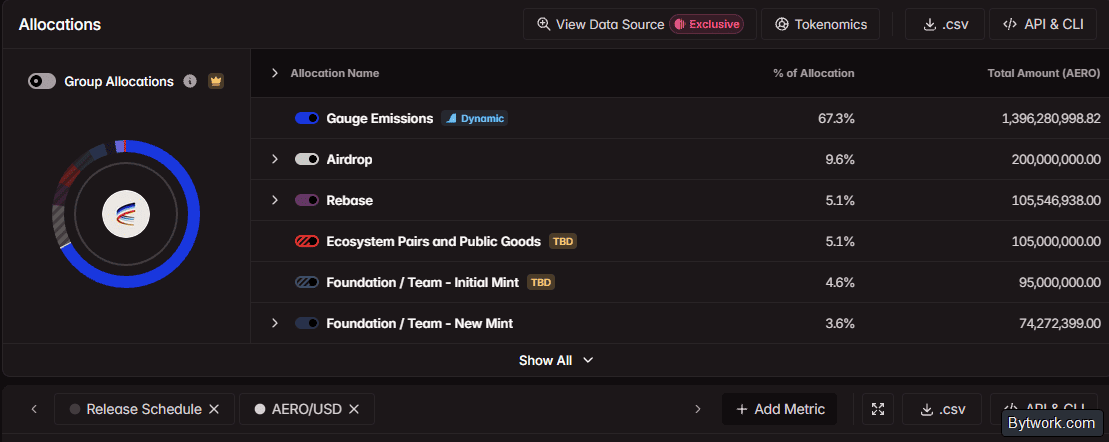
The majority of the supply (67.3%) is allocated to emissions for gauges (Gauge Emissions) to incentivise liquidity providers, while the remaining tokens are distributed among airdrops, rebases, and team/fund shares.
In 2026, a merger of Aerodrome and Velodrome into the Arrow platform with a new token is planned – 94.5% of the supply will go to current AERO holders.
What are the strategies with the token?
- Manual reinvestment (compounding) – selling part of AERO to increase the LP position.
- Profit taking – swapping for stablecoins/ETH.
- ve‑locking (governance lock) – locking AERO to vote for your own pools, allowing you to earn both as an LP and as a voter.
Nuances:
- Flight School – a veAERO bonus programme for locks of 2500 AERO or more.
- veAERO voting power decays as the lock approaches expiry, so locks are often renewed (rolled over) to the maximum.
Risks include high volatility of AERO and potential smart contract vulnerabilities.
How to swap or withdraw funds?
The Swap tab allows you to instantly exchange tokens on the Base network. The protocol automatically finds the best route through liquidity pools. Swaps generate fees that are distributed among liquidity providers and voters.
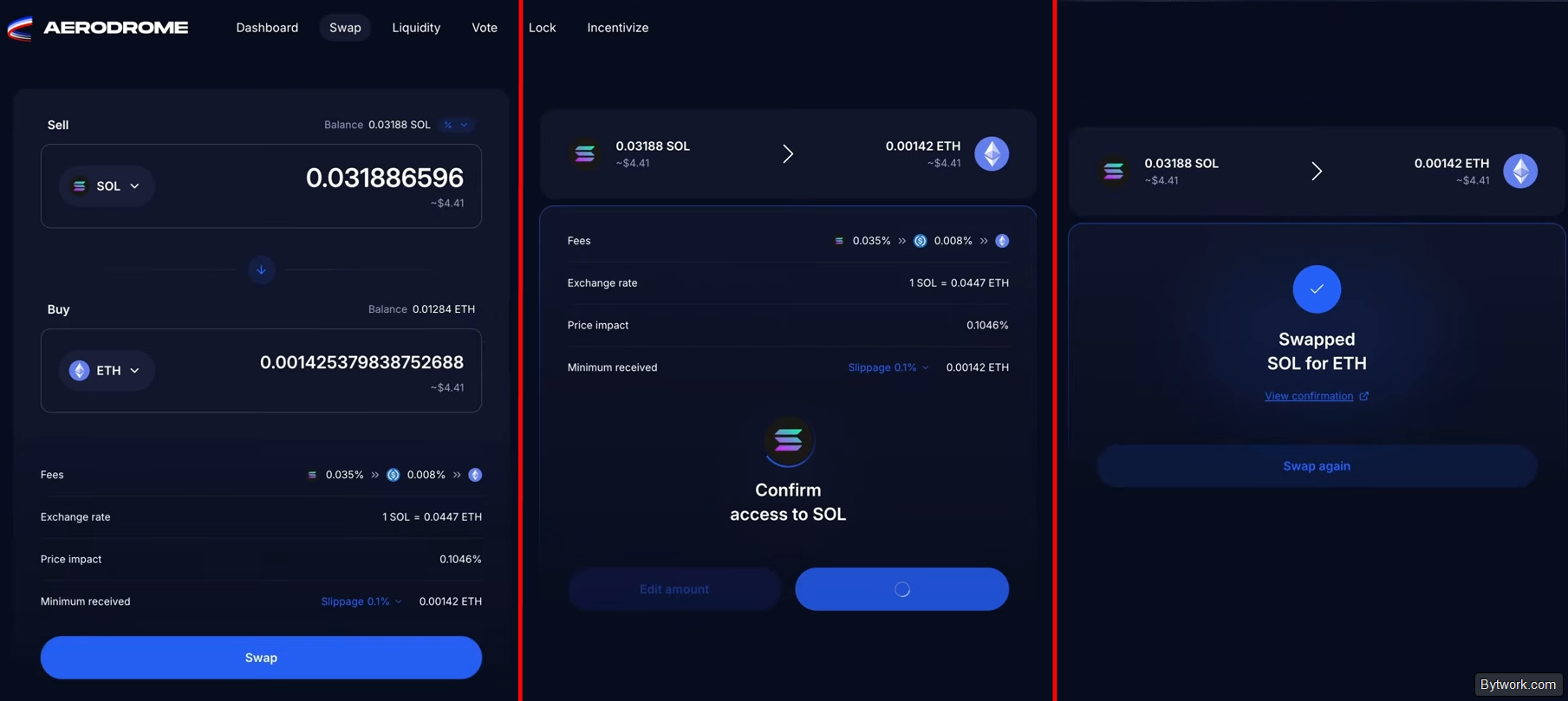
You can set the acceptable slippage level (usually 0.1–0.5% for liquid pairs).
Swap is used to buy assets before depositing into the pool, for manual reinvestment of rewards (compounding), and for locking profits into USDC or ETH.
Next, to withdraw funds from Aerodrome:
- Open the
DashboardorLiquiditytab, find the pool and clickManage. - Click
Claimto collect accumulated AERO tokens. - Go to the
Unstaketab, select MAX LP tokens and confirm the transaction. - After unstaking, click
Withdraw, choose 100% and confirm the withdrawal.
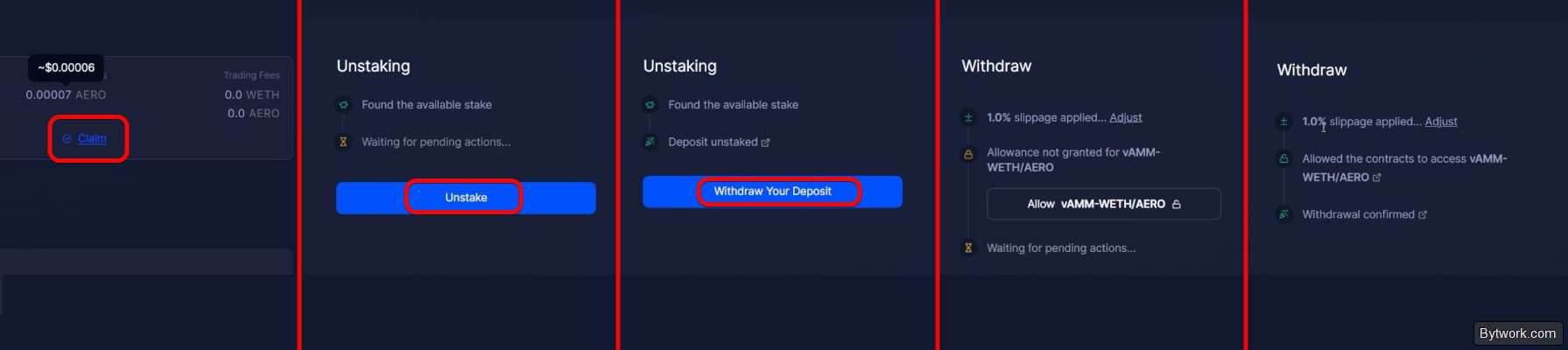
We have successfully withdrawn. However, remember that for any withdrawal transaction (unstake, claim, withdraw), your wallet must have ETH on the Base network to pay for gas.
FAQ
- How does the real yield compare to the advertised one?
Calculators like Krystal.app show an APR of up to 265% for the ETH–USDC pool, but this figure is calculated for an extremely narrow range (literally just a few dollars wide). When expanded to a practical width (e.g., 200 price ticks), the yield drops to 14–30%. That's a difference of 6 to 10 times. In practice, the overestimation is around 40% because these services rely on ideal conditions that are unattainable during actual position management.
- What are the hidden mechanics behind the autopilot?
The autopilot function reopens positions not to boost the user's returns, but to generate fees for the protocol. The algorithm aggressively shifts the range, increasing the number of transactions and fees collected, without guaranteeing any growth in APR. The truly effective strategy is manual range management without using the autopilot.
- How does Aerodrome differ from Uniswap V3?
Aerodrome combines V2 pools (full-range, passive management) and Slipstream CL pools (concentrated liquidity) within a single platform. The key difference is the veAERO system, which offers a triple income source (trading fees + token emissions + bribes), whereas Uniswap distributes only trading fees.
- Is staking the position mandatory?
Yes. An unstaked position loses roughly 10% of its fees to voters and does not receive AERO emissions. Staking transforms the position into a triple income stream—trading fees, AERO emissions, and an enhanced APR.
- What is the minimum capital required to get started?
The technical minimum is $15–$33 for testing purposes, while the practical minimum is $1,000+ to offset gas costs and generate noticeable returns. With approximately $10,000 in capital and a veAERO lock, voting revenue runs at about $20/week during quiet periods and can reach up to ~$200/week during periods of high activity.
Conclusions
After working with the protocol, we can draw 5 conclusions.
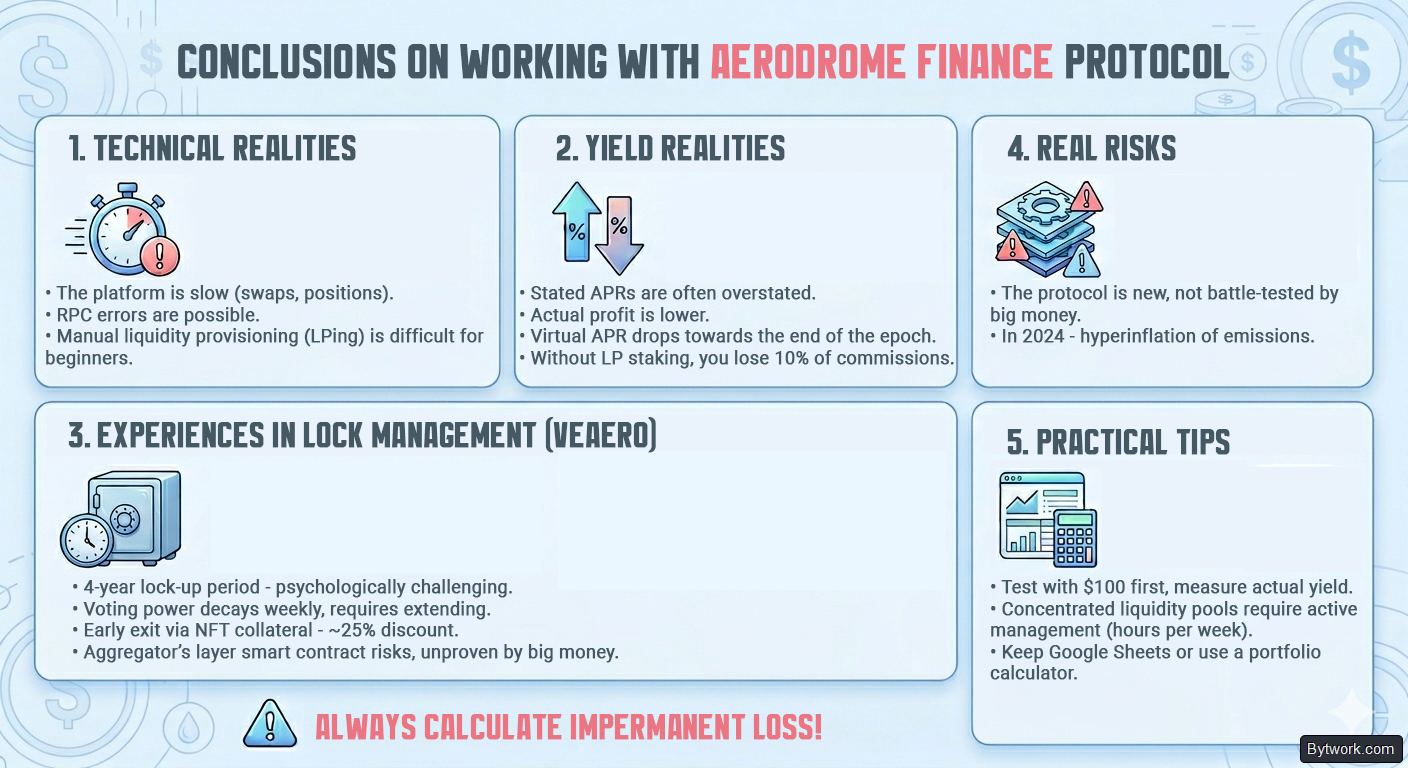
1. Technical realities
The platform is not fast (swaps, opening positions). RPC errors may occur. Manual liquidity addition will be challenging for beginners.
2. Yield realities
Displayed APRs are often inflated. Real profit is lower because the virtual APR drops towards the end of the epoch. Without LP staking, you lose 10% of fees.
3. Lock management experience (veAERO)
Locking for 4 years is psychologically tough. Voting power decays every week, you need to constantly renew the lock. Early exit via NFT collateral gives a ~25% discount.
4. Real risks
Aggregators built on top of Aerodrome add smart contract risk layers. The protocol is new and has not been battle‑tested with large capital. In 2024, emission inflation was hyper‑inflationary.
5. Practical advice
Start by testing with $100, measure real yield. Concentrated pools require active management (hours per week), otherwise capital sits idle. Keep a Google Sheet or add calculations to a portfolio calculator.
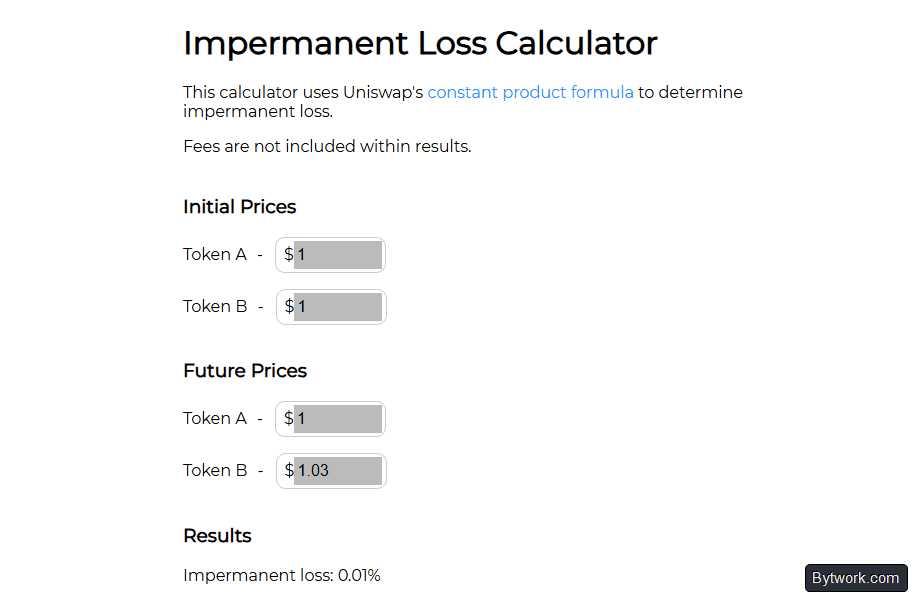
Also always calculate impermanent loss.
Maksim Anisimov, exclusively for bytwork.com.
Disclaimer – all information provided in this article should not be considered financial advice! The article was created for educational purposes.


