Experience using Ethena. How to boost USDT to over 13% APY?

You will learn how to use the Ethena platform and its product – USDe. This is likely what you are considering if you want to use Ethena. We won't take the developers' word for it. We will look under the hood of Ethena's delta-neutral strategy, break down the Off-Exchange Settlement (OES) security mechanism, and honestly assess the risks of negative funding.
What is the essence of the protocol?
Ethena is a synthetic dollar, a stablecoin protocol similar to USDT (Tether) and USDC (Circle). Despite the dominance of these giants, Ethena has become the fifth-largest stablecoin on the market. The reason is the new wave of regulation in the US and the growing demand for stablecoins.
Tether and Circle earn billions by investing collateral in US Treasury bonds. Ethena has attracted attention by sharing a portion of the income with users.
The diagram shows how the capital (collateral) in Ethena is distributed:
- 62% - delta-neutral positions and liquid staking (Crypto Basis + Liquid Stables). This is the fundamental backbone of USDe.
- 37% - placement in DeFi lending protocols to maximize yield.
- 1% - institutional lending.

This distribution is designed so that USDe maintains a price of $1 regardless of market movements and generates a base yield. Let's look at the essence of the protocol in the table below:
|
Category |
What's the essence? |
Facts and figures |
|
Synthetic dollar |
USDe – a synthetic dollar, a scalable crypto-native alternative to traditional stablecoins. |
Top-5 stablecoin by market cap ($4–10 billion). |
|
How does it work? |
Delta-neutral hedging: buying the asset (spot) and simultaneously opening a short position on futures. |
1:1 collateral without overcollateralization. |
|
What are the sources of income? |
1. Staking rewards (ETH LST). 2. Funding rates on short positions. |
Average yield of sUSDe ~11%. |
|
What are the protocol's assets? |
BTC, ETH, SOL (as collateral and basis for shorts) + liquid stablecoins (USDT/USDC). |
BTC makes up a significant portion of the collateral for scalability. |
Instead of bonds, Ethena uses derivatives to generate yield for its USDe stablecoin. This provides a volatile but potentially much higher return: from the current 4% to peak 61% APY. It is the sharing of this income with users that has sparked the surge in interest and TVL growth.
Ethena also has its own token – ENA. Below we look at the token and the technology:
|
Category |
What's the essence? |
Facts and figures |
|
What is the token for? |
ENA – used for staking, voting, and receiving rewards from partner protocols. |
Total supply – 15 billion tokens; significant unlocks expected in 2026–2027. |
|
What is their technology? |
L2 blockchain for RWA (Converge) and a DEX based on Ethena (Ethereal). |
Converge uses USDe as gas. |
|
Is the protocol safe? |
Assets (BTC, ETH, stablecoins) are held by independent custodians (Copper, CEFFU), not on exchange balance sheets. |
Reserve fund (~$60 million) to protect against negative funding. |
|
What are the risks? |
Negative funding (having to pay the market), collapse of exchange counterparties, smart contract risk. |
Despite the downturn amid the altcoin correction, the protocol maintains significant liquidity and remains an important player in the current stablecoin cycle.
Now we will connect a wallet to examine the protocol more closely.
How to connect a wallet?
To connect, go to Ethena.fi, then click Launch App. Next, select and connect your web3 wallet.
In the top right corner, click Connect Wallet. Use MetaMask or Rabby. Any other Ethereum-based wallet will work as well. The main thing is that the wallet works with Ethereum or its L2 solutions.

USDe is built on Ethereum and compatible networks. The protocol supports not only Ethereum mainnet but also Hyperliquid, Ink, Kinto, Blast, Scroll, Metis, Avalanche, Plasma, MegaETH, and others:

After connecting the wallet, you need to obtain USDe.
What is USDe and how to get it?
USDe is Ethena's main product. It's not quite an ordinary stablecoin. It is pegged to $1 and generates income. For example, you deposit $1, get 1 USDe, can stake it for passive income, and when you withdraw, the protocol must return $1 to you.
How to get USDe?
- In the Ethena app, go to the
Swapsection, select USDe as the target asset. - Exchange, for example, USDC for USDe via the built-in DEX – enter the amount, confirm the transaction.

USDe is also available on other platforms. For example, decentralized exchanges (Uniswap, 1inch, etc.) sometimes offer better rates.
The token is also available on centralized exchanges, e.g. Bybit and Binance.
What is the staking yield of sUSDe?
Once you have USDe, to earn income go to the Earn tab and stake it. Click Stake, specify the amount of USDe in your wallet – it will be converted to sUSDe (staked USDe). This way you start earning income from the strategy implemented by Ethena. The current APY is 4.2%, though it has been above 19%.

Ethena's strategy does not always yield maximum returns – the peak usually occurs during bull markets. In our case, the staking yield over 3 months was 6.9%.
How to use USDe in other DeFi applications?
To use USDe and sUSDe in other DeFi protocols, you mostly need the Ethereum mainnet. On Aave, for example, you can deposit USDe into the pool at 5.08% APY plus bonuses (token incentives).

The yield from Ethena's strategy is preserved.
By the way, a pro strategy for those who fear the 7-day unstaking period of sUSDe. It is optimal to use the Aave integration. A deposit of 50% sUSDe and 50% USDe allows you to earn a yield comparable to pure staking, while maintaining liquidity for a portion of the funds.
USDe represents your funds invested in Ethena's trading strategy – the so-called delta-neutral strategy. This is completely different from USDT.
How does the delta-neutral position work?
Unlike USDT, which is backed 1:1 by cash via short-term Treasury bills without any trading strategy, Ethena creates a synthetic delta-neutral position.
Simple mechanics: the received dollars are converted into spot ETH and BTC, and then an equivalent short position is opened on the futures market.
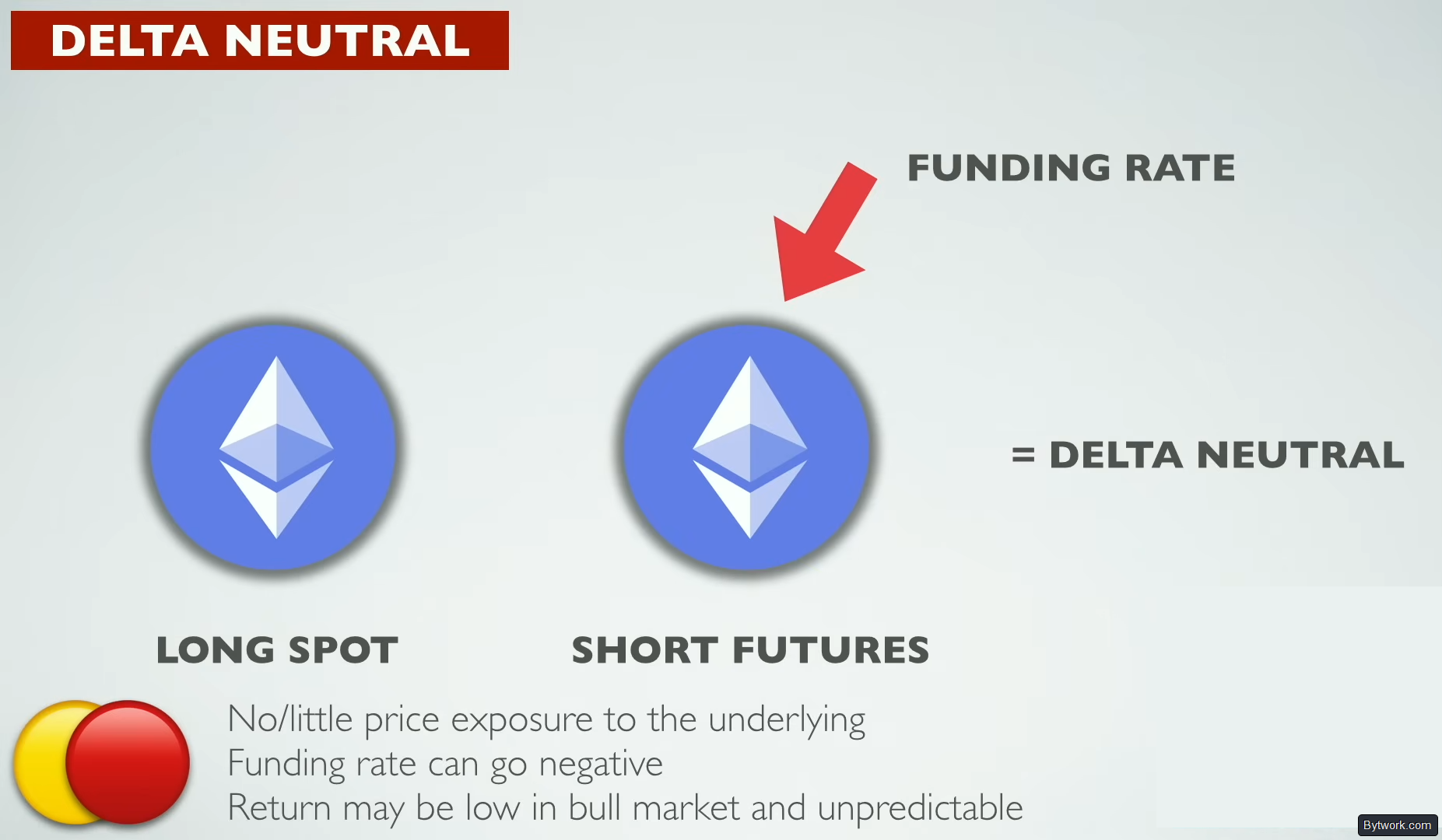
The long and short sides offset each other. Thus, when the price rises, the profit on the spot covers the loss on the futures; when it falls, vice versa. As a result, the value of the position remains unchanged. This is what keeps USDe around $1.
Funding rate as a source of income
The yield on sUSDe is generated by the funding rate – a mechanism that keeps the futures price in line with the spot price of BTC and ETH. When positive, Ethena's short futures position receives payments, which are then directed to USDe stakers. This is where the stated 4.2% comes from.
The rate depends on market conditions. In a bull market it is usually positive, in a sideways or bear market it can turn negative, reducing or eliminating yield. This income is not tied to US Treasury bonds – it is entirely determined by the crypto market and Ethena's trading strategy.
For major assets like ETH and BTC, the rate is predominantly positive, though periods of negative values do occur.
Using USDe as collateral and the USDtb alternative
Ethena also has a second stablecoin – USDtb. This is a more traditional instrument. Here, dollars are invested into a money market fund (BUIDL from BlackRock) that operates on-chain. It is backed by real-world assets (RWA).
USDtb is designed to comply with the new US stablecoin legislation (GENIUS Act). Essentially, it is $1 in Treasury bills managed by BlackRock, but it does NOT generate any interest yield. For such a purpose, USDT or USDC are better suited – they are widely adopted and serve the same function.
As for DeFi, on Aave on Ethereum mainnet you can supply USDe (or stake it). USDtb is also available on Ethereum mainnet – you can deposit it into the pool to earn yield from lending to other users.
What is the ENA token for?
ENA (Ethena) is the native token of the Ethena protocol, an ERC-20 on Ethereum. It transforms the protocol from a USDe issuer into a full-fledged financial ecosystem.
What is ENA for?
- Staking tokens for additional yield and partner rewards (sENA).
- Voting on protocol parameters, reserves, grants, and exchange partners.
- Staking ENA gives a bonus of up to 50% on rewards for holding USDe.
To avoid losing the 50% boost to USDe rewards, the value of staked ENA must be at least 50% of the USDe amount.
Therefore, we always keep a buffer of 50–100 ENA tokens above the norm so that the boost does not drop due to price volatility.

The tokenomics are as follows:
- Maximum supply – 15 billion tokens.
- Distribution – 28% ecosystem, 30% team, 25% investors, 15% foundation.
- ~55% of supply is held by insiders. And in 2026–2027, unlocks of ~$1.4 billion are expected.
Now let's move on to the risks.
What are the risks and disadvantages?
The protocol openly states the existence of risks, including smart contract risk, liquidity risk, operational risks of custodians, and counterparty risks on exchanges.
The risks and peculiarities of holding USDe and sUSDe are completely different from those of USDT. Essentially, you are investing in an on-chain hedge fund that implements a delta-neutral strategy to capture the funding rate. This is a common practice, but you are indeed investing in a hedge fund, not holding a stablecoin.
Open Ethena's dashboards – you can see exactly how the trades are executed. After receiving dollars, the protocol buys Bitcoin and Ethereum and executes the strategy, mainly on major centralized exchanges (Binance, Bybit, OKX). This adds risk.

However, Ethena does not hold assets on exchanges but with custodians (2 custodians: Ceffu and Copper).
Institutions use off-exchange custodians to mirror assets on exchanges for trading, but not store them directly there. If an exchange goes bankrupt or problems arise, assets on it would be frozen – then USDe could crash by 99%.
Custodians mitigate this risk but add complexity. In normal circumstances, your dollar remains safe, and the income is extracted from the short side of the trade. Upon withdrawal, the protocol must close the position and return your dollars. But additional risks compared to a regular stablecoin do exist.
Let's look at the protocol's risks in the table below:
|
Risk |
Essence |
Facts |
|
Negative funding |
In a bear market, funding rates become negative, and Ethena pays exchanges. |
Funding is positive 80-89% of the time over the last 3 years. To survive a prolonged bear cycle, at least 32% of income must be set aside into the reserve fund. |
|
Centralization and counterparties |
Dependence on centralized exchanges (CEX), custodians, and oracles. |
Shorts are opened on Binance, Bybit, OKX. Assets are with OES providers (Copper, CEFFU). Oracle manipulation leads to false liquidations. |
|
Liquidity and scalability |
Limited size of the derivatives market and risk of USDe de-pegging. |
Ethena takes no more than 25% of open interest. A threshold of 15% could make the protocol unprofitable. Withdrawal period from sUSDe is 7 days. |
|
ENA tokenomics |
Inflationary model and sell pressure from insider unlocks. |
55% of supply is for the team and investors (market average is 42%). In 2026–2027, token unlocks worth ~$1.4 billion. |
|
Collateral (LST and ETH) |
Risk of stETH de-pegging and lack of yield from BTC. |
Loss of stETH parity to ETH reduces collateral value. BTC does not provide native staking yield. |
|
Regulatory pressure |
Bans and the risk of USDe being deemed a security. |
USDe is not adopted under MiCA (EU); threat from the SEC. Jurisdiction changed from Germany to the British Virgin Islands, access blocked from several countries. |
|
Systemic DeFi risk (looping) |
Cascade of liquidations due to leverage in integrations with Aave and Pendle. |
Users create looping with up to 10x–11x leverage. A sharp drop in yield or ETH price triggers a cascade of liquidations. |
Ethena's growth is limited by the size of the derivatives market. If the protocol takes more than 15-25% of the total open interest on exchanges, it will start to depress the funding rate itself, making its strategy unprofitable.
It's important to understand that the risk in this protocol is not a mathematical error (as with Luna). The real risks are a prolonged bear market and the collapse of one of the top exchanges on which the protocol relies.
Also, during a flash crash, USDe temporarily lost its peg to $1 on several CEXs. The collateral value fell, accelerating liquidations of positions. The peg quickly recovered due to arbitrage, but the incident showed that short-term de-pegging is possible for USDe as well.
If you plan to use it as collateral, weigh the additional risks against the potential yield.
Conclusion
Ethena is a major DeFi protocol with billions in TVL, operating on the principle of an investment fund for stablecoins. It collects liquidity, generates high yield through basis trading and staking, returns ~98-99% of this yield to its USDe users, and keeps a fixed percentage as minting fees. All of this brings the project about $9.4 million in net profit per year.
It is important to understand that in a prolonged bear market, USDe will not instantly de-peg. Instead, it will slowly lose collateral value due to negative funding payments until the reserve fund is deployed.
Study strategies, do your own research, and understand the mechanics of protocols and assets. Don't miss our guide to DefiLlama.
Maksim Anisimov, specifically for bytwork.com.
Disclaimer: this is not financial advice; always do your own research.


