Who is Analyst Tom Lee? Biography and history of forecasts. Is it possible to believe him and how often do they come true?

CoinDesk includes him in the list of the most influential people in the crypto industry.


Thomas Jong Lee (known as Tom Lee) is a popular American equity strategist, research director, and financial commentator.
In this article, we will analyze:
- Who is Tom Lee (his biography)?
- How did he become popular?
- What forecasts does he give?
- How many predictions have come true and how many have not?
- And most importantly, can we trust his forecasts?
Who is Tom Lee (Biography)

Lee was born in Westland, Michigan (USA).
He was the 3rd child of 4 children of Korean immigrants. Tom Lee's father was a retired psychiatrist, and his mother was a homemaker. A little later, Tom Lee's mother became the owner of the Subway franchise.
Training. Lee holds a bachelor's degree in economics from the Wharton School of the University of Pennsylvania. His specialty was finance and accounting.
He also joined the Delta Upsilon fraternity at the university.
Lee holds a CFA Certificate (a prestigious international qualification for professionals in investment, finance, and risk assessment), and is an active member of the New York CFA Society and the New York Economic Club.
Career

Important! We searched for a long time for any information on the Internet about who he was, whether there was a rich/ influential relative or someone who pushed him, as it often happens with many famous personalities (the same Elon Musk and his richest father!).
At the moment, there is no documentary evidence or investigative journalism indicating that Tom Lee owes his success and connections or money to his family/relative.
All sources lead to the fact that he achieved everything thanks to the elite financial education system and many years of work in the largest banks in the world.
Tom Lee began his career in the early 1990s. His first major job was at Kidder, and later at Peabody. & Company", and then in "Salomon Smith Barney".
Already in 1999, he joined JP Morgan Chase. & Co as the chief equity strategist (after only 7-8 years from the start of his career, this is a good indicator).
While he was working at JP Morgan, his research attracted the attention of critics.
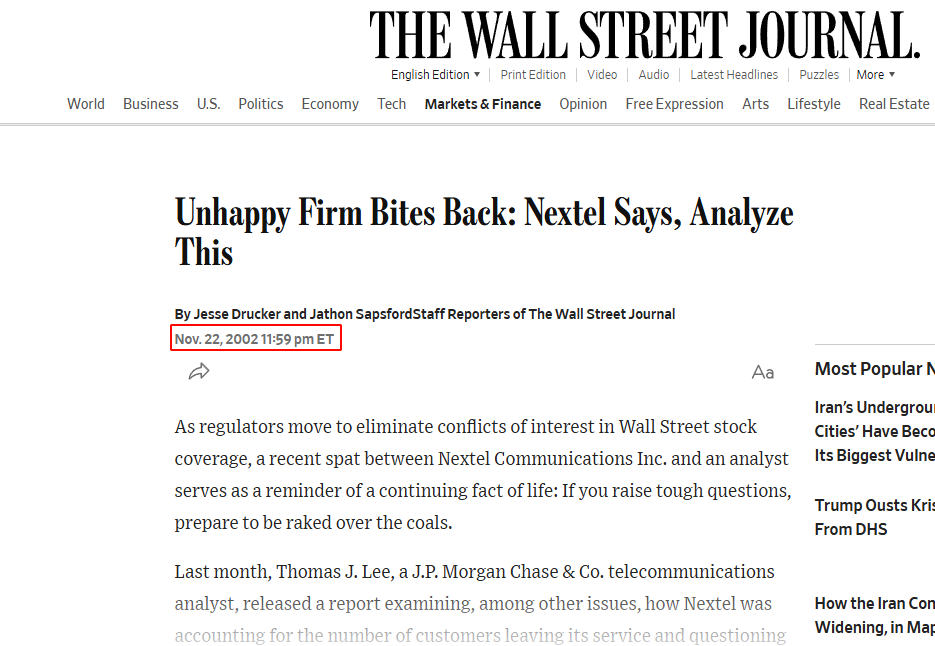
However, as early as 2002, Nextel, a publicly listed company, criticized Lee's research. There was a conflict because the company didn't like Lee's research.
This conflict attracted national media attention and was covered in a Wall Street Journal article dated November 22, 2002, with the headline "Disgruntled firm fights back: Nextel says: Analyze this."
At that time, there were many interesting observations in Lee's review, which raised the respect and interest in him from readers and economists.
Fundstrat Global Advisors – Tom Lee's company and other projects

Then, in 2014, Lee left JP Morgan to found his own research consulting firm «Fundstrat Global Advisors».
Fundstrat Global Advisors is not solely owned by Tom Lee - it is a private company founded by him and John Bai in 2014.
The company has at least one external shareholder, the venture capital fund Kyber Capital, which owns a minority stake in the business.
As for Tom Lee's positions in the Fundstrat structure, there are quite a few of them:
- Co-Founder the company
- Head of Research at Fundstrat Global Advisors
- Managing Partner
- Chief Investment Officer Fundstrat Capital (a management company launched in 2024)
- The leading portfolio manager of all three of the company's exchange-traded funds (ETFs), including Fundstrat Granny Shots U.S. Large Cap ETF
Lee is currently the head of research at Fundstrat Global Advisors and an advisor at NewEdge Wealth, a Connecticut-based asset management company. Lee is also on the board of directors of the New York Asian Film Festival.
Lee was also the subject of national media reports, including the Wall Street Journal, where the cover featured an article titled "Thomas Lee said, 'Buy,' as COVID-19 caused the stock market to collapse," an article based on investor reactions to several high-profile investment decisions he made in 2020.
Lee was the first major Wall Street strategist to provide his clients with an official analytical study of cryptocurrencies, in particular Bitcoin, which was covered in the media at the time.
He appeared on media outlets such as CNBC, Fox Business, Bloomberg, Yahoo Finance, and CNN, where he actively promoted Bitcoin.

Lee also actively covered the topic of Covid. Lee's retweets from James Todaro in early August 2020 caused controversy, as evidenced by a CNN article on September 9, 2020, "A New Front for Coronavirus Disinformation: Wall Street Research," in which Lee's retweets of Todaro's tweets were described as allegedly misinformation about the coronavirus.
On June 30, 2025, Lee became Chairman of the Board of Directors BitMine Immersion Technologies, Inc (not to be confused with bitmain.com).
|
Characteristic |
Bitmain (bitmain.com) |
BitMine Immersion Technologies (BMNR) |
|
What is it |
The world leader in the production of equipment (Antminer miners). |
A public company that manages data centers and cryptocurrency assets. |
|
Where is it |
Headquarters in Beijing, China. |
Headquarters in Las Vegas, USA. |
|
The main business |
Development of chips and sale of hardware for mining. |
Cooling of other people's equipment and accumulation Ethereum is in reserves. |
|
Status |
A private company (one of the largest unicorns). |
A public company, shares are traded on the NYSE American Stock Exchange (ticker BMNR). |
BitMine Immersion Technologies, Inc. (BMNR) is an American blockchain company specializing in Bitcoin mining and strategic accumulation of Ethereum.
Yes, judging by the number of posts, there won't be enough "medals" on the jacket.

Заслуги
- At the end of 2025, CoinDesk includes him in the list of the most influential people in the crypto industry.
- A regular financial and economic guest talking about cryptocurrency on CNBC, Bloomberg and Fox Business.
How did he become popular? Reason

Tom Lee's path to fame is not the story of a single moment, but rather the result of years of building a reputation as a brave, independent and visionary analyst who was not afraid to go against the crowd.
His popularity evolved from several key milestones that eventually transformed him from a "Wall Street weirdo" into one of the most influential voices in the world of finance and cryptocurrencies (but more cryptocurrencies).
The main impetus was that in 2017, he became the first ever top Wall Street strategist to start producing regular professional reports on Bitcoin.
Before him, enthusiasts and programmers were engaged in cryptocurrency.
Lee made Bitcoin popular, making it a legitimate asset in the eyes of serious investors.
|
Period |
Key Event / Forecast |
What was the impetus / step towards popularity |
|
2002 |
Conflict with Nextel and J.P. Morgan investigation |
As an analyst at J.P. Morgan, Lee released a critical report on Nextel, which provoked her harsh criticism and accusations against him. The bank's internal investigation fully confirmed his correctness and professionalism. This incident, highlighted in The Wall Street Journal, laid the foundation for his reputation as a principled and independent expert who puts data above the interests of corporations. |
|
2014 |
The foundation of Fundstrat and the first crypto forecast for Bitcoin |
Lee is leaving J.P. Morgan to found the independent research firm Fundstrat. At a time when cryptocurrencies were considered a marginal topic, he became one of the first well-known Wall Street strategists who began to seriously study them and include them in their reviews. He suggested that clients allocate 1-2% of their portfolio to Bitcoin, calling it "digital gold." It was a risky move that set him apart from the crowd and attracted the attention of innovative investors. |
|
2017 |
Publication of the First Fundamental Bitcoin Valuation Model |
Lee is releasing a report in which, for the first time, he proposes a mathematical model for evaluating Bitcoin as a "substitute for gold," predicting growth to five digits by 2022. While many on Wall Street ridiculed cryptocurrencies, Lee offered a rigorous, data-driven analysis. This caused a strong reaction: some called him a "crypto madman", others began to listen. |
|
2020 |
Forecast of a V-shaped market recovery after the pandemic |
In March 2020, amid the panic over COVID-19, Lee was one of the few analysts who predicted a rapid V-shaped market recovery and urged investors to buy on the downside. This prediction came true brilliantly, significantly strengthening his reputation as a macro guru who understands market cycles better than others. |
|
2019–2021 |
Repeated and bold predictions about Bitcoin |
In 2019, on CNBC, Lee advises investors to invest 1-2% of their funds in Bitcoin, to which the host responds with the words "that sounds crazy." Later, in May 2021, after a strong correction of Bitcoin, he goes on CNBC and confirms his forecast of growth to $100,000 by the end of the year. These moments are widely spread in the media and social networks, forming the image of an analyst who is not afraid to look "crazy" and defends his point of view, even when the market goes against him. |
|
2022–2025 |
Confirmation of the "insider" status |
He becomes a regular guest on CNBC, Bloomberg and Fox Business. In 2025, he will serve as chairman of the board of directors of BitMine, a company building the largest corporate reserve in Ethereum. At the end of 2025, CoinDesk includes him in the list of the most influential people in the crypto industry. By this point, he had finally moved from the status of an "outsider" to the status of a recognized authority and a key bridge between traditional finance and the world of cryptocurrencies. |
Total. Main push: July 2017:
The point of no return was the Fundstrat report entitled "A Framework for Valuing Bitcoin".
This was the first time that an analyst of this level applied classical financial models (such as Metcalfe's law) to cryptocurrencies.
Lee argued that Bitcoin is not "air", but a social network for money. When his forecast for $6,000 came true and was repeatedly exceeded within a couple of months, Lee instantly transformed from "just a financial analyst" into a global star.
Why is it popular now?

Now his popularity is based on the "Misery Index" - this is his author's indicator, which he implemented for the crypto market.
Investors keep an eye on him because he offers a scientific approach to market psychology, rather than just guessing on charts.
What is the Bitcoin Misery Index (BMI) - Tom Lee's Project
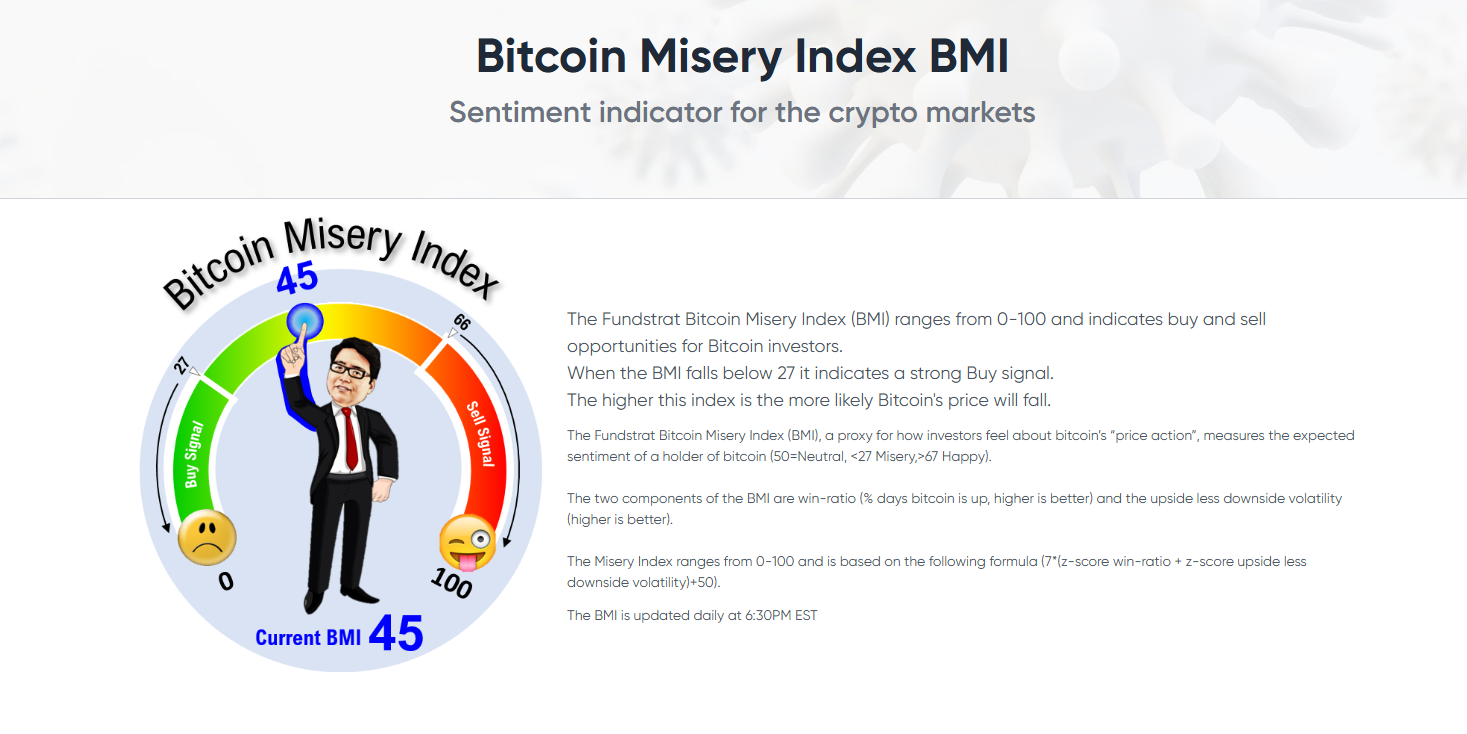
Bitcoin Misery Index (BMI) - is a proprietary, paid-for "misery index" indicator that Tom Lee introduced in March 2018.
Instead of looking only at the price, Lee decided to measure the psychological state of Bitcoin holders.
The logic is simple: when investors are "hurting" the most and they are ready to give up, the best moment to buy comes.
How BMI works
The index is calculated on a scale from 0 to 100 and combines two indicators:
- Volatility: how dramatically does the price change
- Percentage of profitable trades: what proportion of investors are currently "in the black"?
Interpretation of index values
|
Value (0-100) |
Market conditions |
What does this mean for an investor |
|
0 - 27 |
"Minimal happiness" |
Investors are depressed, panicking, and selling massively. The best time to buy. |
|
28 - 66 |
Neutral |
The usual market movement without obvious distortions. |
|
67 - 100 |
"Maximum happiness" |
Euphoria, everyone believes in endless growth. A signal for a possible sale. |
Why did it make him popular?
Tom Lee has turned the idea of market forecasts upside down. He explained that price is a consequence of emotions.
- A buy signal: when the index drops below 27, it means "Misery" (suffering). Historically, after reaching this mark, Bitcoin gave the best growth in the next 12 months.
- Example: in March 2018, when the index fell to a low, Lee claimed that this was the "best entry point," which added credibility points to him among traders.
The essence of the method: Tom Lee uses BMI to go against the crowd. When everyone is "happy," he begins to be cautious. And when everyone is "suffering," he gives his wildest bullish predictions.
Comparing BMI and Fear & Greed
|
Parameter |
Bitcoin Misery Index (BMI) |
Crypto Fear & Greed Index |
|
Availability |
Paid Fundstrat subscription |
Free everywhere |
|
Update |
In closed reports |
Once a day |
|
Methodology |
Transactions + Volatility |
Volatility + Polls + Social Media |
|
Meaning |
Low Index = Buy |
Low Index = Buy |
Result. If you are not a subscriber to Fundstrat analytics for several thousand dollars a year, the easiest way is to use TradingView (indicator search) or look at the Fear & Greed Index, since their charts are correlated by 90%. A mostly useless paid and very expensive application from Tom Lee.
What predictions did Tom Lee make and which ones have come true?

Now let's list all of Tom Lee's most famous predictions and see if they came true or not.
Bitcoin Forecast:
|
Forecast year |
The BTC Goal |
Due date |
The real result |
Status |
|
2017 |
$6 000 |
End of 2017 |
BTC has reached ~ $20,000 |
Predicted it. And even exceeded it |
|
2018 |
$25 000 |
End of 2018 |
BTC Dropped to ~ $3,200 |
Didn't come true |
|
2019 |
$10 000 |
End of 2019 |
BTC was ~ 7,200$ (peak of 13$k) |
Partly |
|
2020 |
$40 000 |
End of 2020 |
BTC Reached ~ $29,000 |
Didn't come true (but in general, it is considered by many to be very close) – although we believe that it did not come true, the gap is too big. |
|
2021 |
$100 000 |
End of 2021 |
BTC Reached ~ 69,000 |
Didn't come true |
|
2022 |
$200 000 |
During the year |
The market collapsed (FTX/Luna crash) |
Didn't come true |
|
2023 |
$40 000+ |
End of 2023 |
BTC Ended the Year at ~ $42,000 |
Accurate prediction |
|
2024 |
$150 000 |
End of 2024 |
BTC has reached ~ $100,000 |
Didn't come true |
|
2025 |
$200 000 |
End of 2025 |
The market collapsed |
Didn't come true |
|
2026 |
$250 000 |
End of 2026 |
Current forecast |
Expectation |
Forecast for Ethereum (let's remind, his company specializes in it):
|
Coin |
ETH Target |
When was the forecast given? |
When should it happen |
The real result |
|
Ethereum (ETH) |
$1 900 |
May 2018 |
End of 2018 |
Didn't come true ETH Dropped to ~$100 |
|
Ethereum (ETH) |
$10 500 |
January 2021 |
2021–2022 |
Didn't come true The peak was ~ 4,800$ |
|
Ethereum (ETH) |
$9 000 |
October 2024 |
End of 2025 - 2026 |
Didn't come true ETH reached only ~$4,800 and dropped completely in 2026. |
Altcoin Forecast:
|
Coin |
Price target |
When was it given |
Due date |
The real result |
|
Solana (SOL) |
Growth above the market |
2023 |
2024 |
SOL increased from $20 to $200+. It came true |
|
Grayscale Trust (GDLC) |
+50% to the market |
2020 |
2021 |
The basket of altcoins has grown significantly. It came true |
|
Альткоины (Small Cap) |
Growth by 200% |
February 2020 |
Summer 2020 |
Short-term pump before correction |
|
Binance Coin (BNB) |
Promised great growth |
2019 |
After 2020-2021 |
Predicted it. Lee advised exchange coins, BNB grew 10 times. |
|
Bitcoin Cash (BCH) |
$1 000 |
2018 |
2019-2020 |
It didn't come true. The coin went into a prolonged fall. |
How many predictions have come true and how many have not?
Now that we know all of his loudest and most accessible predictions, let's see how many came true in the end.
Let's start with Bitcoin.
How many predictions about Bitcoin have come true?
We know about 10 forecasts (but for now we will count 9) of them, we know that 6 did not come true, then the percentage of failures is as follows:
Approximately 66.7% of forecasts did not come true
It is important to understand that in the world of financial and cryptocurrency forecasts, even the most respected analysts (including Lee) often make mistakes in timing, but they can fall into a trend.
For example, his 2017 prediction of BTC at $55,000 by 2022 formally "did not come true" on the specified date, but the price reached this goal in 2021.
Therefore, many investors look not only at the statistics of hits, but also at the overall vision of the market.
However, you need to understand that he very often corrects his forecasts, and gives them very abstractly, and is already closer to understanding, sometimes changing them in a couple of weeks or months.
He creates a buzz around himself with very optimistic scenarios, and then he corrects them (but not always).
How many predictions have come true for Ethereum and other altcoins?
It's important to remember that his company specializes in accumulating ETH! And this should mean that he and his team should understand this asset well, since they believe in it!
So, we know about 3 global forecasts from Tom Lee on the Air.
And, drum roll – not a single one came true!
Even unlike Bitcoin, where forecasts were sometimes very close, the hit in Ethereum is almost zero!
For example, ETH at $10,500 in 2021, when the real price was only $4,800.
The situation is slightly better for altos, he really guessed right with BNB and some other exchange-traded tokens!
Can we trust Tom Lee's predictions?
You should not trust his forecasts. Even from statistics, for BTC alone, almost 67% of failures is a lot, and for Ethereum, all 100% of failures (which is sad).
You can listen to him, but you need to draw conclusions yourself, and rely only on your knowledge and understanding of the market!
In fact, you just need to take his opinion as one of many, compare it with others, and draw your own conclusions based on analytics and your own understanding of the market (charts/indicators, etc.).
Conclusion

Tom Lee is an ambiguous figure who became popular due to the fact that he actively began to promote Bitcoin in articles and on television among Stock market investors.
Yes, he had his merits before that, but thanks to them, he would not have become as popular as during the promotion of BTC in 2017 and loud statements to the audience of traders / Stock market investors and just people watching those broadcasts. And also thanks to the high-profile forecasts in those distant years for BTC and the fact that it would cost a lot of money, which most did not believe in and considered him an optimist (reading the cryptocurrency market as "gray").
But in the end, he hit the nail on the head, and moreover, his forecast turned out to be modest compared to what BTC achieved that year!
Yes, it gave him a boost, but objectively speaking, most of his predictions were very unrealistic and in the end never came true!
Trust him, like almost all analysts, is not worth it, just take their forecasts and further analyze them using your own knowledge and understanding of the market!
Based on all this, we can really say that Tom Lee is an optimistic analyst who often calls very exorbitant amounts!
Yes, it is important to understand that once upon a time Bitcoin could actually reach $ 250,000 for 1 coin, but this did not happen in the years that he predicted, thereby sometimes misleading investors who believed him and entered this market, but the forecast did not come true.


