We Tested 10 Solana DeFi Farms: here Are the Best

Let’s break down all the best DeFi protocols on Solana so you know where to start, what the protocol terms are, and what makes each one unique. We’ll also open real positions to get hands‑on experience with the protocols from the very beginning.
Solana ranks among the top 3–5 blockchains by TVL, and its share in the DeFi sector reaches 6–10%. In this crypto cycle, the network has cemented its place in the top five, although newer networks like Robinhood are siphoning off TVL. For accurate DeFi protocol metrics we use DefiLlama.
First, let’s examine the core of the protocols, grouped into three categories: conservative, DEX exchanges, and leveraged protocols.
Table 1. Liquid staking and base yield protocols (LST). This table covers protocols whose flagship offering is safe custody and staking of SOL with minimal risk.
|
Name |
Mechanism |
Conservative yield |
Aggressive yield (with leverage) |
|
Sanctum |
Custom LSTs (jupSOL, bonkSOL) |
5.5% – 5.8% APY (MEV) |
None |
|
Jito |
MEV staking with JitoSOL |
5.2% – 5.9% APY |
8% – 12% APY (looping on Kamino) |
|
Binance (BNSOL) |
Exchange‑issued LST token |
5% – 7% APY |
Higher (via depositing into DeFi) |
Below are protocols where profits come purely from supplying liquidity for trading and collecting fees.
|
Name |
Pool mechanism |
Yield in wide (safe) ranges |
Yield in narrow (risky) ranges |
|
Meteora |
DLMM (dynamic price bins) |
3% – 6% APR (stablecoins) |
40% – 100%+ APR (SOL/USDC) |
|
Orca |
Whirlpools (concentrated liquidity) |
10% – 25% APR |
100% – 150%+ APR (high risk) |
|
AMM + CLMM + Sniping |
Stable fee income |
25% – 35% APR (SOL/PYTH) |
Now the aggregator protocols that rotate external liquidity, leverage, lending, and derivatives to boost yields.
|
Protocol name |
Earning method |
Base yield (Lend) |
Maximum yield (looping / indices) |
|
Staking JUP, jupSOL, JLP index, leverage |
5% – 6% APY (jupSOL) |
21% – 26% (looping), >100% (JLP at peaks) |
|
|
Kamino |
Lending, auto‑looping, depositing into DEX pools |
~5% APY (SOL as collateral) |
Depends on leverage (up to 10x on Multiply and JLP) |
|
Solstice |
Delta‑neutral strategies and minting eUSX |
None |
~13.96% IRR (protection against negative funding) |
|
Xtocks |
Pools of tokenised real stocks (RWA) |
20% – 35% APR (conservative) |
Up to 77% APR (aggressive) |
What should you choose? Solana yield strategies range from low-risk MEV staking (Jito, Sanctum) offering 5.2–5.9% APY to high-risk DEX market making (Meteora, Orca) yielding 40–150%+ APR. Lending protocols (Jupiter JLP, Kamino) serve as a balanced middle ground for automated yield generation, while active position management remains best suited for maximizing returns. Below is an express audit of these protocols, their terms, and the associated risks.
1. Jupiter
The flagship Jupiter protocol bundles into a single interface a swap aggregator, staking, lending with borrows, margin looping, perpetual trading, cross‑chain bridges, limit orders, and DCA automation.
Jupiter holds the #1 spot by TVL on Solana. The Jupiter Z system, with 15 market makers, guarantees zero slippage for over 100 tokens.
The JLP pool liquidity consists of 44–47% SOL, 8–9% ETH, 11–15% WBTC, and 30–35% USDC and USDT, and its historical yield at peaks has exceeded 100% per annum.
How do you earn?
The protocol offers staking of JUP with a buyback mechanism, and SOL staking via jupSOL at 5%‑6% APY.
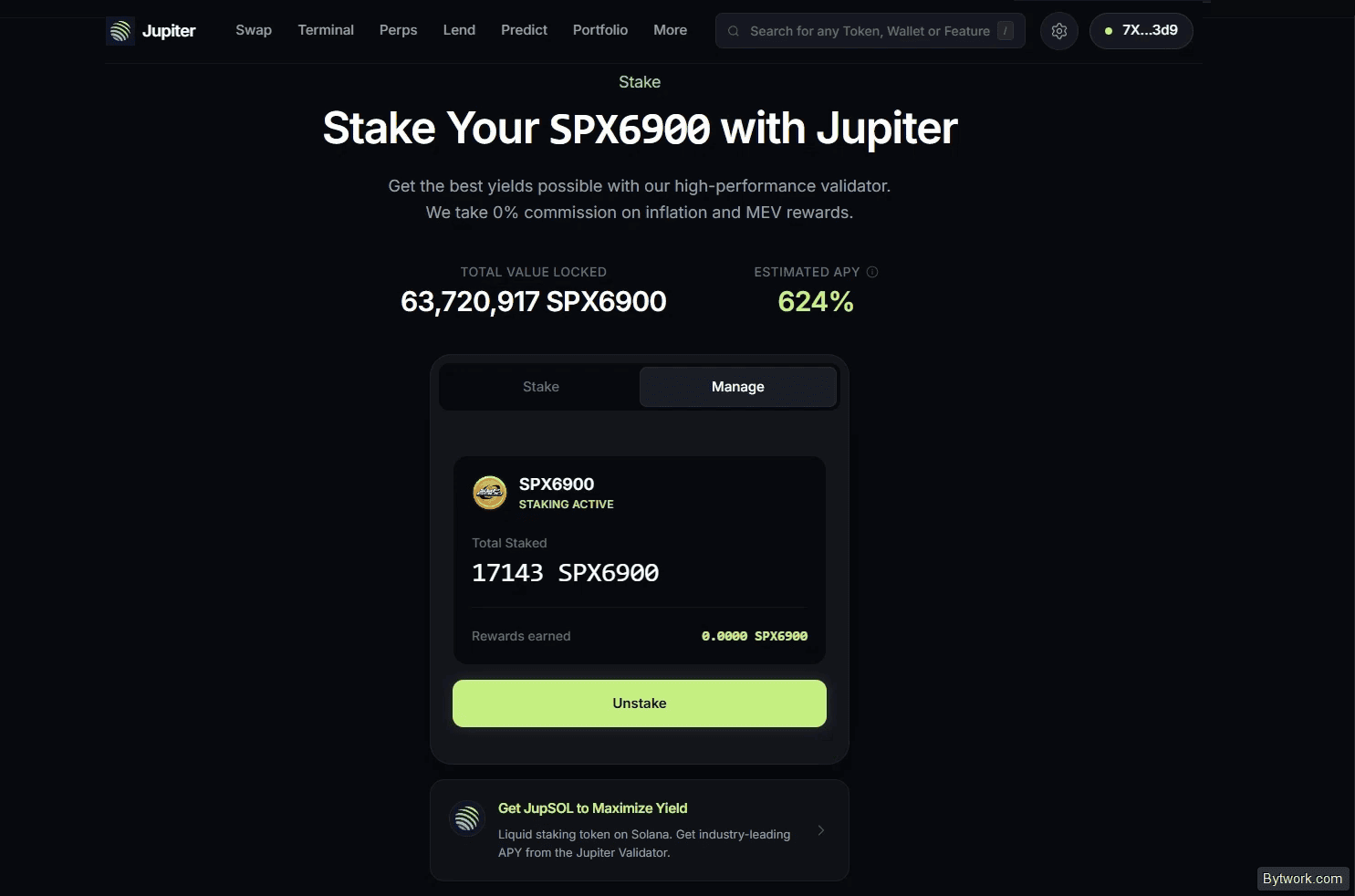
In our Jupiter staking we hold 17,143 SPX6900, which have so far generated 0.0000 SPX6900 in rewards, while the total locked amount has surpassed 63,720,917 SPX6900 with an estimated rate of a whopping 624% APY.
Looping strategies with up to 10x leverage yield 21–26% per annum. The fact that the protocol has never been hacked confirms its status as a gold standard of security.
2. Kamino
The largest lending protocol, Kamino Finance, holds the top spot by TVL in the lending category. Kamino combines Kamino Lend markets, Liquidity Vaults, and looping strategies with custom or autonomous management.
How do you earn?
We deposit SOL and liquid staking tokens (LST) like JitoSOL, jupSOL, or bSOL at ~5% APY and borrow stablecoins USDC, USDT, PYUSD at dynamic rates.
The Multiply feature automates looping of LST tokens against SOL with up to 10x leverage to boost staking yields.
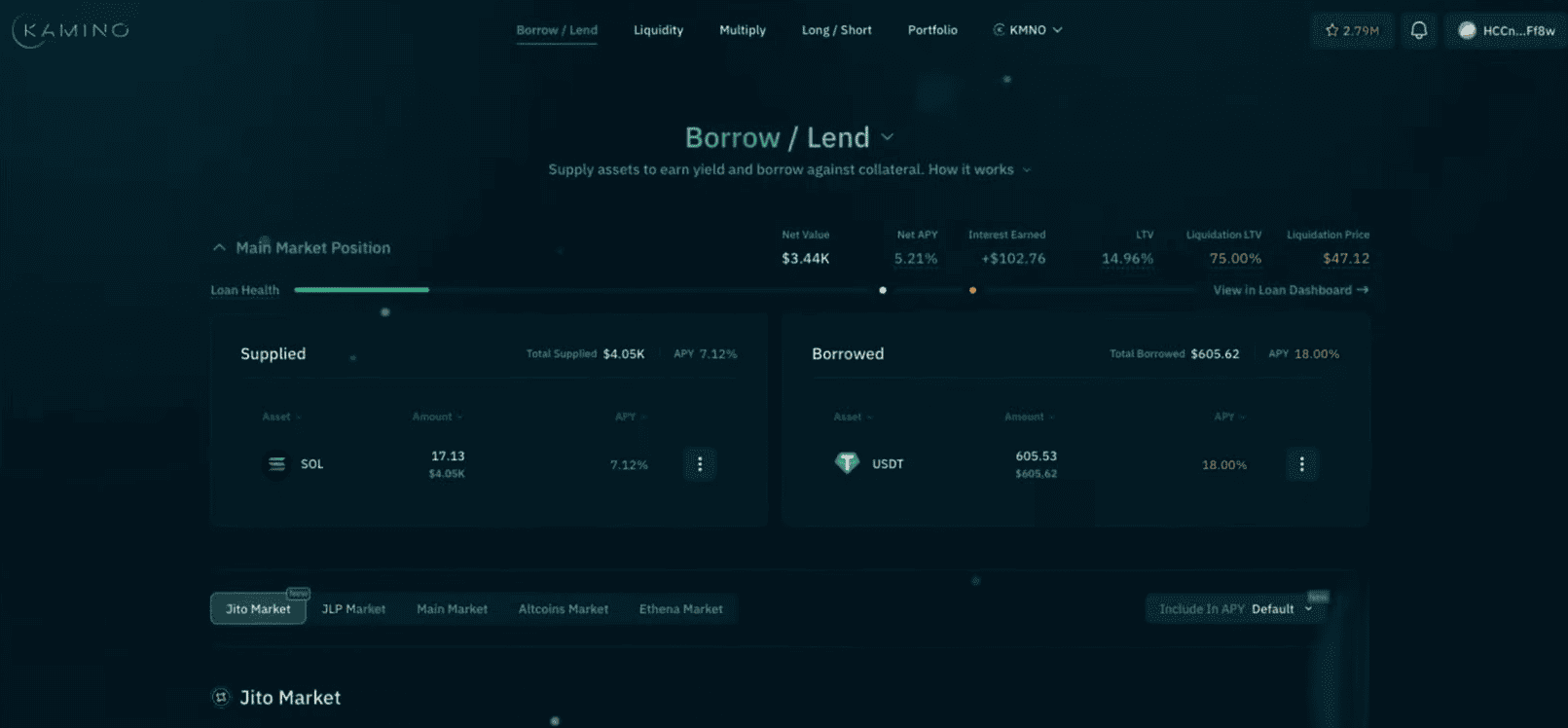
Our active lend order on Kamino, with a net balance of $3.44K, is backed by collateral of 17.13 SOL ($4.05K) at 7.12% APY and a debt of 605.53 USDT at 18.00% APY, with a safe LTV of 14.96%.
Also, the Liquidity Vaults module manages liquidity ranges on Orca and Raydium for pairs like JitoSOL‑SOL, reducing impermanent loss.
Advanced investors borrow USDC against JitoSOL collateral for Meteora pools and the RWA token AUTO, or use the JLP index as collateral to buy more JLP with leverage from 1.6x to 3x.
3. Sanctum (liquid staking)
Sanctum is an infrastructure aggregator for liquid staking. It ranks second in staking by TVL on Solana.
Sanctum allows anyone to launch custom LSTs such as jupSOL, bonkSOL, or laineSOL with automatic accrual of staking and MEV yields. The protocol’s native token is INF, which combines a basket of LSTs in the Infinity pool.
What is the yield?
The yield of the popular jupSOL token is about 5.8% APY. The protocol’s architecture preserves a base capital yield in the range of 5.5–5.8% per annum and keeps assets in DeFi circulation without locking them for an epoch.
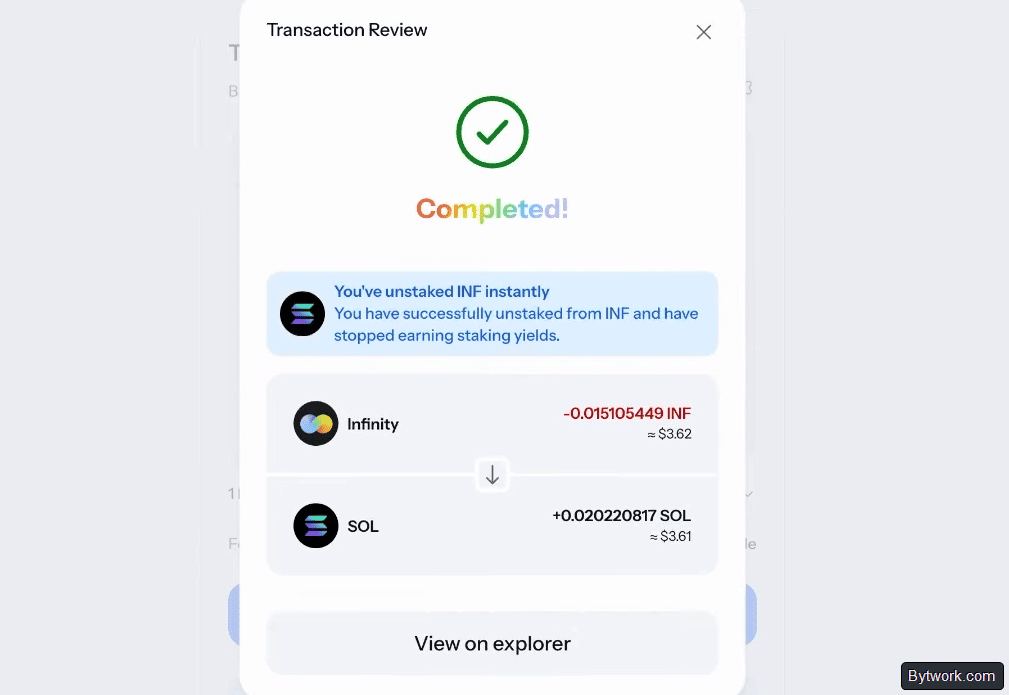
In our example, we performed an instant unstake, withdrawing 0.015105449 INF (~$3.62) from the Infinity pool, which gave us 0.020220817 SOL (~$3.61) on the wallet.
The protocol is interesting. Leading LSTs have a collateral LTV of up to 85–90% on Kamino, and the Sanctum Reserve pool ensures instant exchange of any amount of LST for SOL, reducing the risk of trade failure.
4. Binance Staked SOL (liquid staking)
The liquid staking token BNSOL from Binance is the largest exchange‑issued LST product on Solana, competing in TVL with Jito, Marinade, and BlazeStake.
What is the yield?
The average yield is about 5–7% per annum. The yield is automatically accumulated inside the asset, so the value of BNSOL grows relative to SOL every epoch (every 2–3 days).
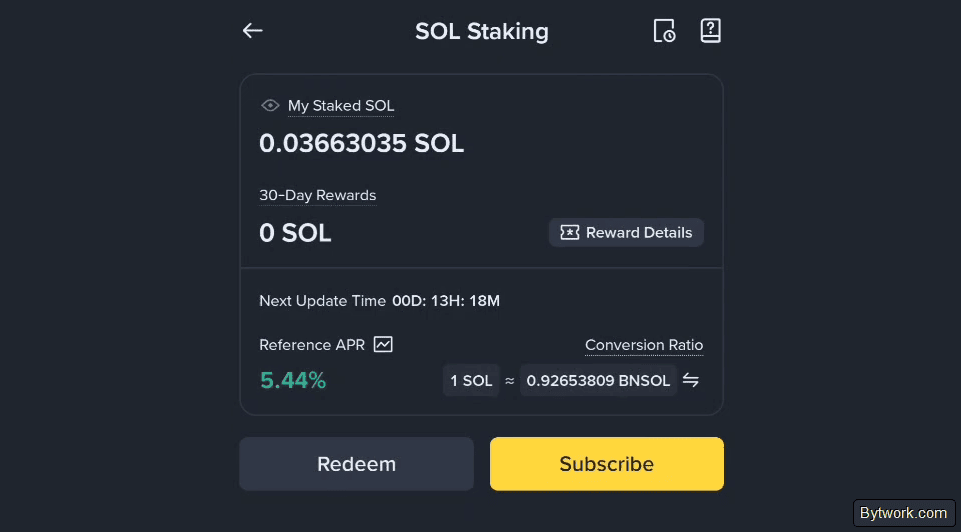
We staked 0.03663035 SOL at a base 5.44% APR with an exchange rate of 1 SOL ~ 0.92653809 BNSOL, but over the last 30 days the rewards are still zero.
Holders can withdraw BNSOL to Web3 wallets while retaining rewards, and use it in Solana DeFi protocols. The token has high liquidity and is integrated as collateral on Kamino, as well as in liquidity pools on Orca and Raydium to maximise APY through leveraged farming.
5. Jito (liquid staking)
The liquid staking protocol Jito issues the JitoSOL token based on its own MEV infrastructure, the Jito‑Solana client. Jito captures extractable value via on‑chain auctions and distributes the proceeds to JitoSOL holders as tips.
What is the yield?
The base yield of the token dynamically moves in the range of 5.2–5.9% per annum through an exchange‑rate model, increasing the asset’s value relative to SOL each epoch.
We have 95.741 Jito in staking, which have already generated 1.6368 JupSOL in rewards, and the total locked amount has reached 83,913,428 JupSOL with an estimated rate of 6.24% APY.
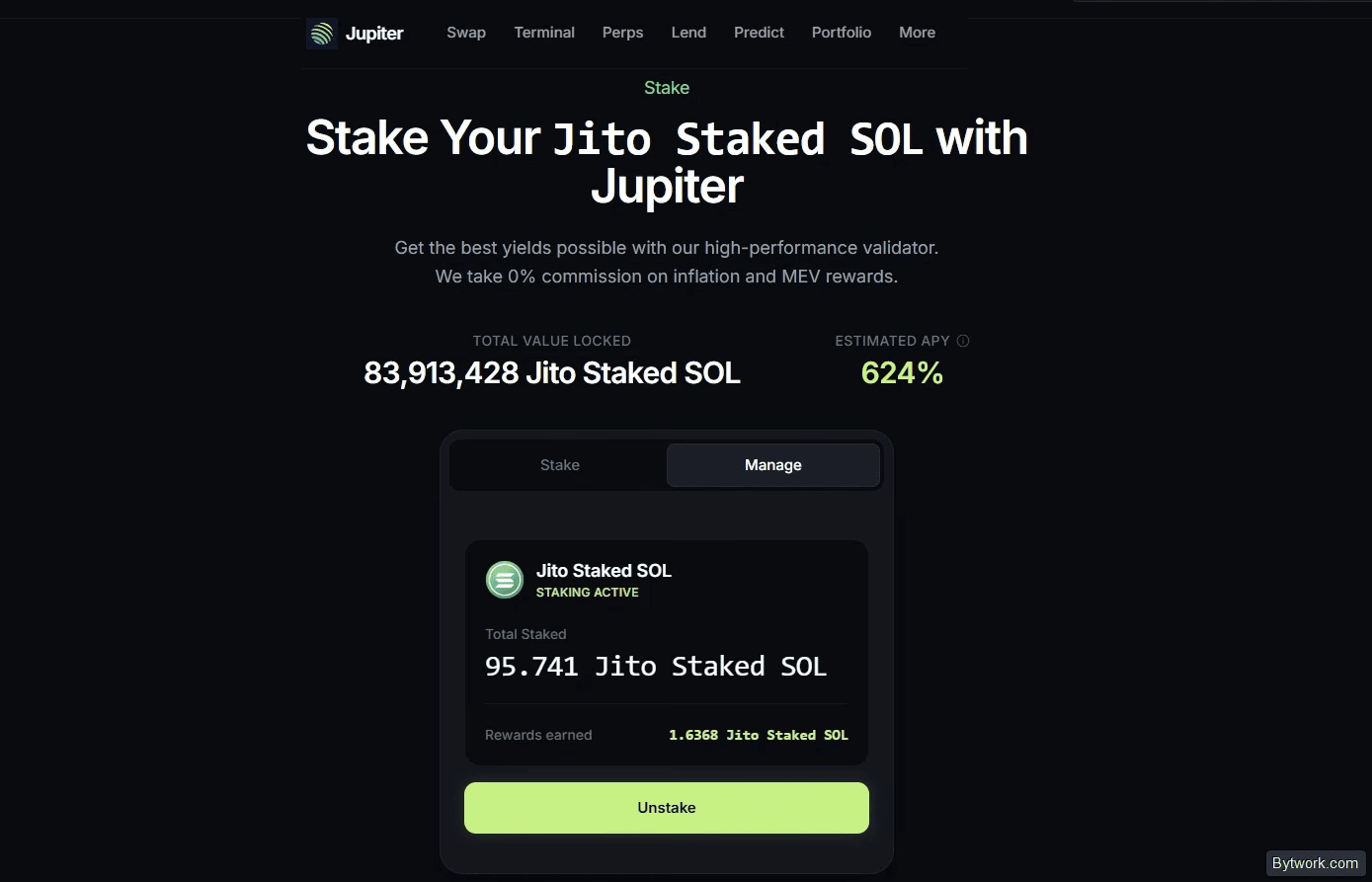
Conveniently, JitoSOL is supported by all Solana DeFi services, and Kamino Finance has a dedicated Jito Market with LTV up to 90%. This allows looping strategies with up to 10x leverage to boost yields to 8–12% APY without market‑liquidation risk.
The protocol also offers Jito Restaking modules and automated Vaults for third‑party network security. Finally, diversifying capital between Jito, Sanctum, and Marinade reduces smart‑contract risks.
6. Raydium (DEX)
The DEX Raydium uses a hybrid AMM and concentrated liquidity CLMM model, focusing on crypto assets and memecoins after the shutdown of tokenised equity markets like Xtocks.
Raydium leads in transaction volume due to automatic pool migration from Pump.fun. Conservative wide ranges in SOL/USDC and SOL/USDT pairs generate stable fee income without frequent rebalancing.
What is the yield?
In correlated pairs like SOL/PYTH, the impermanent loss risk is lower, and yields range from 25–35% APR.
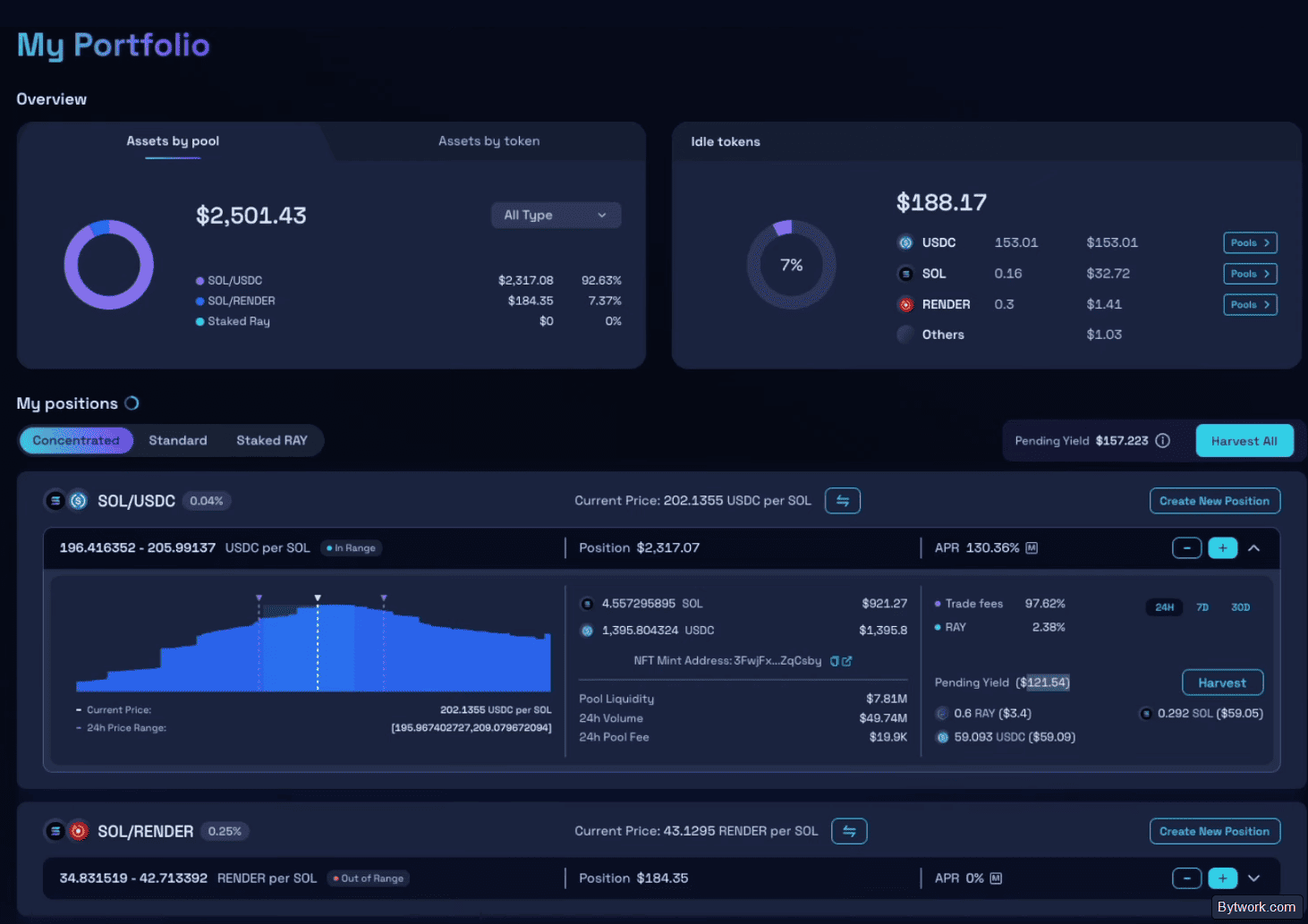
CPMM contracts have increased Raydium’s capital efficiency compared to Orca, although Meteora leads in yields within narrow ranges thanks to its DLMM system. We hold 2 positions. A concentrated SOL/USDC position worth $2,317.07 is perfectly within the current corridor of 196.41–205.99 USDC at a rate of 202.13 USDC and generates a hefty 130.36% APR.
Algo traders use bots and send transactions with Jito Tips from 0.01 SOL for instant sniping of new tokens the second pools open. Working with Raydium is closely tied to GMGN.
We separate pools on Raydium. For example, the SOL/USDC pair is used as a yield generator (stablecoins), while pairs like SOL/PYTH are for accumulating assets with yield.
7. Meteora (DEX)
The liquidity protocol Meteora on Solana uses the DLMM architecture with capital distributed across discrete price bins. Trading within a bin happens with zero slippage, which boosts capital utilisation and fee income compared to Orca and Raydium.
For wide price ranges, Meteora offers Spot, Curve, and Bid‑Ask templates.
What is the yield?
In narrow DLMM pools like SOL/USDC, yields are 40–60% APR in calm markets and can exceed 100% APR during high volatility. For the stable USDC/USDT pair, concentrating liquidity in a few bins gives 3–6% APR with no volatility risk.
Our LAUNCHCOIN/SOL position, priced at $35.23, is open in the corridor 0.000398–0.000456 SOL per LAUNCHCOIN under a spot strategy on Meteora.
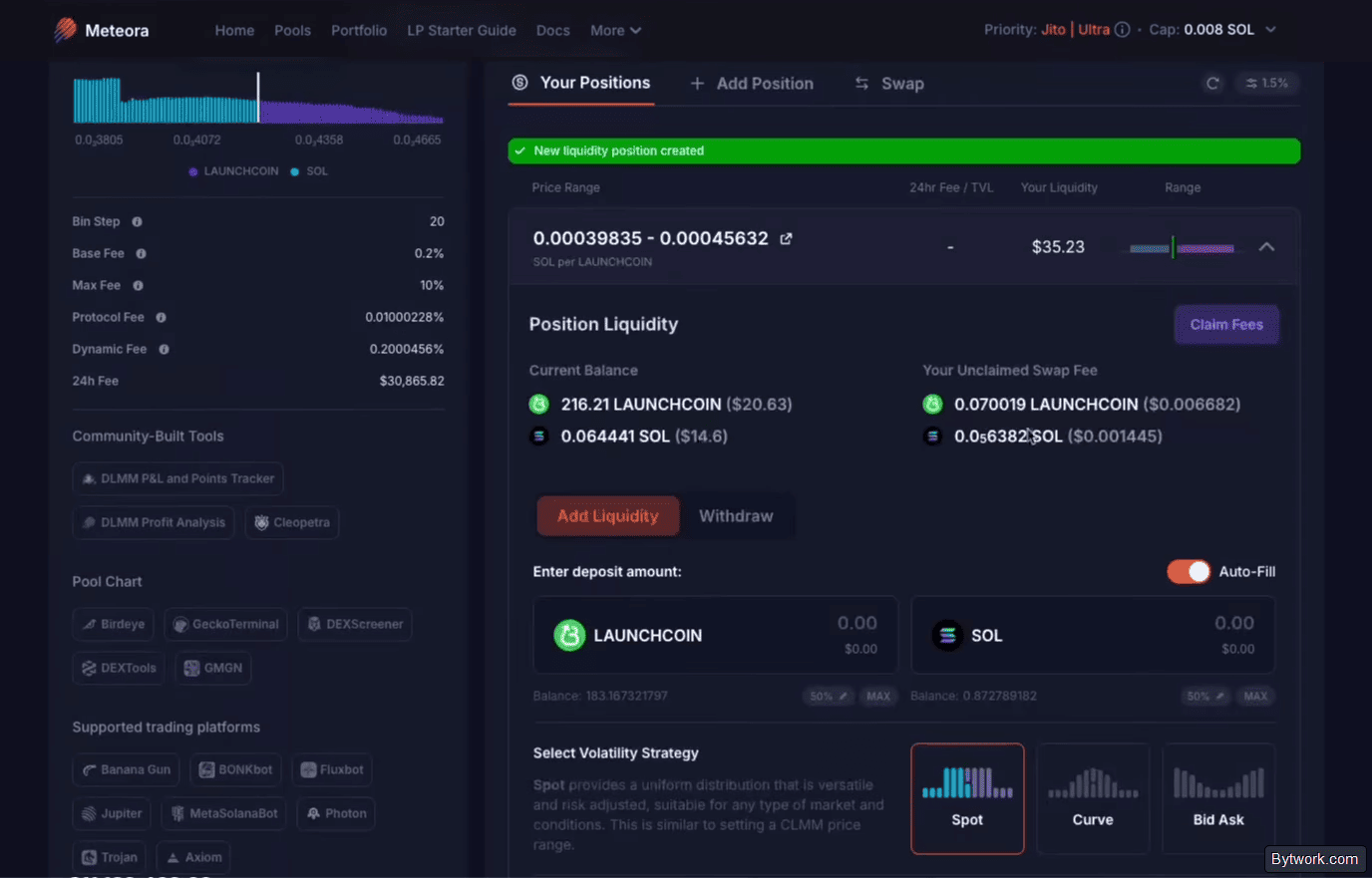
The protocol’s mechanics are also suited for delta‑neutral strategies and require regular position shuffling.
8. Orca (DEX)
The DEX Orca on Solana uses the concentrated liquidity Whirlpools model with flexible fees from 0.01% to 1%.
Orca competes in capital efficiency with Meteora and Raydium.
What is the yield?
- For the SOL/USDC pair in a wide conservative range around 30% from the spot price, the base yield is 10–25% APR with minimal impermanent loss risk.
- Balanced middle range within 15% of the rate yields 20–40% APY.
- Aggressive narrow range within 5% in volatile sessions can give over 100–150% APR, but requires hourly monitoring due to the risk of quickly breaking out of the range.
An active SOL/USDC position worth $14.50 is in the working range 75.35–94.35 USDC and delivers 114.14% annualised yield.
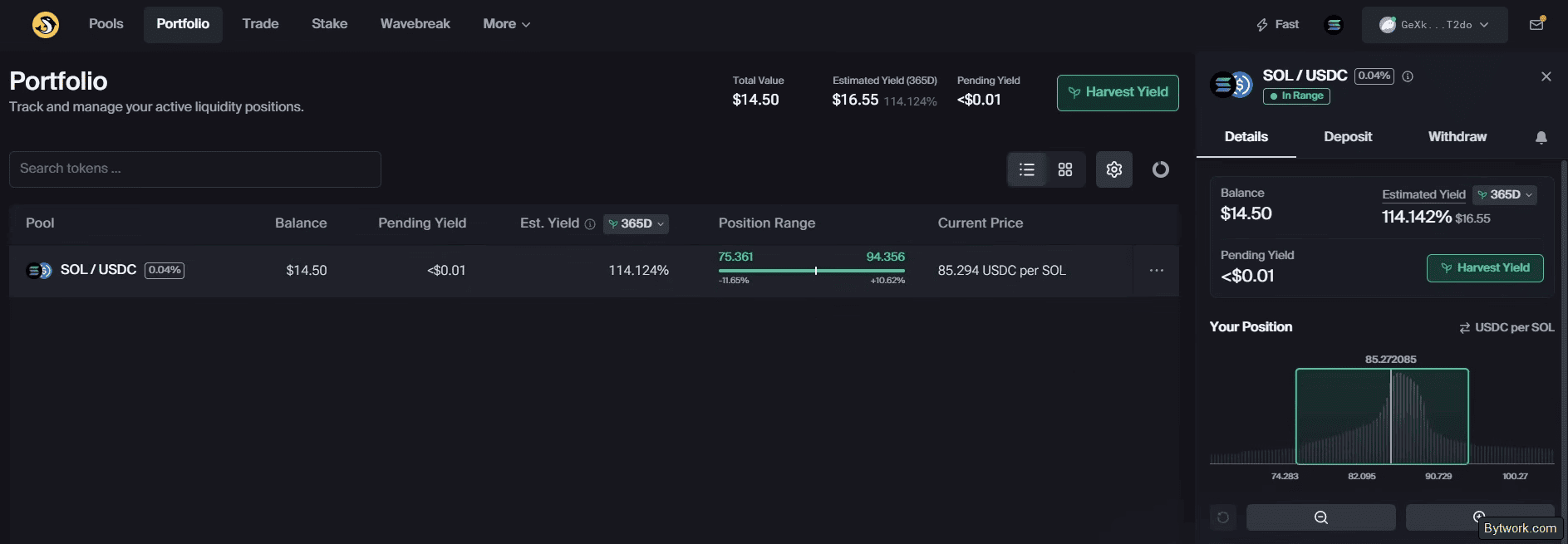
However, in practice we see that frequent rebalancing of narrow ranges like 10% often leads to closing at a loss, with losses reaching up to 7% of the position, and it then takes about 3 months of being in range to break even.
9. Xtocks
The xStocks protocol, launched jointly with Backed Finance and Kraken, holds 97% of the tokenised stock market volume with TVL over $350 million, guaranteeing 1:1 backing by real assets.
How much does it yield?
- Aggressive strategies in liquidity pools on Raydium and Orca generate up to 77% APR,
- while conservative approaches yield 20–35% APR.
You can dive deeper into xStocks mechanics through farming on the aforementioned DEXs.
We deposited 0.15130674 SPYx (~$101.05) into xStocks at a modest 0.02% APY, with a return transaction fee of 0.024 SOL ($2.17).
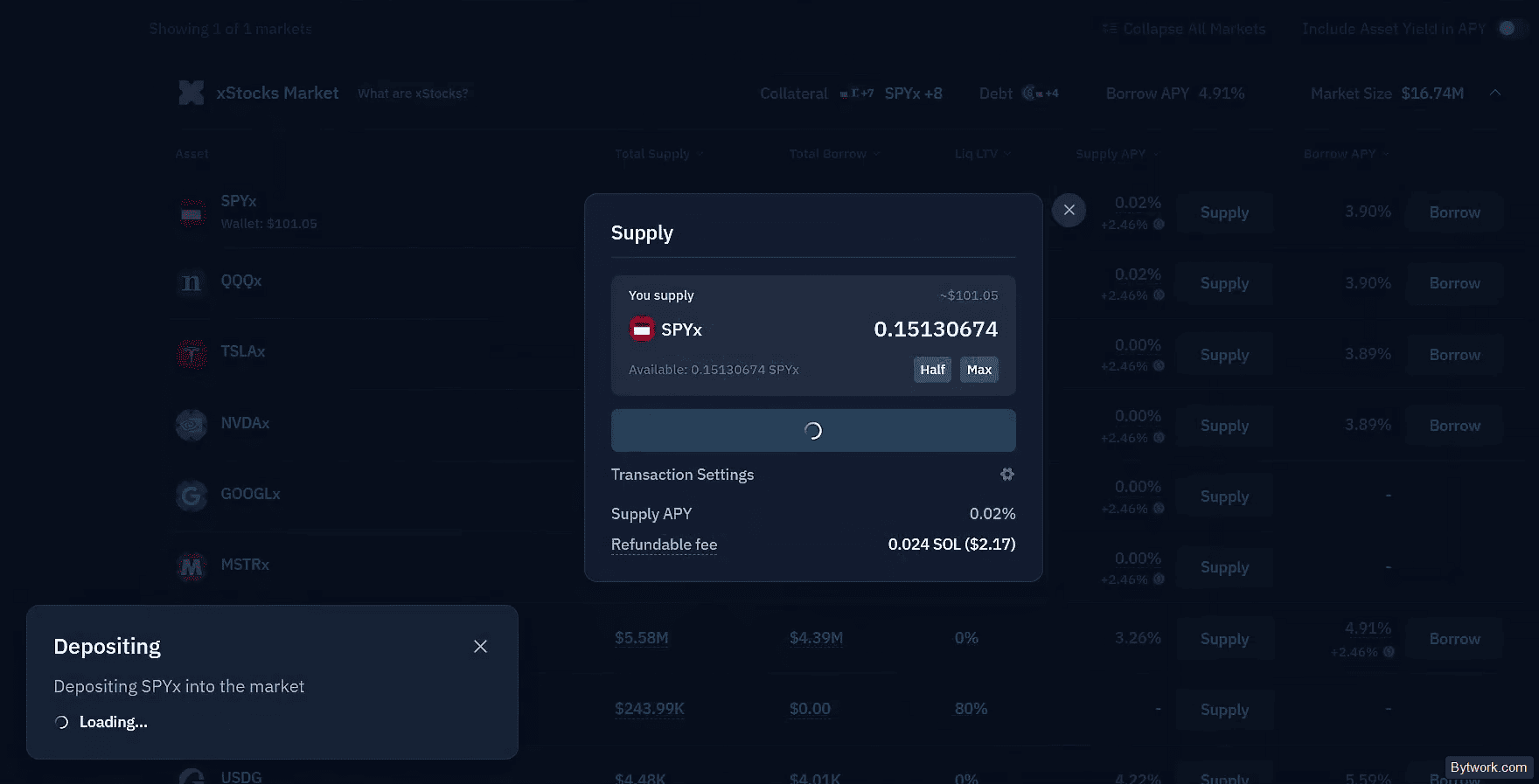
We avoid setting overly narrow ranges for tokenised stocks on Raydium to prevent frequent “out‑of‑range” situations.
10. Solstice
Solstice, rounding out the top three platforms with TVL exceeding $500 million, runs a delta‑neutral strategy, generating profit through longs in LSTs and shorts in perps.
The foundation of the entire ecosystem is the native over‑collateralised digital dollar USX.
What is the yield?
The protocol maintains an eUSX yield of ~13.96% IRR, attracting reserves in USX, fiat cash, and RWA to protect against negative funding.
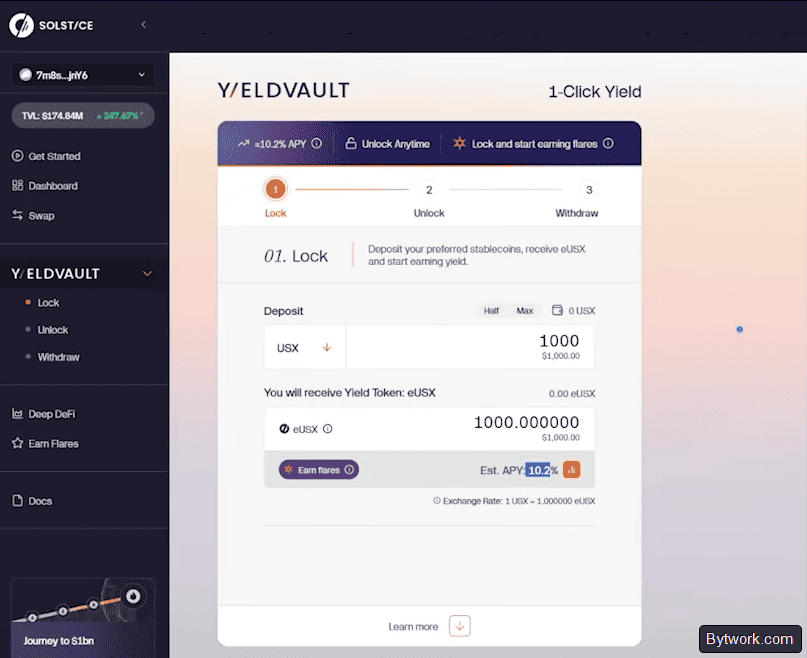
In the Yield Vault section, we lock 1,000 USX ($1,000.00) in exchange for 1,000.000000 eUSX at 10.2% APY, and we can withdraw liquidity at any second.
We have covered working with the TOP 10 protocols, and now it’s time to address common questions.
Addressing your questions
We often receive questions about working with DeFi protocols. These questions are recurrent, so based on our experience we’ve compiled a separate Q&A below, with real figures, facts, and specific operational nuances.
First, let’s tackle yield‑related and non‑obvious conditions.
What real yield was achieved in SOL and stables over the last 2–3 months?
In SOL, over 61 days we managed to get 14.9% annualised against a target of 12%. In stables via Aave, over 81 days we squeezed out 12.5% annualised versus the expected 11.14%. Targets were beaten, but in the case of stables, all growth came purely from external capital inflows.
What yield did the SOL/USDC pool on Meteora show over a week?
A capital of $50,000 brought in $3,500 net in fees over 7 days, which is exactly 7% weekly return.
Why is Meteora more profitable than Raydium despite having lower TVL?
The DLMM mechanism, with its bin‑based distribution, extracts far juicier fees than Raydium.
Why is high APR on narrow ranges misleading?
The crazy profit on paper is just an extrapolation of a good day, while over a 20‑day period volumes typically drop by 20–30%. Moreover, rebuilding a pool when the price breaks out simply locks in a loss and burns all accumulated earnings.
Why can high APY be dangerous?
A high APY (e.g., 156%) is usually squeezed into a narrow price corridor; once the price breaks out, the yield instantly drops to 0. Also, this metric is recalculated every second and does not guarantee the final annual rate.
How to determine if a pool is suitable for adding liquidity?
The daily trading volume should cover the TVL by at least 2×. The minimum TVL for a pool is $250,000. The maximum individual position size is $1,000; otherwise, you will crash or pump the price on entry and exit.
What is the trade‑off of high MEV yield on Jito?
Relying on MEV validators centralises transaction ordering and creates network risks that the diversified model of competitor Marinade inherently avoids.
Now let’s look at security issues because protocols carry serious risks.
Should you read the audit before depositing a large amount into Kamino?
Yes, absolutely. Despite 13 checks and an RTA audit, real smart‑contract vulnerabilities are hidden inside the reports themselves, not in their number. Marketing banners don’t protect against bugs.
Why doesn’t a low Utilization Rate (40–60%) guarantee strategy safety?
Low utilisation only signals the absence of profitable looping strategies and negligible returns. The risk of a sudden squeeze remains, as a large depositor can instantly drain liquidity from the pool, spiking rates and crashing collateral prices.
How important is the choice of the number of bins?
This is a critical parameter. Narrow the range – the price will immediately break out; widen it – fees get diluted to pennies. This option is not automated in the interface; you have to adjust it manually to preserve profit.
And a few technical questions below.
How much does the withdrawal lock increase during user surges in liquid staking?
The usual 7‑day exit gate stretches to 16 days during panic, and up to 21 days in a severe crisis. The wsETH case clearly showed how the lock extended to 21 days, freezing liquidity and causing pure losses to holders. We experienced all this first‑hand.
Can you pay Solana network transactions with jitoSOL instead of SOL?
No. Despite earning ~6.72% APY, jitoSOL is just a liquid wrapped token; the network does not accept it for gas. Any operation strictly requires a reserve in native SOL.
Do institutional investors have advantages over retail stakers?
Yes, partnerships with custodians like Falcon X for Jito and Bitgo for Marinade offer VIP interfaces without loss of control, funnelling liquidity and fat fees to large players.
Now let’s move on to risks.
Protocol risks
As usual, we will also cover risks.
Table 1. Economic risks and trading strategy vulnerabilities
|
Threat type |
Where it burns |
What triggers the process |
Consequences |
|
Margin wipeout |
Kamino, Jupiter |
50% price crash with 2.3× leverage open |
Deposit completely burns to zero |
|
LTV specifics |
JitoSOL, mSOL, JupSOL |
Market drop (hits wrapped tokens harder than SOL) |
Lowered LTV threshold forces rapid liquidation |
|
Impermanent loss (IL) |
Orca, Raydium, Meteora |
Sharp rise in the native token price (SOL) |
Bots forcibly sell the rising SOL for USDC |
|
Looping breakdown |
Lending (Kamino, Jupiter) |
Sudden spike in borrowing cost |
Overall strategy yield instantly turns negative |
|
Range breakout |
Meteora, Orca |
Price moves outside the set range |
Fee accrual completely stops |
|
Rebalancing |
CLMM pools (Meteora, Orca) |
Forced shift of trading boundaries |
Manually locks in a loss of up to 7% of position (takes about 3 months to recover) |
|
Profit dilution |
JLP index token |
Heavy inflow of new liquidity from external users |
Yield plummets from 123% to a modest 12% |
|
Trading against the market |
JLP index token |
Traders on the platform start taking profits en masse |
JLP index holders absorb other traders’ winnings into their own balance |
Table 2. Systemic threats, infrastructure gaps, and scams
|
Threat type |
Where it burns |
What triggers the process |
What happens to the balance |
|
Shitcoin hunting |
Fresh tokens, new pools |
100% slippage, Jito Tips drain, devs didn’t burn LP |
Cash burned on fees or a hard rugpull by admins |
|
Code holes |
Any DeFi, Drift case |
Smart‑contract bugs, integration errors, admin key leaks |
System hacked and parameters rewritten by attackers |
|
Market manipulations |
Exploits (Drift case) |
Wash‑trading, oracle attacks, fake coin minting |
Scammers completely drain liquidity from pools |
|
Cash crunch |
Lending platforms |
Pool utilisation >92% or an instant whale exit with $1 billion |
Deposits get blocked and loan rates spike to 5–6% |
|
Scam issuers |
HighUSD, X Stocks |
Moving into raw stables or relying on Cayman‑based entities |
Complete de‑peg or a straightforward offshore scam |
In short, without a clear understanding of sniping risks and liquidity pool mechanics, there’s nothing to catch in the Solana memecoin ecosystem. To avoid falling for rugpulls from dishonest devs, spot insider wallets in time, and stop burning cash on slippage, check out our detailed guide on the GMGN platform.
Afterword
Solana remains a critical player in DeFi, despite newer networks like Robinhood and older blockchains. Local protocols are evolving and generating profit if you study their nuances and the concept of impermanent loss, where a rapid rise in one asset forces the protocol to sell it at a less favourable price.
Protocols also carry risks, which we cover in detail in every article, and they must be taken into account. Better yet, keep a profit‑and‑loss table in Google Docs.
The essence of Solana protocols with the DLMM distribution mechanics extracts maximum value in Meteora – far more than in Raydium.
But unfortunately, earning in DeFi remains a complex and rather geeky topic. To make money here, you need to understand what Health Factor, liquidation threshold, utilization rate, flash loan, isolation modes, and all that mean. Without grasping these things, you will be rekt in no time. That’s why we are here – to explain all these mechanics in the DeFi Protocols section.
We emphasise – we are not sponsored by any of the projects listed.
Your editor – Maksim Anisimov for bytwork.com.
Disclaimer: all information provided in this article should not be considered financial advice! The article was created for educational purposes. Never invest more than you can afford to lose, and always consult your personal financial advisor.

Now reading


In DePin, people create networks themselves, share traffic or capacity, and receive rewards in tokens from these projects.




The Ellipal firmware update enhances security (fixes vulnerabilities), adds support for new cryptocurrencies and tokens, and optimizes the interface and operational stability.


